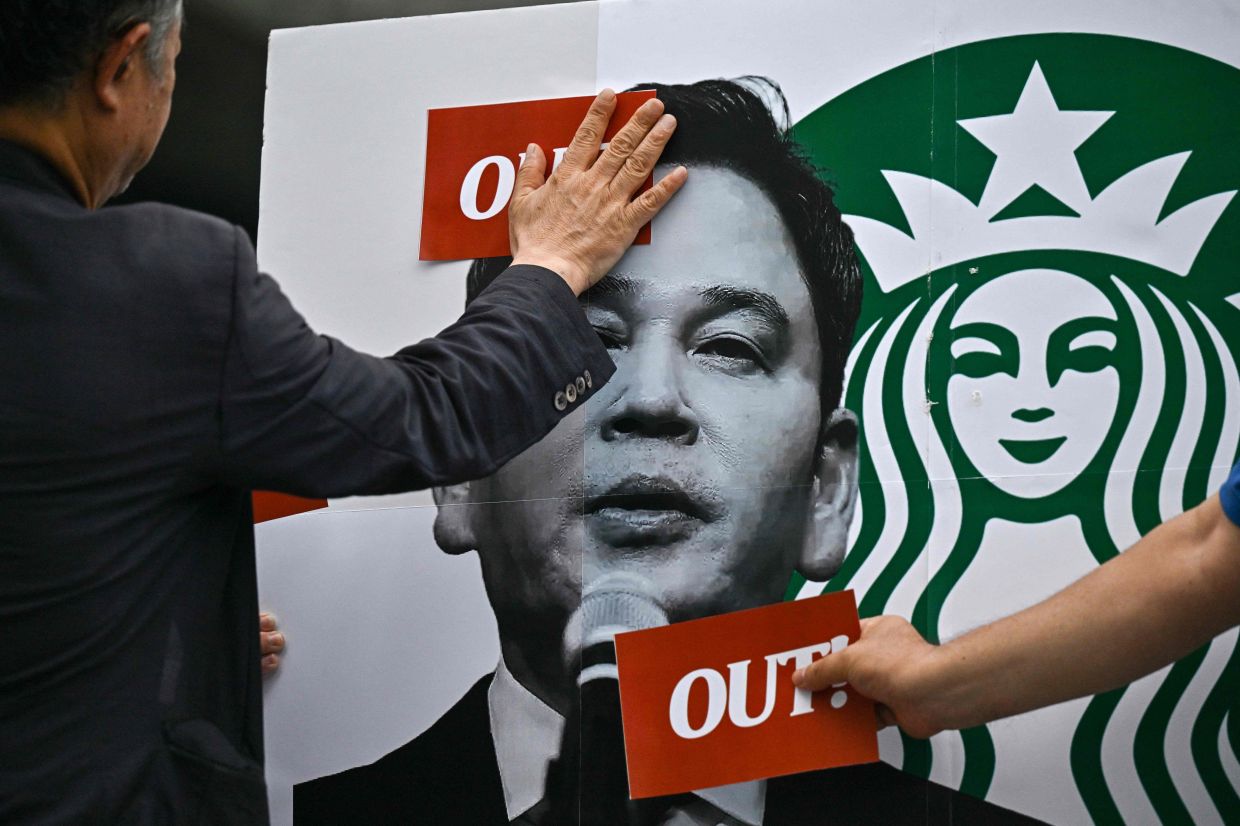
South Korean police have brought in a Shinsegae Group executive for questioning as part of their investigation into a promotional campaign by Starbucks Korea that inadvertently triggered widespread outrage by commemorating a date associated with one of the country's darkest chapters. Yang Jong-hwan, who heads Shinsegae Group's audit team, was questioned as a witness by the Seoul Metropolitan Police Agency, according to the operator, which has promised full cooperation with authorities examining the circumstances surrounding the failed "Tank Day" initiative.
The promotional blunder centred on a reusable cup campaign scheduled for May 18, a date that holds profound significance in South Korean national memory as the anniversary of the Gwangju uprising. The 1980 crackdown saw government forces suppress pro-democracy protesters in the southwestern city, resulting in at least 165 deaths according to official accounts, though historians and witnesses dispute the figure as substantially understated. The coincidence was neither accidental nor the result of oversight in a vacuum—it occurred against a backdrop of a nation deeply attuned to historical remembrance and the moral weight of collective trauma.
The scandal erupted with surprising speed and intensity, revealing the deep sensitivities surrounding how commercial entities navigate South Korea's complex relationship with its recent past. Shinsegae Group, one of the country's largest conglomerates and operator of Starbucks Korea's more than 2,000 outlets nationwide, responded with swift but ultimately insufficient damage control. The Korea chief executive was dismissed the day the controversy became public, signalling management's acknowledgement of the severity of the misstep. Chairman Chung Yong-jin subsequently made a public bow of apology, a gesture laden with cultural significance in the Korean context, yet this proved insufficient to quell the storm.
The incident has evolved beyond a corporate public relations problem into a matter of legal consequence. Civic groups filed formal complaints against Chung and other company executives, alleging violations of a 2016 law specifically designed to protect the integrity of historical narratives around the pro-democracy movement. This legislation, crafted in the aftermath of national reckoning with authoritarian governance, prohibits the dissemination of false or misleading information concerning the 1980 crackdown. The complaints also include allegations of defamation and insult, suggesting that activists view the corporate negligence as not merely careless but as an affront to collective memory.
Internal investigations by Shinsegae revealed a troubling chain of failures in oversight and due diligence. Multiple officials signed off on promotional materials without scrutinizing the design file—a systematic lapse rather than a singular error by one employee. This discovery underscores how institutional inattention, multiplied across several decision-makers, allowed such an historically tone-deaf campaign to advance toward implementation. The negligence raises broader questions about corporate governance in South Korea, particularly regarding institutional responsibility to understand and respect historical context in a society where such awareness is both expected and legally mandated.
The immediate commercial consequences were substantial. Starbucks Korea experienced a sharp sales decline in the early days following the scandal's eruption, a tangible market punishment for the misstep. Protests materialized in Seoul and Gwangju, the latter city carrying particular significance given its central role in the 1980 events. The geographic focus of demonstrations underscored how the issue resonated not as an abstract historical matter but as a living wound in communities that endured the crackdown. For Malaysian and Southeast Asian observers, the episode illustrates how corporate actions can reverberate through historical and political sensitivities specific to each market—a cautionary tale relevant to regional businesses operating across diverse cultural contexts.
In response to sustained public and official pressure, Starbucks has implemented mandatory historical education for its workforce. All stores across South Korea will close for half a day on the following Monday to allow employees to attend a structured lesson about the Gwangju uprising and its significance. Senior executives, including the chairman, will undergo similar educational sessions two days later. This remedial approach, while symbolically important, represents both an acknowledgement of institutional ignorance and a recognition that such historical knowledge should be foundational rather than corrective.
The prominence of this incident reflects Starbucks' significant position in the South Korean market. As the company's third-largest market globally after the United States and China, South Korea represents a strategically vital territory for the American coffee chain. The reputational damage extends beyond quarterly sales figures to brand perception in a market where cultural sensitivity and historical awareness carry considerable weight with consumers. For multinational corporations operating in Southeast Asia and East Asia more broadly, the Starbucks Korea case demonstrates the necessity of embedding local historical and cultural knowledge into corporate decision-making processes at every level.
The political dimension of the controversy became evident when President Lee Jae-myung weighed in, expressing outrage at what he characterized as "inhumane and disgraceful conduct." Presidential attention to a corporate matter signals the degree to which the public and political establishment viewed the transgression as extending beyond conventional business failure. The involvement of law enforcement and the invocation of legislation designed to protect historical memory suggests that South Korea treats such matters as bearing on the integrity of national narrative and collective identity, not merely as marketing miscalculation.
Looking forward, this episode serves as a reminder that global corporations must integrate rigorous local knowledge systems into their operations. The failure by multiple Shinsegae officials to catch the May 18 date carries implications for how international companies should structure their decision-making processes in markets with significant historical sensitivities. For regions like Southeast Asia, where commemorative dates and historical narratives carry profound political and social weight, corporations would be wise to examine the Starbucks Korea case as evidence of what occurs when such considerations are treated as peripheral rather than central to strategic planning.