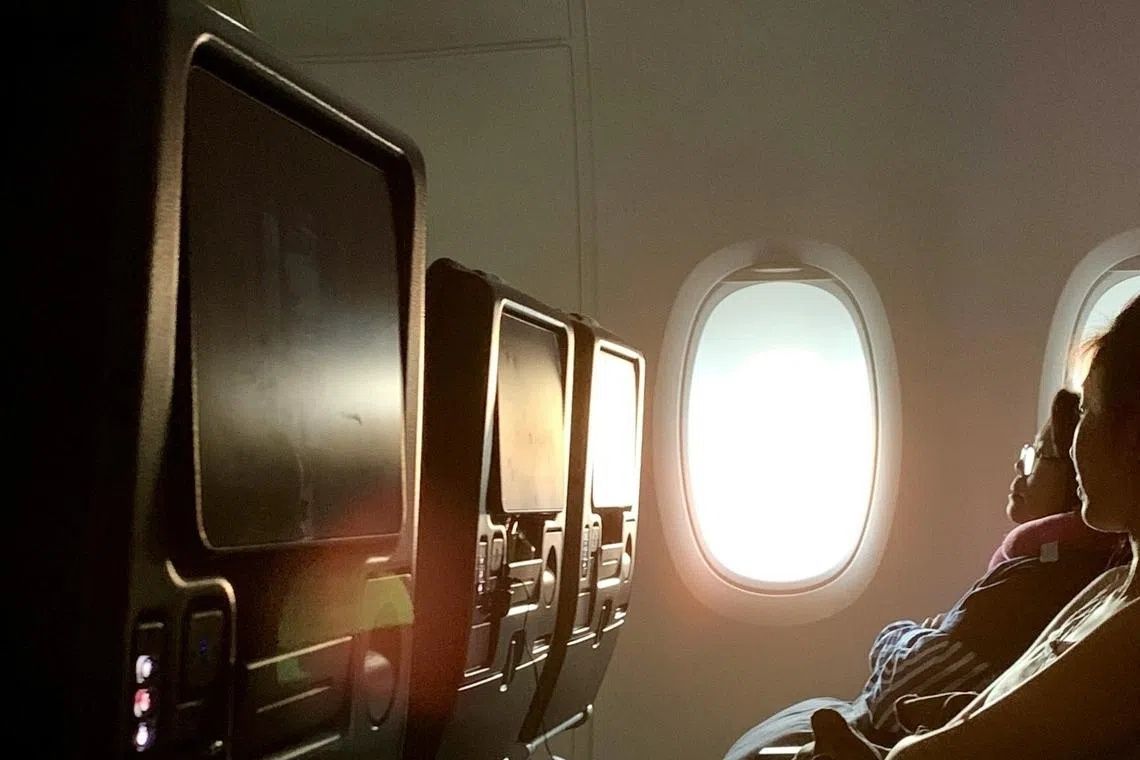
A South Korean middle school student has triggered a formal government review of in-flight entertainment practices by filing a petition with the Ministry of the Interior and Safety, raising concerns about inadequate safeguards for children exposed to violent and sexually explicit content during commercial flights. The complaint, submitted through the Petition 24 online platform, highlights a gap in current airline policies that the teenager argues fails to meet the standards set out in national child protection legislation.
In the petition, the student described becoming involuntarily exposed to inappropriate scenes during a recent flight, despite attempting to avoid watching the screen mounted on the seat in front. The young passenger emphasised that the content proved difficult to ignore once displayed, leaving them with little choice but to witness material considered unsuitable for their age group. The complaint gains particular weight from the fact that the petitioner's younger sibling, enrolled in elementary school, was similarly exposed to the same footage—a situation that deepens concerns about the vulnerability of very young travellers.
The teenager's proposed solution focuses on technological intervention rather than content removal alone. They advocated for mandatory installation of privacy screens on all seatback monitors, a measure designed to prevent unintended viewership of restricted material by adjacent passengers, particularly children. This approach acknowledges the physical reality of shared aircraft cabins where screens positioned in tight quarters naturally fall within the sightlines of neighbouring seats, making accidental exposure a practical problem rather than merely a theoretical concern.
The petitioner grounded their complaint in existing South Korean law, specifically referencing the Child Welfare Act and Youth Protection Act, both of which impose explicit obligations on institutions to shield minors from harmful content. This legal framing suggests that airlines may currently operate in a zone of regulatory ambiguity, where national child protection statutes have not been clearly applied to the in-flight entertainment context. The question of whether carriers adequately meet these statutory duties when they allow age-restricted material to be visible to child passengers remains unresolved.
South Korea's two dominant carriers, Korean Air and Asiana Airlines, maintain policies that theoretically align with child protection principles. Neither airline includes content rated for audiences aged 19 and above in their in-flight catalogues, and both typically obtain edited versions of feature films with graphic scenes trimmed or digitally altered. These practices suggest industry awareness of content sensitivity, yet the incident described in the petition indicates that current filtering mechanisms may not fully address the practical logistics of protecting younger passengers from incidental exposure.
The uncertainty surrounding which specific film prompted the complaint prevents a fuller assessment of current airline compliance standards. Without knowing whether the problematic content fell within or outside the 19-plus rating threshold that the carriers claim to exclude, it remains unclear whether the issue stems from policy inadequacy or enforcement inconsistency. This ambiguity underscores the need for clearer guidelines that account for the viewing realities of mixed-age cabins.
A significant precedent exists in the carriers' handling of Parasite, the internationally acclaimed 2019 film that became the subject of removal from both Korean Air and Asiana Airlines playlists in 2020. Despite its 15-plus rating in South Korea—theoretically permissible under current airline standards—the film's violent and sexual content prompted both carriers to withdraw it entirely. This decision reflects an acknowledgment that ratings designed for cinematic viewing may not translate straightforwardly to the semi-captive audience environment of aircraft cabins, where proximity and unavoidability create distinct exposure dynamics.
The removal of Parasite illustrates the tension between maintaining diverse entertainment offerings for adult passengers and protecting younger travellers from incidental exposure. Airlines face conflicting pressures: offering competitive in-flight experiences requires substantial content libraries, yet the impossibility of enforcing age-based viewing restrictions in open cabin configurations creates practical obstacles to content curation. Privacy screens represent a technological middle ground, allowing carriers to maintain content breadth while giving families concrete tools to manage exposure.
For Malaysian and other Southeast Asian travellers, this petition carries relevance beyond South Korea's borders. Regional carriers serving diverse, often mixed-age passenger groups confront identical challenges around in-flight content governance. Malaysia Airlines, AirAsia, and other regional operators similarly grapple with balancing entertainment diversity against child protection responsibilities. The South Korean petition may prompt broader regional examination of whether current airline practices adequately protect children from incidental exposure to inappropriate material, particularly on long-haul flights where extensive entertainment options become more critical to passenger comfort.
The petition's progression through South Korea's formal government review process will likely set precedent within Northeast Asian aviation. Should the government recommend mandatory privacy screen installation or other protective measures, regional carriers may face similar demands. The outcome could reshape in-flight entertainment standards across Asian aviation, as well as inform how airlines globally reconcile commercial entertainment interests with statutory child protection obligations in environments where age-based content restrictions prove technically difficult to enforce.
Beyond the immediate question of technical safeguards, the petition raises fundamental questions about where responsibility for content exposure lies. Should airlines bear sole responsibility for preventing children's inadvertent viewing, or do parents share duty for managing their children's media exposure even in semi-public spaces? The teenager's formulation of the problem as a systems-level failure rather than individual parental oversight suggests a generational perspective that expects institutions to engineer protection into their operations rather than relying on user vigilance. This philosophical shift may influence how entertainment policies evolve across the region's carriers in coming years.

