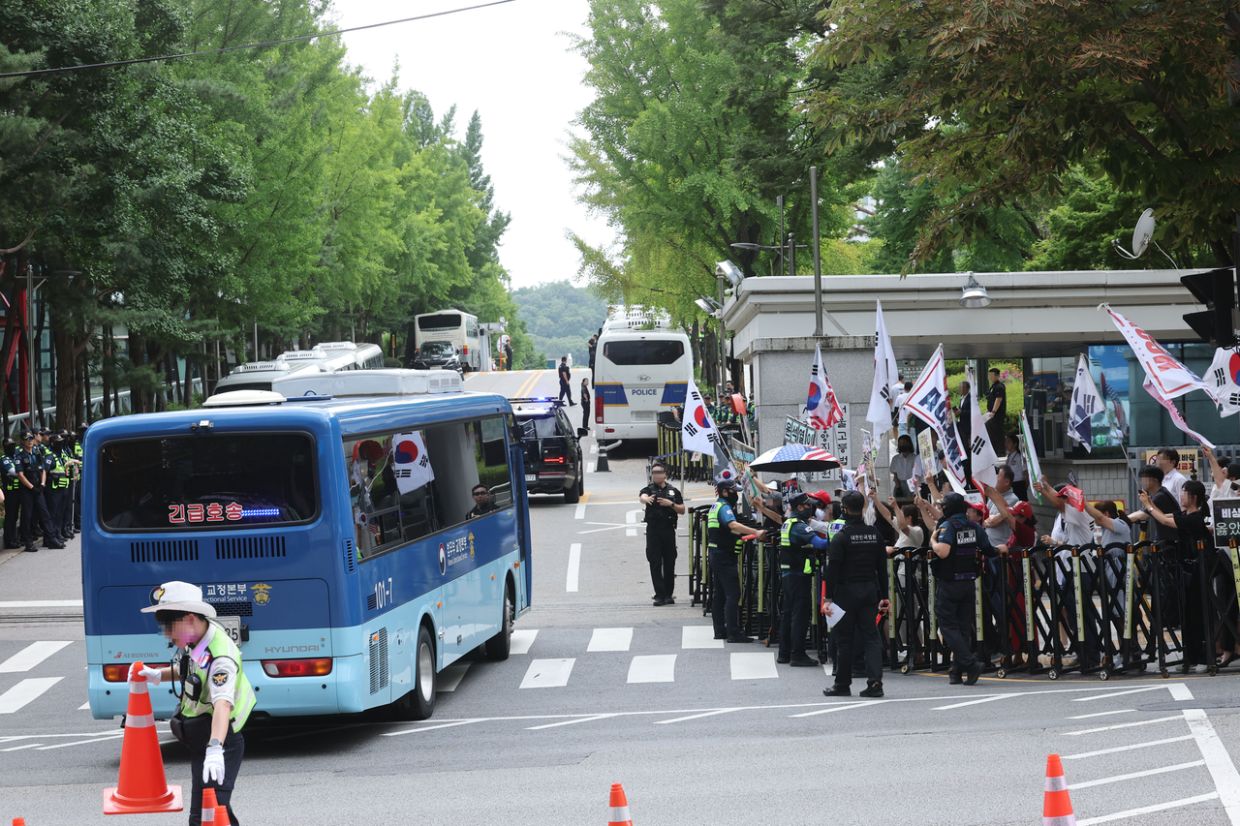
Former South Korean President Yoon Suk Yeol received a two-year prison sentence on Monday after the Seoul Central District Court determined he had breached campaign finance regulations by accepting unpaid polling services during his bid for office. The court established that political broker Myung Tae-kyun had conducted 14 opinion surveys valued at 27.92 million won ($18,600) without compensation, constituting an illegal campaign contribution under the Political Funds Act. This conviction marks a significant moment in South Korea's ongoing struggle to maintain electoral integrity through strict regulation of campaign spending, an issue that resonates across East Asia where democratic institutions face similar pressures.
Judge Lee Jin-gwan, presiding over the case, articulated the court's reasoning by emphasizing the foundational role of objective polling in democratic elections. The judge noted that when political actors circumvent campaign finance regulations by receiving polling services outside prescribed legal channels, the resulting data can be leveraged to distort public perception and fundamentally compromise the fairness of electoral competition. This perspective underscores how courts increasingly recognize that democratic transparency extends beyond simple vote-counting mechanisms to encompass the entire ecosystem through which candidates shape and measure public sentiment.
The investigation initially examined whether Yoon and his wife, former first lady Kim Keon Hee, had collectively received 58 surveys worth more than 270 million won from Myung between June 2021 and March 2022. However, prosecutors could only establish sufficient evidence for 14 of these surveys. The court determined that Kim had directly authorized Myung to control critical aspects of the polling operation, including timing, content, methodology, and whether results would be made public. Evidence indicated that Yoon possessed knowledge of this arrangement and implicitly endorsed it, creating what the court characterized as a sustained tacit understanding among all three parties regarding the provision of these survey services.
Beyond the polling irregularities themselves, the court identified a quid pro quo element involving Kim Young-sun, a former National Assembly member. Yoon allegedly promised Myung that the People Power Party would nominate Kim Young-sun in exchange for the polling support. Subsequently, Yoon wielded his influence through Chang Je-won, who served as chief of staff during the presidential transition, to shape the party's nomination process in Kim Young-sun's favour. This dimension of the case reveals how campaign finance violations frequently intertwine with patronage networks and the distribution of political rewards within ruling parties.
Notably, the court emphasized that establishing a formal quid pro quo arrangement was not necessary to prove a violation of the Political Funds Act. This legal interpretation strengthens enforcement against implicit exchanges that might otherwise evade prosecution due to lack of explicit documentation. Such a standard is particularly important in contexts where political actors often communicate intentions through coded language or informal channels rather than written agreements, making explicit evidence difficult for prosecutors to obtain.
Myung Tae-kyun, the political broker who conducted the surveys, received an 18-month prison sentence and was immediately taken into custody in the courtroom. His conviction reflects judicial acknowledgment that professional consultants who facilitate illegal campaign contributions bear direct responsibility alongside the politicians who benefit from their services. The broker's involvement illustrates how South Korea's political ecosystem includes specialized intermediaries who operate at the margins of legality, monetizing their access to political figures.
The case creates an intriguing contrast with the parallel proceedings against former first lady Kim Keon Hee, who faced related charges stemming from the same polling irregularities. Both the trial court and appellate court acquitted Kim of violating the Political Funds Act, determining that prosecutors had failed to demonstrate she received a measurable financial benefit equivalent to the surveys' market value or that the polling services were explicitly conditioned on Kim Young-sun's nomination. The Supreme Court is scheduled to deliver its final ruling in Kim's case on Thursday, potentially establishing whether the two decisions can be reconciled or whether they reflect inconsistent applications of the same legal standard.
For Malaysian observers, this case illuminates how neighbouring democracies struggle with campaign finance enforcement despite possessing comprehensive statutory frameworks. South Korea's experience demonstrates that legal rules alone prove insufficient when political actors develop sophisticated methods to obscure the true nature of transactions. The polling services scandal also reveals how campaign finance violations frequently encompass multiple layers—the unlawful provision of services, implicit quid pro quo arrangements, and subsequent efforts to manipulate party nomination processes—each requiring separate investigation and proof.
The judicial reasoning in Yoon's case emphasizes that modern democracies must treat opinion polling as a regulated resource with measurable financial value. Unlike previous eras when campaigns relied primarily on traditional media and public events, contemporary elections depend heavily on survey data to target messaging and allocate resources strategically. By accepting free polling, candidates gain competitive advantages that translate directly into superior campaign effectiveness. The court's recognition of this reality reflects evolving judicial understanding of what constitutes campaign finance violations in information-rich political environments.
The conviction also raises questions about the distinction between campaign contributions and ordinary business relationships. Myung operated as a commercial polling firm, yet agreed to provide services without compensation. The court treated this as an in-kind contribution, consistent with international best practices in campaign finance regulation. However, the case illustrates how gray zones persist—determining when a discounted service crosses into illegal contribution territory involves subjective judgments about fair market value and the provider's intent.
From a broader Southeast Asian perspective, Yoon's conviction demonstrates that even established democracies with sophisticated legal systems confront persistent challenges in constraining the influence of money in politics. South Korea's experience suggests that aggressive prosecution of campaign finance violations requires sustained political will, as such cases often implicate sitting or recently powerful political figures whose allies may seek to minimize consequences. The fact that a former president faced imprisonment indicates South Korea's judiciary has maintained relative independence in electoral matters, though the differential outcomes in Yoon's and Kim Keon Hee's cases suggest some uncertainty remains in how courts interpret and apply these regulations.

