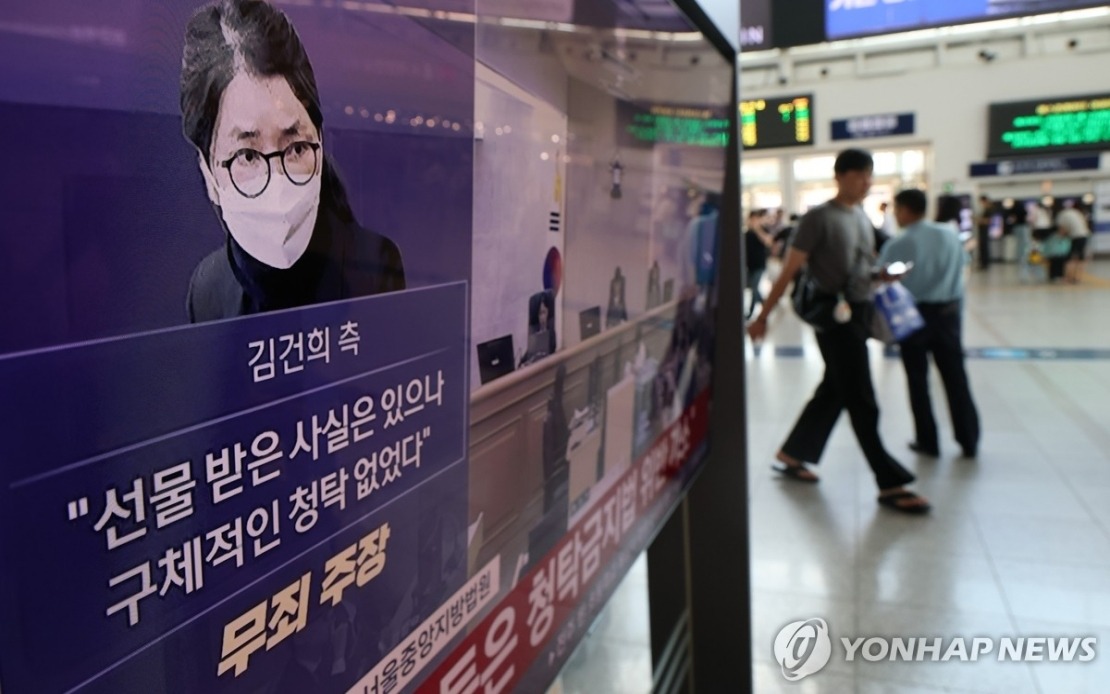
Former South Korean first lady Kim Keon Hee has been convicted and sentenced to seven years in prison by the Seoul Central District Court for accepting bribes valued at roughly 300 million won. The high-profile case marks a significant moment in South Korea's ongoing battle against elite corruption, as the wife of ousted President Yoon Suk Yeol became the latest prominent political figure to face jail time for abuse of her position.
The court found Kim guilty on all charges related to the acceptance of expensive gifts—including jewellery, luxury handbags, watches, and artwork—exchanged for personal favours spanning from 2022 through 2025. Presiding Judge Cho Sun-pyo delivered a stinging rebuke from the bench, stating that Kim had weaponised her status as first lady purely for personal enrichment rather than public service. The judge emphasised that her attempts to return gifts or claim she had purchased items herself after investigations began demonstrated her full awareness of the illegality underpinning her actions.
Among the specific allegations substantiated by the court were the receipt of a Van Cleef & Arpels necklace and jewellery from a construction company chairman in exchange for securing a government position for his son-in-law. In separate transactions, Kim accepted a golden turtle ornament from Lee Bae-yong, then-head of the National Education Commission, whose appointment she reportedly facilitated. A Dior bag worth 5.4 million won came from a pastor, while a Vacheron Constantin timepiece arrived from an unnamed businessperson. Additionally, Kim stood accused of receiving a painting by acclaimed artist Lee Ufan from a former prosecutor seeking her assistance in obtaining an electoral nomination.
These illicit exchanges occurred predominantly while her husband occupied the presidency, between May 2022 and his removal from office in April 2025. The clustering of transactions during her tenure as first lady underscores the vulnerability of institutional safeguards protecting high office in South Korea. The pattern also suggests a systematic approach to monetising her proximity to power, with multiple donors seeking specific bureaucratic or political outcomes in return for their gifts.
The prosecution team, led by Special Counsel Min Joong-ki, had sought a sentence of seven and a half years, making Friday's judgment a partial victory. Kim's legal representatives signalled their intention to appeal, suggesting the case will likely extend through higher court levels. The Seoul Central District Court also imposed sentences on co-defendants: the construction company chairman received a suspended one-year term over two years, the businessman who provided the watch faced a suspended ten-month sentence, and the pastor was fined 8 million won.
This conviction arrives as Kim faces mounting legal jeopardy from multiple directions. An appeals court has already sentenced her to four years imprisonment in a separate corruption case, meaning she now confronts the prospect of substantial cumulative prison time should appeals prove unsuccessful. The cases reflect the depth of allegations against her spanning the entire period of her husband's presidency, suggesting investigators uncovered a broad pattern rather than isolated incidents.
Moreover, Kim remains scheduled to stand trial regarding allegations that her husband's People Power Party orchestrated the forced recruitment of Unification Church members to manipulate the 2022 presidential primary election. That case represents a fundamentally different category of alleged wrongdoing—electoral manipulation rather than personal enrichment through bribery—and could expose her to charges of conspiracy and election interference if evidence proves sufficient.
The case carries significant implications for South Korean civil society and governance reform. Historically, South Korea has struggled to hold elite figures accountable for corruption, with many previous cases against former presidents and their families resulting in pardons or reduced sentences through political pressure. The conviction of a sitting first lady represents a notable departure from this pattern, suggesting that even the closest associates of presidential power face meaningful legal consequences for proven wrongdoing.
For Malaysian observers, the South Korean case offers instructive contrasts and parallels. Like Malaysia, South Korea has grappled with entrenched corruption networks involving business, government, and the families of political leaders. Both nations have experimented with special prosecutors and independent investigation bodies to circumvent traditional institutional inertia. However, South Korea's conviction rate for high-profile political figures has gradually improved over the past decade, reflecting institutional learning and public pressure for accountability. Malaysia, by contrast, continues navigating significant challenges in prosecuting major corruption cases, particularly those implicating former political elites.
The Kim Keon Hee verdict also underscores the vulnerability of first ladies and political spouses across Asia to exploitation by parties seeking favour. Without formal government positions, such figures often occupy ambiguous legal spaces where their influence proves difficult to quantify or regulate. The Seoul court's willingness to treat Kim's access and proximity as commodifiable assets establishes a framework for future prosecutions of similarly positioned individuals throughout the region.
Looking forward, the case will likely generate appeals arguments centring on sentencing proportionality, the characterisation of certain exchanges as gifts versus bribes, and the degree of causation between gifts and specific government actions. These legal questions will shape how South Korean courts calibrate anti-corruption enforcement against political and business elites. If the seven-year sentence survives appellate review, it would signal that South Korean courts regard the weaponisation of presidential family status as a sufficiently grave offence to warrant substantial prison terms.

