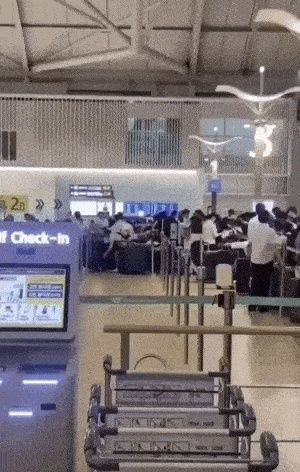
Incheon Airport, one of Asia's busiest aviation hubs, is preparing to fortify its check-in areas with additional physical barriers following a series of disruptive incidents triggered by aggressive queue-jumping. The airport authority has flagged concerns after a video released on July 2 showed dozens of travellers surging through the departure hall in Terminal 1, circumventing orderly queuing systems by pushing luggage carts past existing barriers. The incident prompted airport officials to commit to installing plastic partitions between current queue barriers—a defensive measure designed to create sealed corridors that prevent passengers from cutting laterally across designated lines.
The tumultuous scenes captured on film reveal a pattern of behaviour that has become increasingly problematic at South Korea's largest international gateway. According to Yonhap News Agency, at least five comparable incidents occurred throughout July, with airport personnel sustaining injuries while attempting to restore order and redirect passengers into proper queuing positions. The recurring nature of these disturbances has elevated the issue from an operational inconvenience to a legitimate workplace safety concern, prompting the airport to deploy additional inspection personnel in departure halls to maintain discipline and protect both travellers and staff members.
Behind the chaos lies a specific cohort of traders operating under a business model known as "daigou." These merchants, typically from mainland China, operate at a small but substantial commercial scale, purchasing discounted duty-free merchandise in bulk across South Korea before transporting their goods back to China and other Asian markets for retail resale. The daigou phenomenon has become sufficiently prevalent that it now constitutes a recognizable demographic factor in international passenger flows at major Northeast Asian airports. The traders' aggressive approach to boarding procedures appears driven by the economics of their operation—larger luggage quantities and tighter scheduling create pressure to maximize efficiency, occasionally at the expense of conventional airport protocols.
The surge in queue-jumping incidents correlates directly with operational changes at Incheon Airport itself. Airlines have progressively deployed larger aircraft on high-frequency routes connecting Incheon to major Chinese cities, effectively increasing passenger capacity by approximately 100 seats on certain flights. This expansion in aircraft size has compressed the temporal window for boarding procedures while simultaneously enlarging the passenger cohort competing for check-in access. The airport authority acknowledges this structural contributor to congestion, recognizing that infrastructure and staffing levels designed for previous traffic patterns may require recalibration to accommodate contemporary demand.
The daigou trading ecosystem operates at the intersection of South Korea's competitive duty-free retail environment and broader East Asian e-commerce dynamics. South Korean cosmetics, skincare products, and luxury goods command premium valuations in Chinese consumer markets, creating substantial profit margins for intermediary traders willing to navigate customs regulations and logistics challenges. The duty-free shopping privilege available at international airports amplifies these margin advantages, incentivizing daigou operators to consolidate large orders in single transactions. This structural economic incentive explains why the trading community shows such determination to maximize shopping time and transport capacity—the financial stakes of individual transactions substantially exceed those typical of leisure travellers.
Temporary relief emerged as Chinese regulatory authorities implemented stricter enforcement measures targeting daigou operators, reportedly reducing the volume of traders departing South Korea during subsequent weeks. This intervention from Beijing's authorities demonstrates how cross-border enforcement cooperation—even when asymmetrical or indirect—can modulate passenger demographics at third-country airports. However, Incheon Airport officials remain cautious, recognizing that enforcement cycles fluctuate and that similar surges could recur if Chinese regulatory pressure eases or traders identify alternative routing strategies.
For Malaysian travellers and the broader Southeast Asian aviation sector, the Incheon Airport situation offers instructive lessons about managing high-volume international passenger flows when specific demographic cohorts pursue economically rational but socially disruptive behaviours. Malaysia's own airport infrastructure, particularly at Kuala Lumpur International Airport, handles comparable daigou trading activity, though perhaps at less concentrated scales. The physical security measures Incheon is implementing—particularly the sealed queue corridors—represent a direct architectural response to behavioural patterns that might warrant consideration by other regional aviation authorities grappling with similar challenges.
The incident sequence also highlights tensions between commercial aviation growth and passenger experience management. Airlines' deployment of larger aircraft represents sound fleet optimization logic, yet the consequent compression of check-in procedures can inadvertently incentivize the very queue-jumping behaviours that undermine safety. This dynamic suggests that sustainable solutions may require coordination across multiple stakeholders—airport operators, airlines, and regulatory authorities—rather than enforcement responses alone.
Looking forward, Incheon Airport's commitment to physical infrastructure improvements represents a pragmatic acknowledgment that social order at high-volume facilities increasingly depends on environmental design rather than reliance on staff intervention alone. The plastic partitions will function as passive enforcement mechanisms, making rule-breaking physically more difficult while reducing confrontation and injury risk. This approach aligns with contemporary airport security philosophy, which emphasizes prevention through design rather than reactive management of already-disruptive incidents. The airport's decision to continue monitoring departure halls signals recognition that the underlying economic incentives driving daigou behaviour remain structurally intact, regardless of temporary fluctuations in trader numbers.

