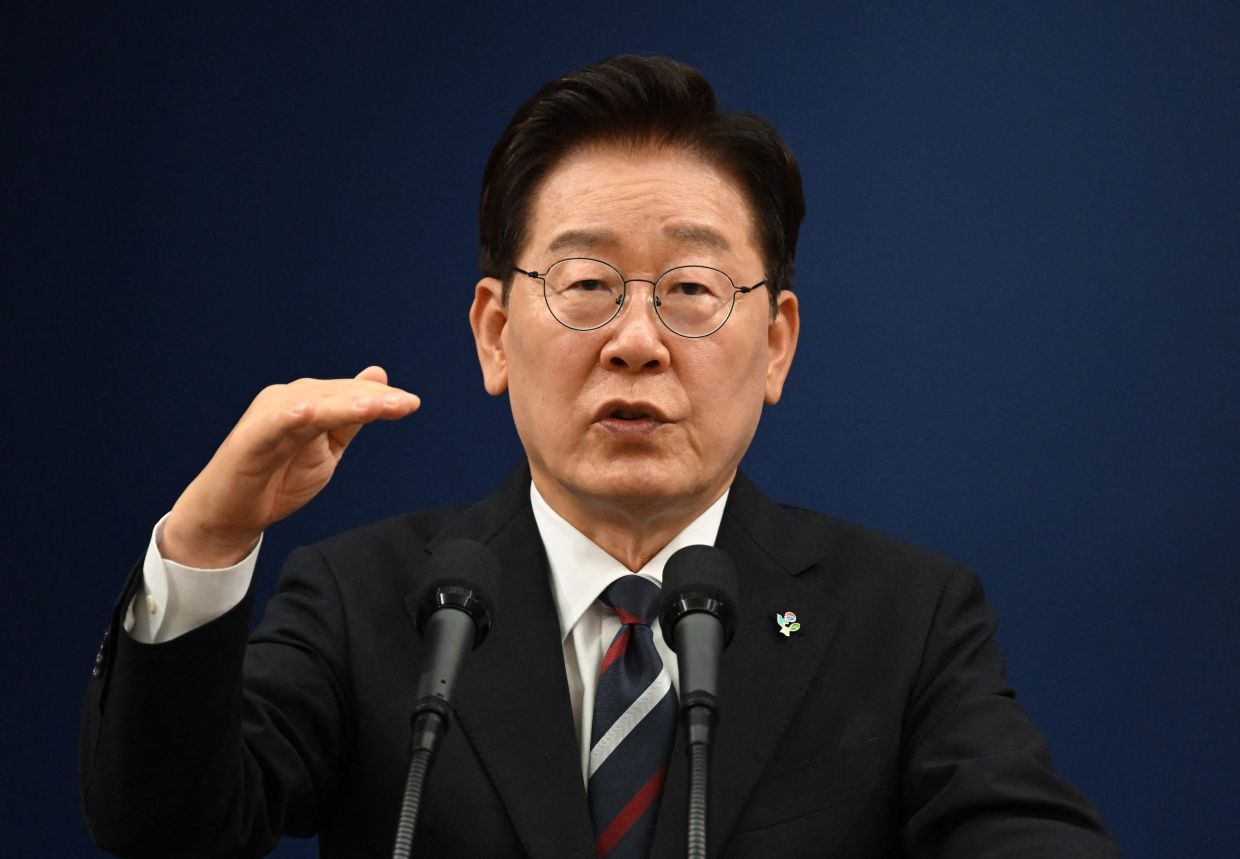
South Korean President Lee Jae Myung's political standing has deteriorated markedly, with his approval rating slipping into negative territory for the first time since his inauguration. According to polling data released on June 22 by Realmeter, a leading local survey firm, just 46.7 per cent of respondents now view his performance favourably, marking a continuation of a five-week downward spiral that has fundamentally shifted the political landscape.
The erosion of presidential support represents a significant inflection point in Lee's early tenure. His approval rating has collapsed from a robust 60.5 per cent in mid-May to below half of the electorate within the span of roughly six weeks. This trajectory mirrors a pattern seen among recent South Korean leaders, though Lee has reached this threshold somewhat faster than his immediate predecessors. Former President Yoon Suk Yeol experienced a similar crossover just six weeks into his administration, while earlier presidents Moon Jae-in and Park Geun-hye took longer to fall underwater, reaching this tipping point at 19 and 16 months respectively.
Disapproval has now climbed to 49.7 per cent, marginally exceeding the approval figure, though Realmeter notes both figures remain within the survey's margin of error. The remaining respondents, comprising 3.6 per cent of the sample, expressed uncertainty. The poll surveyed 2,517 voters aged 18 and above between June 15 and 19 using an automated response system. While the differential between approval and disapproval remains narrow, the psychological and political significance of crossing below 50 per cent approval cannot be understated, as it signals that a sitting president has lost majority support among the general population.
Analysts point to two principal drivers of Lee's political misfortune: mounting outrage over election administration failures during the June 3 local elections and intensifying factional warfare within his own Democratic Party of Korea. The ballot shortage scandal has provoked sustained criticism and demands for accountability, undermining public confidence in governmental competence. Simultaneously, the party faces an internal leadership struggle ahead of an August 17 convention to select a new party chair, generating divisions that have weakened cohesion among supporters and diluted the government's political capital at a critical moment.
Regional variations reveal considerable vulnerability in areas traditionally considered presidential strongholds. In the conservative bastions of Daegu and North Gyeongsang Province, Lee's approval fell 9.9 percentage points to just 34.6 per cent, suggesting significant erosion among his core constituency. The Greater Seoul region, encompassing Incheon, Gyeonggi Province, and the capital itself, has proven equally troublesome. In Incheon and Gyeonggi, approval dropped 7.6 percentage points to 44.8 per cent, while Seoul recorded a steeper decline to 39.8 per cent. This weakness in Seoul particularly concerns the administration, as the capital represents a substantial share of South Korea's electoral weight and a bellwether of broader sentiment.
Breakdowns by ideological orientation expose concerning fissures within the president's political coalition. Support among moderate voters declined 4.9 percentage points to 47.5 per cent, suggesting that centrist voters—often decisive in determining electoral outcomes—are growing increasingly disenchanted. Liberal voters, representing the Democratic Party's core base, still predominantly support Lee at 80.4 per cent, though this represents a 3.2 percentage point decline. Most strikingly, conservative voters offer minimal backing at only 19.8 per cent, indicating the administration has failed to secure meaningful crossover support from the opposition ideological camp.
The government's response demonstrates awareness of the political peril. Cheong Wa Dae, the presidential office, issued a statement acknowledging the poll results with carefully measured language, pledging to address public concerns and expectations more attentively. This measured tone suggests the administration recognises both the fragility of its position and the danger of appearing dismissive of voter sentiment. The statement references consideration of both economic conditions and broader governance performance, hinting at awareness that public dissatisfaction spans multiple policy domains rather than reflecting discontent with any single issue.
Parallel polling on party support reveals the Democratic Party trailing the opposition People Power Party, though the gap has narrowed. The Democratic Party's support rose 2.1 percentage points to 40.1 per cent, while the People Power Party declined 2 percentage points to 42.3 per cent. Realmeter attributes the Democratic Party's modest recovery to what it characterises as effective crisis management, including a bipartisan agreement to investigate election administration failures and an emphasis on party unity despite internal tensions. This suggests that visibly confronting failures and projecting organisational cohesion can provide modest political relief, even amid substantial underlying discontent.
Younger voters, a demographic increasingly critical to electoral dynamics across East Asia, have proven particularly alienated from conservative politics. The People Power Party's support among voters in their 20s plummeted 10.5 percentage points to 48.6 per cent, while those in their 30s saw approval decline 5.1 percentage points to 47.4 per cent. This generational divergence reflects broader patterns seen across the region, where younger cohorts express stronger scepticism toward establishment politics and conservative governance, creating substantial headwinds for Lee's administration as it confronts simultaneous crises.
The confluence of poor election administration, internal party conflict, and eroding support among moderates and younger voters creates a challenging political environment for Lee's government. While Realmeter notes some countervailing positive factors—including favourable reception of Lee's European diplomatic tour and the Korean stock exchange's breakthrough above the 9,000-point mark—these achievements have proven insufficient to offset accumulating setbacks. The administration faces mounting pressure to demonstrate competence, unity, and tangible policy successes to arrest the continuing decline in public confidence and rebuild the broad coalition necessary for effective governance during its remaining term.
For Malaysian and Southeast Asian observers, South Korea's political turbulence offers instructive lessons regarding the fragility of political capital and the rapid deterioration of public confidence when governments mismanage high-profile crises. The nexus between electoral administration failures, intra-party discord, and declining approval ratings provides a cautionary template for how multiple governance challenges can compound swiftly, even within a relatively short timeframe. As regional democracies navigate their own institutional and political pressures, the South Korean experience underscores the critical importance of maintaining administrative credibility and party discipline during moments of crisis.