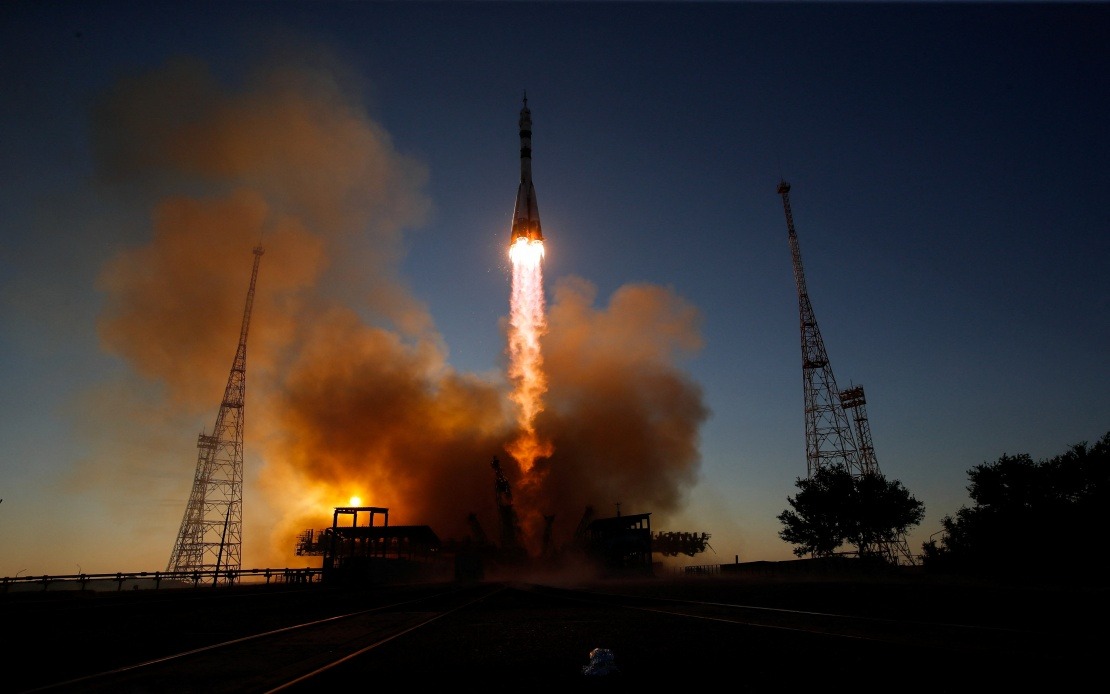
A Russian Soyuz MS-28 spacecraft has separated from the International Space Station, carrying cosmonauts Sergey Kud-Sverchkov and Sergey Mikayev alongside American astronaut Christopher Williams back to Earth. The undocking occurred as scheduled, marking the conclusion of an extended mission that began when the crew launched toward the orbiting laboratory in late November of the previous year.
Roscosmos, Russia's state space agency, confirmed the undocking through live broadcast coverage and outlined the carefully choreographed sequence of events required to safely return the three-person crew to the surface. The separation represents a significant moment in ongoing international cooperation on the ISS, demonstrating how space exploration continues to bridge geopolitical divides through scientific collaboration and shared commitment to human spaceflight.
Following its departure from the ISS, the Soyuz spacecraft will execute a series of maneuvers designed to bring it safely through Earth's atmosphere. Once the capsule achieves sufficient distance from the station to avoid collision risks, the vehicle's propulsion system will perform a deorbit burn—a critical engine firing that slows the spacecraft and drops it out of orbit. This precisely calculated burn is essential for ensuring the craft follows the correct trajectory toward its designated landing zone.
The spacecraft itself will undergo structural separation during the descent process, a procedure refined over decades of Russian spaceflight operations. The crew compartment, known as the descent capsule, will detach from the service and orbital modules after deorbit operations are complete. While the service and orbital modules will burn away in the atmosphere, the shielded descent module—designed to withstand extreme temperatures exceeding 1,500 degrees Celsius—will guide the returning crew safely to the surface.
The landing site selected for this mission lies in the remote Kazakh steppe near Zhezkazgan, a region chosen deliberately for its spacious, relatively unpopulated terrain that provides safety margins for operations. The capsule is scheduled to touch down at approximately 12:50 pm Moscow time, equivalent to 09:50 GMT, though actual landing times can vary slightly due to atmospheric conditions and other variables affecting the final descent profile. The Kazakh steppe has served as Russia's primary landing zone for cosmonauts since the Soviet era, a tradition maintained by Roscosmos for modern missions.
The three crew members have spent approximately eight months aboard the ISS, conducting scientific experiments, maintaining station systems, and contributing to the multinational effort that keeps the laboratory operational. Their eight-month tenure reflects the typical duration for ISS expedition rotations, during which crews work across multiple research domains ranging from biology and materials science to Earth observation and fundamental physics experiments that cannot be conducted in terrestrial laboratories.
The presence of Christopher Williams alongside his Russian colleagues underscores the established pattern of international crew composition on the ISS. Despite geopolitical tensions affecting various sectors, space agencies including NASA and Roscosmos have maintained collaborative mechanisms aboard the station, recognizing that scientific objectives and human safety supersede other considerations. This partnership model has persisted through multiple crises and disagreements, suggesting that the ISS represents one of the few domains where sustained international cooperation remains institutionalized and resilient.
For Southeast Asian observers, the successful operation of such complex international ventures offers perspective on how advanced technical coordination transcends political boundaries. The ISS and its associated launch and recovery operations depend on precision engineering, reliable supply chains, and coordinated communication across borders—capabilities that inform broader discussions about regional technical cooperation and infrastructure development in Asia-Pacific nations.
The Soyuz vehicle type has accumulated an extensive operational history spanning more than fifty years, making it among the most reliable crewed spacecraft systems ever developed. The MS-28 variant represents the latest iteration of this proven design, incorporating modern avionics, life support improvements, and safety enhancements based on lessons learned from previous missions. Each successful mission adds to the empirical database informing future space operations and exploration ambitions across all spacefaring nations.
Russia's continued role as the primary operator of crew rotation vehicles to the ISS remains significant, particularly following the retirement of America's Space Shuttle program and during the development phase of newer commercial and governmental crew vehicles. Roscosmos maintains critical infrastructure and expertise that sustains the ISS partnership, emphasizing the degree to which international space exploration depends on distributed technical capabilities across multiple nations and institutions.
The return of this crew marks another completed cycle in the ongoing ISS mission, which has maintained continuous human presence in low Earth orbit for over two decades. As the station continues operating toward projected service extension through the 2030s, regular crew rotations like the MS-28 return will remain essential, requiring the sustained collaboration of international partners, reliable launch vehicles, and recovery operations performed across multiple countries and geographic zones.

