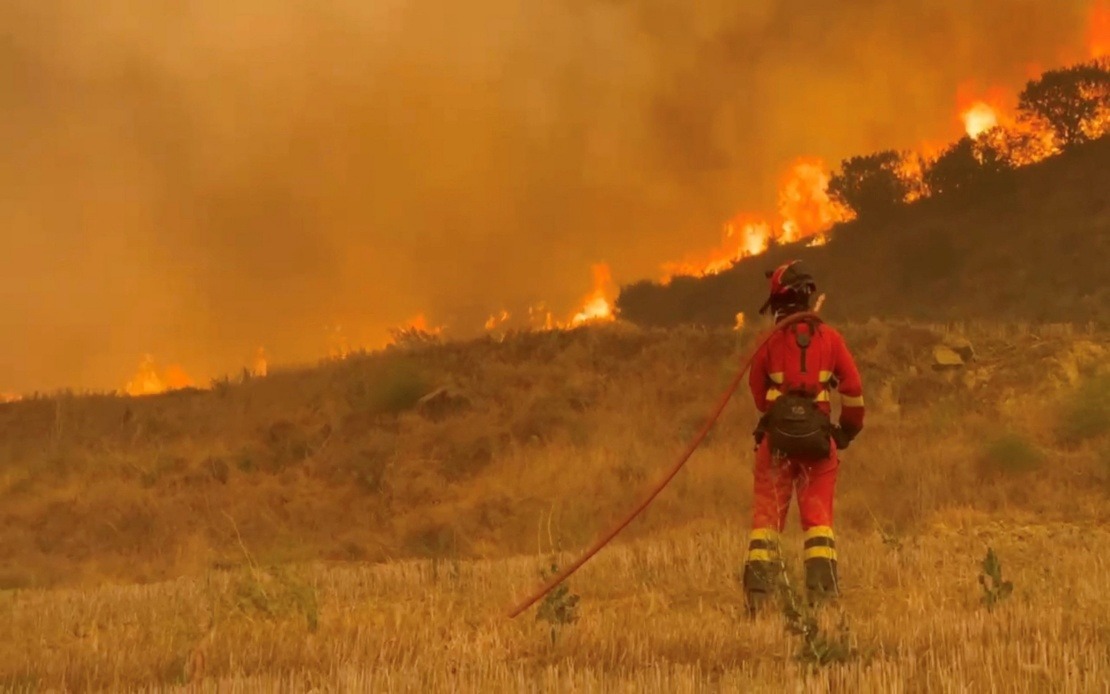
Spain is confronting a major fire crisis as its largest wildfire of the year continues to ravage the northeastern province of Zaragoza, destroying approximately 12,000 hectares of land and compelling authorities to evacuate more than 1,100 people from surrounding communities. The blaze, which ignited on Wednesday in the Cinco Villas region, remained highly volatile through the weekend, with fire officials reporting sustained intensity and troubling overnight expansion patterns that tested the capacity of emergency response teams.
The scope of the disaster has expanded dramatically across jurisdictional boundaries. Authorities have ordered the evacuation of five municipalities within Zaragoza province alongside one municipality in the neighbouring region of Navarre, creating a complex cross-border emergency management scenario. The fire's perimeter has stretched to approximately 60 kilometres, fundamentally disrupting transport networks throughout the affected zones with multiple road closures that have isolated communities and complicated evacuation logistics for residents seeking to escape the advancing flames.
Maintaining critical infrastructure proved essential to preventing secondary humanitarian consequences. While electricity supply disruptions threatened to worsen conditions for evacuated populations and emergency personnel, authorities successfully restored power to all affected settlements by Friday, preventing potential complications from extended blackouts during the crisis. This restoration represented one of the few operational victories in an otherwise challenging emergency response, allowing hospitals, shelters, and command centres to maintain uninterrupted operations.
The firefighting response mobilised substantial resources in an attempt to contain the escalating situation. By Thursday, approximately 400 ground-based personnel and 19 aircraft had been deployed to combat the Zaragoza fire, with tactical priorities centring on protecting residential structures in the town of Uncastillo through overnight operations. The scale of this deployment underscored the severity authorities perceived, yet the continuing spread indicated that available resources remained insufficient to match the fire's expansion rate and intensity.
The crisis extended beyond Zaragoza, with dangerous conditions materialising across other Spanish regions. In the northern province of Guadalajara, a separate wildfire designated as La Mierla had consumed approximately 900 hectares and forced evacuations alongside lockdown procedures for neighbouring communities. This fire prompted regional authorities to formally request deployment of Spain's Military Emergency Unit, which responded by dispatching roughly 100 military personnel to reinforce civilian firefighting operations, reflecting the strain placed on standard firefighting capacity.
A third significant fire developed near Lozoyuela in the hills north of Madrid, adding further complexity to the national emergency situation. Emergency services indicated that this fire was advancing in a more manageable trajectory compared to the Zaragoza conflagration, yet cautioned that it remained neither fully controlled nor contained, representing an ongoing threat requiring sustained monitoring and intervention. The emergence of multiple simultaneous fires stretched Spanish emergency resources across numerous fronts simultaneously.
Criminological investigation revealed human agency in at least one instance of the fires. Civil Guard officers arrested an individual suspected of deliberately initiating the Madrid-region fire, triggering civil legal proceedings that the regional government announced it would join as an interested party. This development suggested that intentional arson, not merely natural ignition, had contributed to Spain's fire crisis, adding a criminal dimension to an already severe natural disaster scenario.
Environmental conditions conspired to create particularly hazardous circumstances for fire propagation. Meteorological factors including elevated temperatures, powerful winds, and critically low humidity levels worked in concert to accelerate fire spread and intensity. The preceding spring's substantial rainfall had nourished abundant vegetation growth across rural landscapes, providing an extensive fuel supply that fires could consume with devastating efficiency once conditions became favourable for rapid combustion and expansion.
Experts identified systemic vulnerabilities extending beyond immediate weather patterns. Climate change has fundamentally altered Spain's fire risk profile by intensifying extreme weather events and extending dry seasons, creating structural conditions that favour more frequent and severe wildfires across the country. Simultaneously, the progressive depopulation of rural areas has eliminated the human presence and land management practices that historically mitigated fire risk through controlled vegetation management and early detection. The combination of climatic shifts and demographic abandonment of agricultural regions has created an increasingly volatile landscape susceptible to catastrophic fire events that overwhelm emergency response infrastructure.

