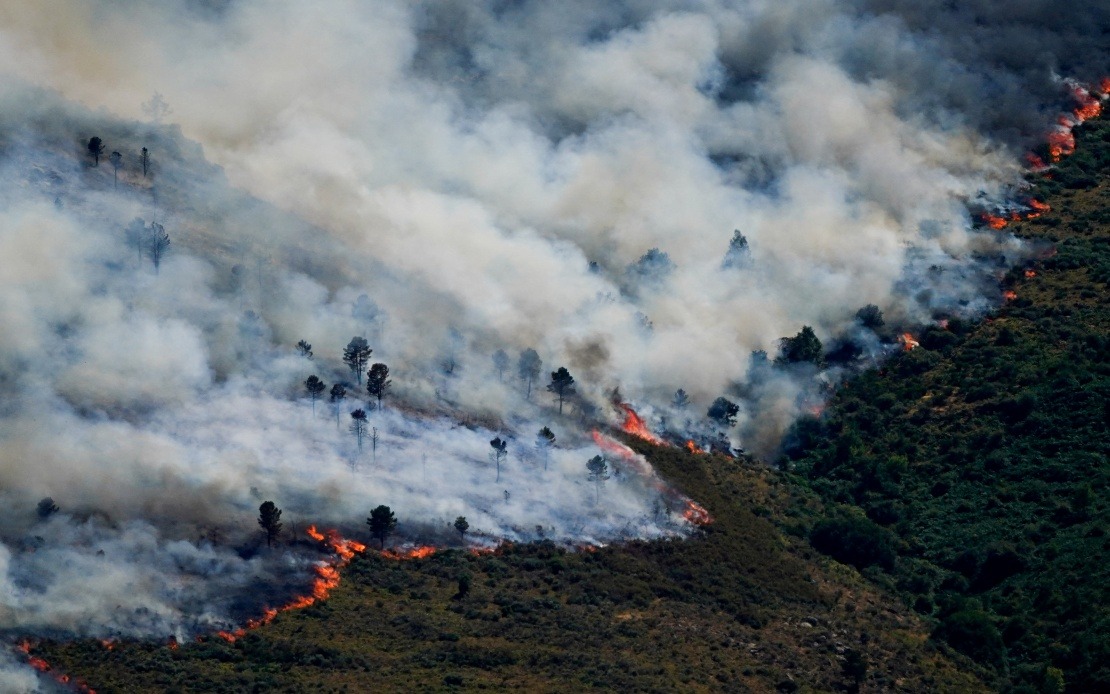
Spain's government declared a national emergency on Friday as catastrophic wildfires swept through regions surrounding Madrid, triggering one of the country's most significant evacuation operations in recent years. The scale of the crisis became evident on Saturday when authorities confirmed that nearly 60,000 residents had been forced to flee their homes to escape the advancing flames, with the situation affecting both the Spanish capital's metropolitan area and outlying provinces.
The evacuation unfolded across two primary zones impacted by the fires. In the province of Ávila, located northwest of Madrid, around 30,000 people were ordered to leave their homes as the fires advanced through forested regions. Francisco Martín Aguirre, the Spanish government's prefect for Madrid, disclosed these figures to journalists as emergency services worked to coordinate one of the largest civilian relocations the region had experienced in recent memory. The evacuation process proved complex given the scale of operation required to move such numbers safely.
The Greater Madrid area itself witnessed the evacuation of approximately 29,488 additional residents, bringing the total displaced persons to nearly 60,000. This dual-zone crisis strained emergency resources as authorities managed simultaneous evacuation operations across multiple jurisdictions and terrain types. The coordination between regional and national authorities became critical in ensuring that evacuation routes remained open and that transport capacity could accommodate the displaced population seeking refuge from the advancing fire fronts.
Beyond those who successfully evacuated, the fires created an additional humanitarian challenge by trapping thousands of residents who remained unable to leave their communities despite the danger. The Interior Ministry documented that more than 28,000 people found themselves unable to depart their homes due to the fire's spread and proximity. Within the greater Madrid metropolitan region, 20,262 residents remained confined to their homes, while another 8,000 in Ávila province similarly lacked safe evacuation routes. This vulnerable population represented an urgent concern for emergency responders tasked with both protecting those still in danger and managing the logistics of mass evacuation elsewhere.
The severity of the crisis prompted Prime Minister Pedro Sánchez to invoke Spain's highest level of emergency protocols. The declaration of a "state of emergency of national significance" on Friday reflected the extraordinary nature of the wildfire threat and underscored the government's assessment that normal administrative procedures would prove inadequate to meet the emergency's scale. This designation enabled rapid deployment of additional military resources, streamlined bureaucratic procedures, and authorized extraordinary expenditures deemed necessary for firefighting and civilian protection operations.
Weather patterns provided the first indication of potential relief as Saturday morning arrived. The Interior Ministry reported that conditions had improved overnight, offering firefighting teams enhanced opportunities to combat the advancing flames. Temperature drops and shifting wind patterns, which frequently prove decisive in wildfire containment, appeared to be developing in ways that would assist rather than hinder firefighting operations. These meteorological changes represented a critical turning point after what had presumably been several days of deteriorating conditions that drove the fires' rapid expansion.
Prime Minister Sánchez, addressing the nation from the emergency services' command centre, conveyed a measured sense of optimism grounded in these improved conditions. He suggested that if the weather patterns continued to favor firefighting operations, the government possessed a realistic chance of bringing the blazes under control during the weekend period. This timeline, if achievable, would prevent further escalation of what had already become one of the season's most serious fire events across the region.
Yet Sánchez simultaneously cautioned that optimism must remain tempered by the continuing complexity of the situation on the ground. The challenges facing firefighting teams persisted despite the weather improvements, as vast areas remained engulfed and the fires still threatened populated zones. Authorities recognized that momentum could shift rapidly if conditions deteriorated or if unexpected secondary fire fronts emerged in areas currently thought to be stabilized. This balanced assessment reflected the reality that even with favorable circumstances, containing fires of this magnitude requires sustained effort and remains vulnerable to unexpected complications.
The Prime Minister emphasized that protecting human life constituted the government's paramount objective throughout the emergency. This declaration of priorities clarified that while property damage and forestry losses represented legitimate concerns, the immediate focus centered on ensuring the safety of the 28,000-plus residents still trapped in threatened areas and preventing casualties among the evacuated population. Emergency shelters, medical facilities, and support services for displaced persons consequently received priority allocation of resources alongside direct firefighting operations.
For Malaysian observers, this crisis illustrates the growing challenge that uncontrolled wildfires pose to developed nations with significant forest resources and concentrated populations near fire-prone regions. Spain's experience demonstrates that even countries with sophisticated emergency response capabilities face unprecedented challenges when environmental conditions align to produce extreme fire behavior. The evacuation of nearly 60,000 people represents a logistical undertaking comparable to major natural disasters, highlighting how climate patterns may be increasing the frequency and intensity of such events across Mediterranean-climate regions globally.
The situation also underscores the importance of regional emergency coordination frameworks and pre-positioned resources for rapid deployment. Spain's invocation of national emergency status enabled extraordinary measures that smaller or less-prepared nations might struggle to implement, yet the scale of the crisis nonetheless strained systems designed for more typical emergencies. This experience carries implications for Southeast Asian countries with significant forest coverage and rural populations, particularly as climate dynamics shift fire seasons and intensity patterns in unpredictable ways.

