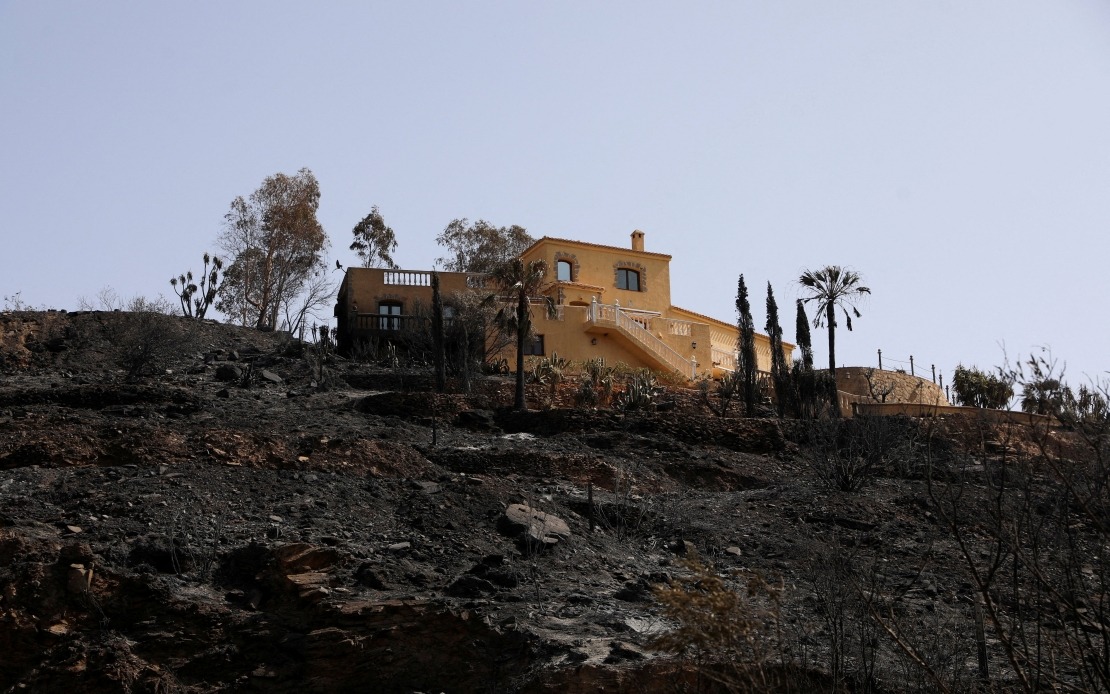
A catastrophic wildfire sweeping through Spain's southeastern province of Almeria has claimed at least 13 lives, with regional authorities confirming on Sunday that the uncontrolled blaze has finally been stabilised after days of destructive rampage through the drought-stricken landscape.
The scale of human suffering remains evident in hospital wards across the region, where seven injured individuals continue receiving treatment, three of whom are in serious condition requiring intensive medical intervention. Spanish public broadcasting outlets have identified that many of those caught in the disaster are foreign nationals, reflecting the multinational composition of residents and workers in the affected areas during the peak summer season.
Emergency services mobilised swiftly after the conflagration erupted on Thursday afternoon near the Los Gallardos municipality, a rural settlement nestled within Almeria province, which forms part of the broader autonomous community of Andalusia in southern Spain. The rapidly advancing flames consumed approximately 7,000 hectares of vegetation, crops, and infrastructure across the drought-vulnerable landscape, destroying homes and agricultural livelihoods in its devastating path.
The scale of the disaster has left an unsettling mystery in its wake. Ten individuals remain officially registered as missing persons, their fates unknown as rescue teams continue systematic searches through the charred terrain. Authorities have launched investigations to determine the origin of the catastrophe, with preliminary findings suggesting that structural failure of an electrical pole or transmission cable may have triggered the initial ignition that transformed into an unstoppable firestorm.
The stabilisation of flames has enabled regional administrators to significantly reduce the intensity of emergency operations that had consumed resources and personnel for nearly a week. Approximately 1,000 residents who had been evacuated from their homes are now permitted to return, building upon the earlier authorisation of roughly 600 evacuees to depart shelters on Saturday. This phased restoration of normalcy represents a crucial step in the recovery process, though the psychological trauma and material losses will linger for months.
Juanma Moreno, the elected head of Andalusia's regional government, cautioned Sunday that despite the fire's apparent containment within established perimeters, the blaze has not yet been fully extinguished or declared completely under control. His measured remarks reflected the persistent danger that smouldering embers and unexpected wind patterns continue to pose to nearby communities and firefighting personnel.
Moreno's statements elevated the conversation beyond immediate disaster management to encompass broader environmental realities facing the Mediterranean region. He characterised this particular wildfire as the gravest conflagration Andalusia has experienced in recent decades, a sobering designation that underscores the accelerating intensity of such natural disasters. The regional leader explicitly invoked the spectre of climate change, urging both the general public and governmental bodies to confront this existential challenge with appropriate seriousness and commitment.
The governor articulated a troubling pattern that climate scientists have documented with increasing frequency: rising temperatures and altered precipitation patterns are generating atmospheric and environmental conditions of unprecedented complexity. These circumstances are spawning wildfires of historical magnitude that far exceed the conventional firefighting capabilities developed over previous generations. Traditional suppression techniques are proving inadequate against the scale and ferocity of contemporary blazes, forcing authorities to continuously innovate their emergency response protocols.
For Southeast Asian observers, this Spanish catastrophe offers instructive lessons about climate vulnerability and disaster preparedness. Malaysia and neighbouring nations in the region face escalating risks from transboundary haze, intensified dry seasons, and extreme weather phenomena that can rapidly overwhelm conventional emergency infrastructure. The Almeria incident demonstrates that even wealthy European nations with sophisticated fire-fighting apparatus struggle against climate-amplified disasters, suggesting that regional governments must invest substantially in early warning systems, community resilience mechanisms, and cross-border coordination frameworks.
The wildfire's particular severity reflects the intersection of climatic stress and accumulated dry vegetation across the Mediterranean landscape. Almeria province, already characterised by arid conditions, experiences increasingly prolonged heat waves and reduced rainfall, conditions that render vegetation highly flammable throughout extended summer months. Climate projections indicate these conditions will intensify across southern Europe, establishing a concerning precedent for regions with similar environmental trajectories.
The presence of foreign nationals among victims highlights another dimension of modern disaster vulnerability: migrant workers and international residents often occupy informal housing arrangements in rural or marginal areas that lack adequate emergency infrastructure and evacuation planning. Their integration into comprehensive emergency management protocols remains an ongoing challenge for Spanish authorities.
As investigations proceed into the fire's origin and as recovery operations unfold across devastated communities, the Almeria wildfire will inevitably influence Spanish climate policy discussions and European emergency management strategies. The incident reinforces mounting scientific consensus that adaptation measures must now accompany mitigation efforts, as communities across continents confront environmental hazards of intensifying severity.

