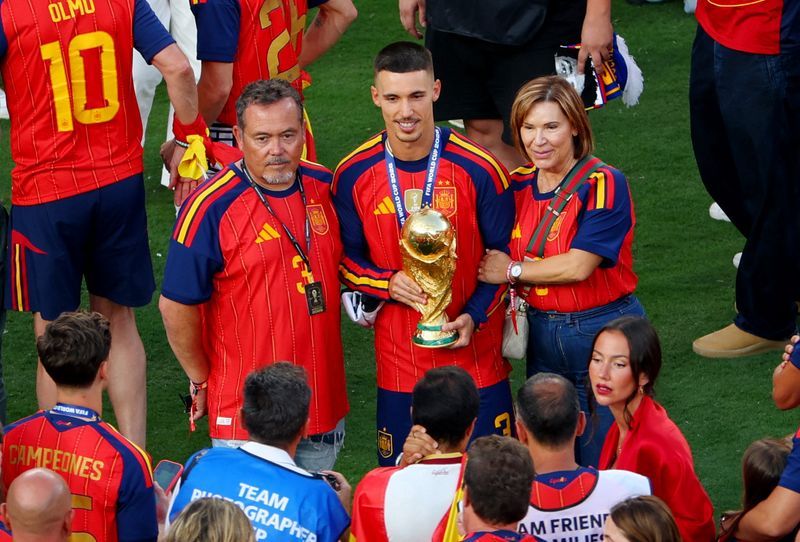
Spain captured the World Cup on Sunday with a 1-0 victory over Argentina at East Rutherford, New Jersey, cementing their position as one of football's most formidable forces. The result represented not a tactical revolution but rather a confident reaffirmation of the possession-based philosophy that has defined Spanish football for over a decade. Throughout the match, Spain controlled proceedings with methodical precision, retaining the ball as a precious asset while methodically breaking down Argentina's defensive structure across regular time and beyond.
Luis de la Fuente's team exemplified their trademark approach by accumulating more than 65 percent possession and completing twice as many passes as their opponents. The Spanish side generated 12 shots on target compared to Argentina's considerably limited threat, with the South Americans not registering their first effort until deep into the extra period. This disparity in statistics underscores the fundamental nature of Spanish dominance—not overwhelming the opponent through explosive attacks, but rather suffocating resistance through sustained pressure and patient build-up play.
The match itself unfolded as a study in controlled tension. Spain's mastery of possession created opportunities, yet their familiar vulnerability—the absence of a world-class central striker capable of clinical finishing—prevented the match from becoming a rout. Despite creating numerous chances, Spain required the full duration of play to find the breakthrough, testament to Argentina's defensive resilience and the inherent difficulty of converting possession into goals. The decisive moment arrived fittingly from the substitutes' bench when Nico Williams and Ferran Torres combined to produce the match-winning goal.
That pattern of substitute players delivering decisive contributions carries profound significance beyond the individual moment. This was Spain's third knockout match in which a replacement player scored the decisive goal—a reflection of the squad's exceptional depth and the philosophical foundation that no individual player transcends the collective. Under de la Fuente, Spain operates as an ensemble where tactical instructions and positional responsibilities carry greater weight than individual star power. Every player absorbed the team's principles, ensuring seamless transitions even when fresh legs entered the pitch.
The broader tournament performance reinforces this narrative of distributed excellence. Spain's 14 goals across eight matches originated from eight different scorers, mirroring their 2024 European Championship success when 16 goals came through 10 different players. Individual brilliance certainly played a role, yet the team's architecture prioritised balance over reliance on any single performer. Notably, Spain's tournament awards haul—Pau Cubarsi as Best Young Player, Unai Simon as Best Goalkeeper, and Rodri as Most Valuable Player—reflects this spread of influence, with France's Kylian Mbappe claiming the Golden Boot as the sole major award escaping Spain's grasp.
Rodri's tournament award deserves particular emphasis given his orchestral role in Spain's midfield. The playmaker's contributions extended far beyond direct goal involvement, instead defining the rhythm and tempo of Spanish football throughout the competition. His recognition acknowledges that modern football success increasingly depends upon creative direction and possession retention rather than traditional forward-facing play. De la Fuente's willingness to construct his team around such players represents a validation of technical football over physical dominance, a philosophy increasingly prevalent among top-tier international teams.
Spain's achievement also extended their unbeaten run to 38 matches, surpassing Italy's previous record and establishing them as the current standard-bearers of consistency in international football. This sustained excellence across multiple tournament cycles suggests systematic development rather than fortunate timing. The appointment of de la Fuente, previously dismissed by Spanish media and journalists as an unconventional choice following significant experience in youth development structures, proved transformational. His patient apprenticeship in Spanish football federation youth programmes provided deep understanding of emerging talent and tactical methodology that ultimately delivered the sport's greatest prize.
Beyond tactical matters, Spain's World Cup triumph carried symbolic weight within Spanish society itself. The squad composition reflects the nation's rich regional diversity, bringing together players from the Basque Country, Catalonia, Galicia, Andalusia, Madrid, Valencia, and the Canary Islands. Mikel Oyarzabal, Unai Simon, and Mikel Merino represent the Basque tradition, whilst Cubarsi and Cucurella exemplify Catalonia's football academy system. Lamine Yamal and Nico Williams embody Spain's successful integration of immigrant populations, representing a newer, more cosmopolitan iteration of Spanish identity.
This geographic and cultural composition transforms the squad into something approaching a microcosm of Spain itself—a nation historically composed of distinct regions with individual identities, separate languages, and particular traditions. The pre-tournament narrative certainly acknowledged these differences, yet Spanish football's greatest strength lies in transforming potential division into collective purpose. On the pitch, regional backgrounds became irrelevant compared to shared commitment to the team's philosophy and tactical requirements.
The World Cup victory accomplishes what Spanish political institutions frequently struggle to achieve—creating genuine national unity transcending regional boundaries and competing interests. For one evening at minimum, football succeeded where political dialogue often fails, demonstrating that common identity and shared purpose remain possible within Spain's complex social fabric. This unifying force carries implications extending beyond sporting achievement, suggesting that inclusive frameworks and collective endeavour can overcome historical tensions and contemporary divisions.
For Southeast Asian football observers, Spain's model offers instructive lessons regarding long-term player development, tactical coherence, and the values systems underpinning elite international competition. The Spanish federation's investment in youth structures and systematic progression, reflected in de la Fuente's career trajectory from youth coach to national team leadership, contrasts with approaches emphasising short-term results. Furthermore, Spain's demonstrated capacity to succeed without featuring a traditionally dominant centre forward suggests that regional football associations might profitably reconsider their tactical templates and position-specific recruitment strategies.
Spain's World Cup triumph represents the culmination of a footballing philosophy emphasising possession, positional discipline, and collective identity over individual heroics. This comprehensive victory—achieved through patient construction, tactical intelligence, and squad depth—establishes a benchmark for contemporary international football. The triumph reflects not merely sporting excellence but also a particular vision of how diverse communities can function cohesively toward shared objectives, a message resonating across football cultures worldwide.

