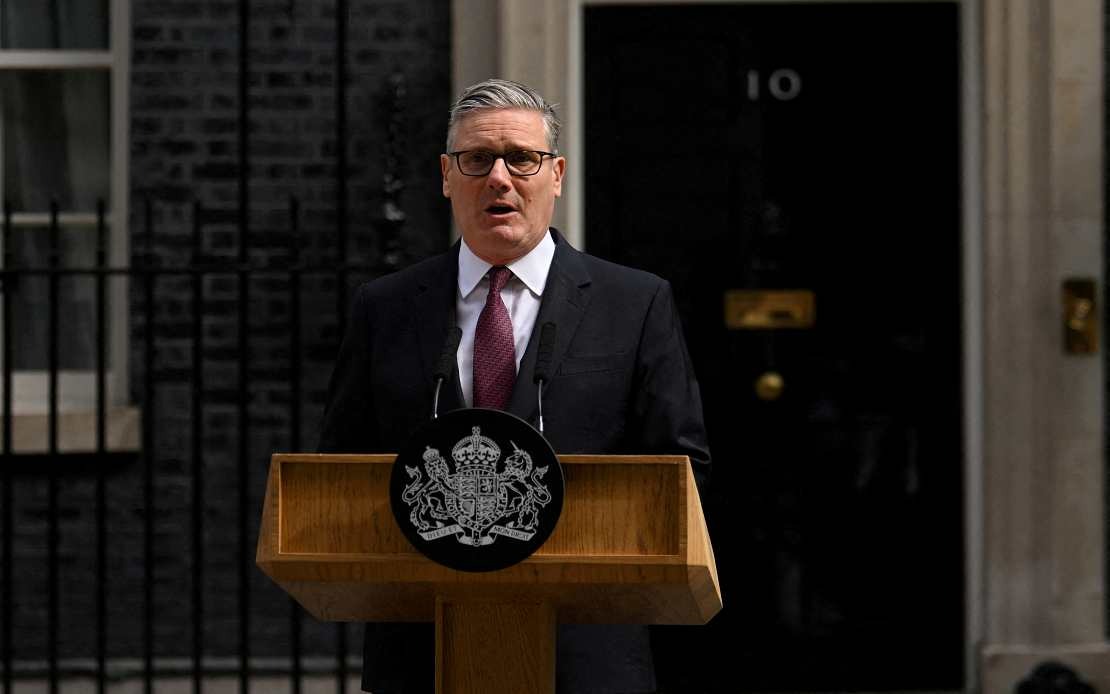
Keir Starmer concluded his tenure as British Prime Minister on Monday with a farewell address delivered from Downing Street, stating that his mission had been accomplished and that he was departing office "with a smile." The remarks came moments before he travelled to Buckingham Palace to formally tender his resignation to King Charles, marking the end of a political chapter that began with Labour's landslide victory in 2024. Starmer's departure creates space for Andy Burnham to assume the premiership, bringing fresh leadership to the United Kingdom at a significant juncture in its political evolution.
The outgoing prime minister's statement reflected on the arc of his leadership, noting that when Labour assumed power in 2024, the nation faced considerable headwinds. Within his tenure, Starmer characterised Britain as having become "stronger and fairer," suggesting that Labour's policy agenda had yielded tangible improvements across key sectors and communities. His emphasis on these measurable gains sought to establish the foundation for continuity rather than rupture, even as power transfers to a new premier. The framing of his departure—as a natural conclusion to a completed agenda rather than an enforced or contested exit—underscores the orderly nature of this transition within the Westminster system.
Starmer's six-and-a-half-year journey to this moment began in 2019, when the Labour Party faced what he described as "historic defeat." That loss prompted a comprehensive organisational and ideological overhaul. Under his stewardship, Labour underwent profound transformation, repositioning itself to appeal to a broader electoral coalition and modernising its policy platform. This painstaking reconstruction culminated in the 2024 general election triumph, which constituted a decisive mandate from the British electorate and validated the strategic choices Starmer had made during years of opposition.
The emotional tenor of Starmer's resignation speech, delivered alongside his wife Victoria and surrounded by party colleagues and personal friends in Downing Street, conveyed a sense of fulfilment rather than regret. His invocation of "passing the baton" to Burnham characterised the transition as an intentional and measured handover, maintaining party unity and signalling confidence in his successor's readiness for the office. This ceremonial aspect is crucial for political continuity; orderly transitions within governing parties typically preserve institutional stability and voter confidence in democratic governance.
For Malaysian and Southeast Asian observers, Starmer's departure and Burnham's ascension represent significant developments in understanding the Anglo-British political landscape. The United Kingdom remains a major economic partner, diplomatic influence, and security ally for nations across the region. Changes in British leadership affect bilateral relations, trade negotiations, and strategic alignment on regional security issues affecting ASEAN member states. Burnham's approach to foreign policy, trade frameworks, and engagement with Asia-Pacific powers will shape Britain's role in regional geopolitics over the coming years.
Burnham's anticipated elevation to prime minister marks the continuation of a Labour government that has pursued specific economic and social policies distinct from its Conservative predecessors. His leadership style, policy priorities, and diplomatic approach will influence how Britain engages with its international partners, including those in Southeast Asia. The transition provides an opportunity to assess Labour's commitment to existing partnerships and to evaluate any recalibration of Britain's regional strategic posture.
The mechanics of Starmer's resignation—proceeding to the Palace to formally notify the monarch, facilitating the constitutional process through which Burnham becomes prime minister—exemplifies the formal procedures embedded in Britain's constitutional monarchy system. King Charles's acceptance of the resignation and his role in facilitating the transition represent the ceremonial scaffolding through which executive power changes hands. This institutional framework, however ancient in origin, continues to function as the constitutional bedrock of British governance.
Starmer's characterisation of his "work is done" invites reflection on what Labour accomplished during its tenure in office. Whether one assesses his term as transformative or incremental depends partly on which policy domains one privileges—economic management, social welfare, constitutional reform, or international standing each tell distinct narratives. His assertion that Britain had become "stronger and fairer" places the burden of validation on measurable outcomes, from employment figures and NHS capacity to educational attainment and regional development indicators.
The transition to Burnham occurs at a moment when Britain faces persistent economic headwinds, geopolitical complexity, and domestic political fragmentation. The new prime minister inherits not merely executive office but also the accumulated challenges and opportunities that characterised Starmer's administration. How swiftly Burnham articulates his own governing vision and distinguishes his priorities from those of his predecessor will shape both domestic perception of his leadership and international assessment of Britain's trajectory. For the region, continuity in bilateral relations coupled with nuanced shifts in emphasis will likely characterise the early months of his premiership.

