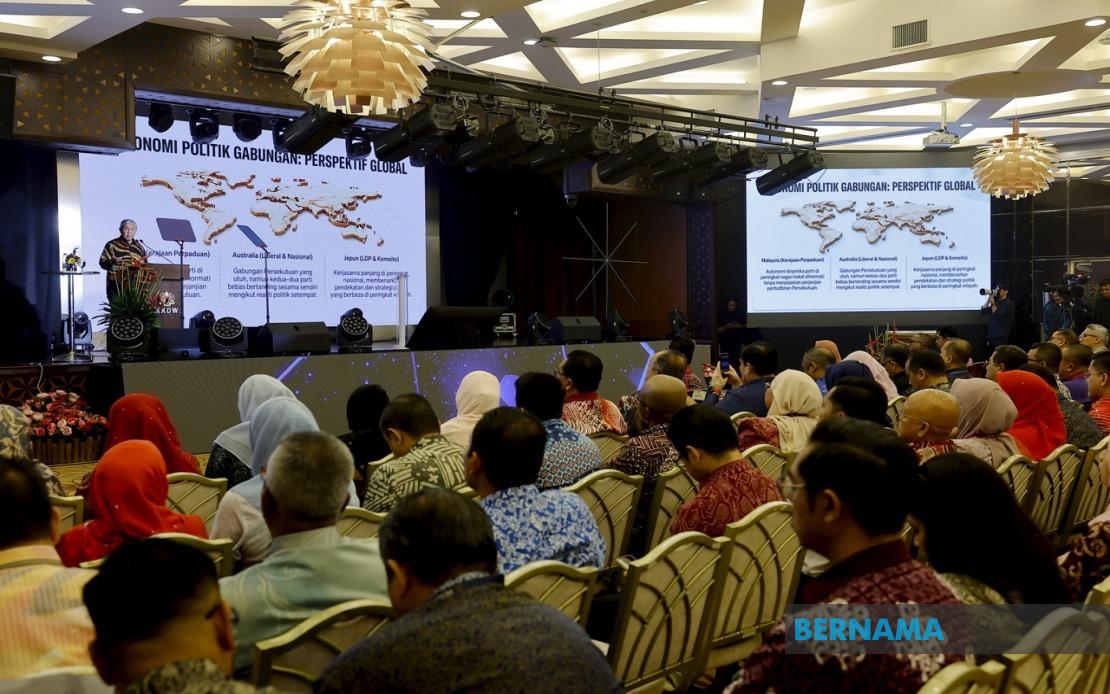
Deputy Prime Minister Datuk Seri Dr Ahmad Zahid Hamidi moved to ease concerns about the impact of state-level political competition on Malaysia's federal administration, declaring that the Unity Government's stability remains unshaken regardless of electoral outcomes in individual states. Speaking at a monthly assembly held by the Rural and Regional Development Ministry in Putrajaya on August 6, Ahmad Zahid, who simultaneously chairs Barisan Nasional, emphasised that the government's structural foundations rest on a binding mutual understanding that will persist until Parliament is dissolved.
The timing of Ahmad Zahid's statement reflects heightened attention to potential fault lines within the coalition following competitive elections in Johor and Negeri Sembilan. These contests have demonstrated that member parties of the Unity Government retain their distinct political identities and competitive ambitions at the subnational level—a reality that observers have closely monitored for signs of broader fracturing. By framing such competition as compatible with federal stability, Ahmad Zahid sought to provide clarity on how Malaysia's coalition government manages internal diversity while maintaining operational coherence at the centre.
Acknowledging that coalition members pursue independent political strategies within their respective states, Ahmad Zahid articulated a governance framework premised on what he termed "political autonomy within a coalition government." This formulation represents a deliberate effort to legitimise factional manoeuvring and electoral competition between coalition partners without implying institutional breakdown. Under this model, each party retains latitude to pursue its own political direction and strategy provided that such activities do not violate the overarching agreement that binds the government together—a distinction that proves critical for maintaining both coalition stability and member-party morale.
The deputy prime minister underscored that the MADANI Government's policy trajectory and developmental agenda will proceed uninterrupted, irrespective of how political fortunes shift across different states. He stressed that government administration, the execution of planned programmes and projects, and the discharge of public responsibilities all remain insulated from state-level political fluctuations. This assurance holds particular importance for investors, development partners, and citizens who depend upon policy continuity and administrative coherence. The government's capacity to absorb state-level rivalry without allowing it to permeate upward to federal functioning represents a test of institutional resilience and coalition discipline.
Ahmad Zahid's framing explicitly rejected the premise that membership within a coalition government requires political parties to surrender their distinct identities or ideological positions. This recognition tacitly acknowledges the compromise inherent in Malaysia's post-2020 political settlement, where former adversaries coalesced to prevent the return of previous governance models. Rather than demanding complete uniformity, the Unity Government operates as a loose federation of interests bound by procedural agreements and shared commitment to specific governance principles. This arrangement reflects pragmatic acceptance that achieving consensus on every policy detail remains infeasible, but maintaining the coalition's overall integrity remains achievable through careful demarcation of autonomous spheres.
For Malaysian voters and regional observers, the significance of Ahmad Zahid's remarks extends beyond reassurance rhetoric. They illuminate how Malaysia's federal system accommodates multi-party competition and coalition dynamics simultaneously. The fact that Barisan Nasional candidates compete against other coalition members in state elections while those same parties cooperate in federal governance demands sophisticated understanding of jurisdictional boundaries and institutional separation. This arrangement differs substantially from Westminster systems where coalition partners typically refrain from direct electoral competition, reflecting Malaysia's distinctive political culture and constitutional architecture.
The reference to Parliament's dissolution as the ultimate boundary marker for the government's tenure establishes a clear temporal horizon for the coalition's obligations. Ahmad Zahid's reminder that federal administration will continue functioning "as long as Parliament is not dissolved" reaffirms the government's commitment to completing its full constitutional term and maintaining stability through to the next general election. This messaging becomes especially important amid speculation about possible early parliamentary dissolution or cabinet restructuring, concerns that periodically surface in Malaysian political discourse.
Regional significance also attaches to Ahmad Zahid's statement, given that Malaysian coalition stability influences broader Southeast Asian political dynamics. Investor confidence, regional security cooperation, and ASEAN institutional functioning all derive benefit from Malaysia's internal political coherence. Periods of coalition strain in Malaysia have historically coincided with reduced regional engagement and inward-focused policymaking. Conversely, demonstration of coalition resilience sends reassuring signals to Singapore, Thailand, Indonesia, and other neighbours regarding Malaysia's capacity for sustained regional participation and commitment to established frameworks.
The deputy prime minister's emphasis on fulfilling "every responsibility entrusted to us by the people" reframes state-level political competition as secondary to the government's foundational mandate. This rhetorical move acknowledges legitimate electoral competition while positioning it as subordinate to the overarching public interest in coherent federal administration. Whether this hierarchy proves sustainable depends ultimately on whether coalition partners exercise sufficient restraint in state-level contests and resist the temptation to leverage temporary advantages for federal-level repositioning. Historical precedent suggests that maintaining such discipline requires constant attention and periodic reaffirmation—work that Ahmad Zahid's statement represents.
Moving forward, the stability Ahmad Zahid projects rests upon continued alignment among senior coalition figures and sustained adherence to foundational agreements. Should state-level contests produce outcomes that significantly disadvantage one or more coalition member parties, or should personalities associated with previous governance models mobilise competing visions of Malaysia's future, the buffering capacity he describes may face practical testing. The government's next critical juncture will likely emerge during state elections in remaining constituencies or if internal coalition dynamics shift substantially, either of which could either validate or challenge Ahmad Zahid's confident assessment of federal durability.

