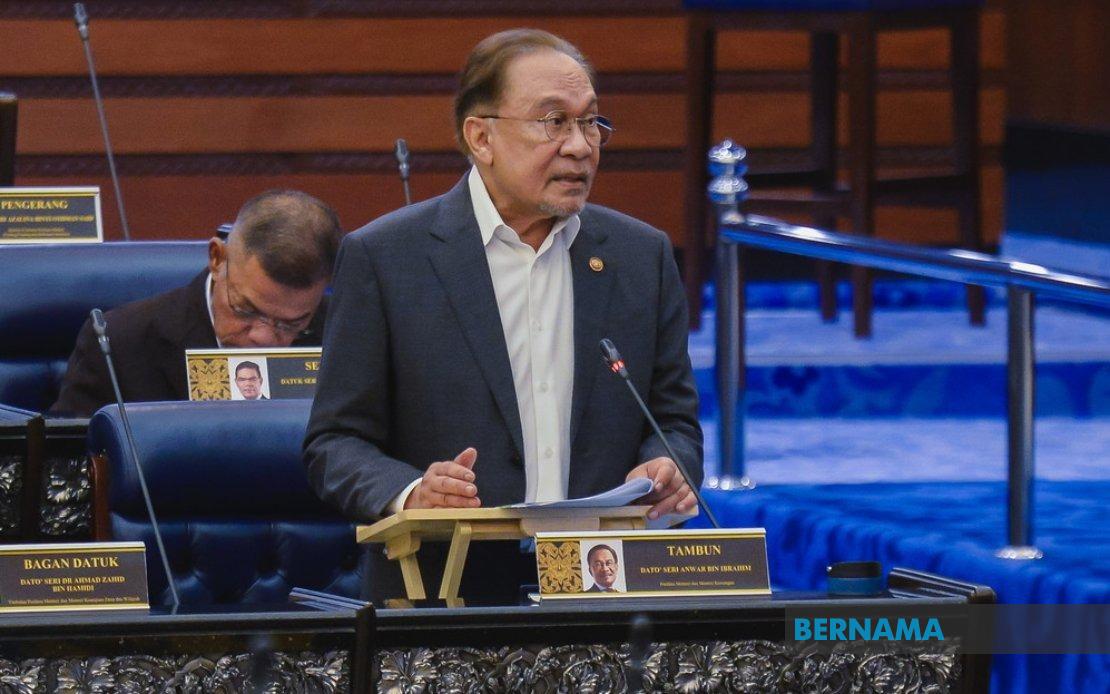
Prime Minister Datuk Seri Anwar Ibrahim has set a clear boundary on federal financial responsibility, insisting that state governments cannot automatically receive additional funding whenever development project costs escalate. Speaking in Parliament on June 30, Anwar stressed that any request for supplementary allocations tied to a Notice of Change must undergo fresh negotiations and reassessment before the Federal Government commits additional resources or loans.
The Prime Minister's stance addresses a recurring tension in Malaysia's federal structure, where states often encounter unforeseen cost increases in major infrastructure projects yet lack the financial firepower to absorb them independently. His remarks came in response to a parliamentary question regarding Kedah's application for extra funding for the Pulau Bunting Water Treatment Plant project, which requires approval of an NOC—a formal amendment to contractual terms that typically signals rising expenses.
Anwar articulated two critical reasons why each NOC-related funding request demands individual examination rather than automatic approval. First, authorities must establish whether the contractor bears responsibility for the cost escalation or whether external factors beyond anyone's control contributed to the shortfall. This investigative step prevents contractors from exploiting the NOC mechanism to recover avoidable losses at public expense, potentially incentivising better project management and accountability upstream.
Second, and perhaps more fundamentally, the Prime Minister emphasised that the Federal Government cannot be bound by decisions made unilaterally by state administrations. In Malaysia's constitutional framework, states retain significant autonomy over local affairs, but when those decisions generate financial demands on federal coffers, the balance shifts. Anwar's statement reflects the reality that federal resources are finite and must serve competing national priorities across all thirteen states and three federal territories.
The Pulau Bunting Water Treatment Plant exemplifies the challenge. This Kedah project, essential for regional water security, initially proceeded under one cost structure. As construction progressed, however, expenses mounted—a scenario increasingly common in Malaysian infrastructure as material prices fluctuate, supply chains prove fragile, and unforeseen ground conditions emerge. Rather than allowing states to present the Federal Government with a fait accompli requiring immediate funding injections, Anwar's approach forces genuine negotiation and examination of root causes.
Such oversight carries particular weight in the Malaysian context, where governance quality and financial discipline vary across state administrations. A blanket approval process for cost overruns could encourage loose initial budgeting, inadequate risk assessment during planning phases, or even negligent contractor oversight. By requiring renegotiation, the Federal Government preserves its capacity to scrutinise whether initial estimates were realistic and whether state-level management failures contributed to the problem.
The implications extend beyond individual projects. Malaysia's infrastructure development pipeline remains substantial, with water security, transportation, and energy transition initiatives demanding significant investment. If states could routinely secure federal top-ups without rigorous justification, the accumulated impact on the federal budget could undermine other national priorities or worsen fiscal deficits. Anwar's framework attempts to balance federal support for state development with fiscal discipline and accountability.
Deputy Prime Minister Datuk Seri Fadillah Yusof, who holds the portfolio for Energy Transition and Water Transformation, is expected to elaborate on the specific machinery through which such renegotiations will occur. This division of labour—with Anwar articulating the principle and Fadillah explaining implementation—suggests the government has given structured thought to how these cases will be processed, rather than operating on an ad-hoc basis.
For states like Kedah and others facing similar situations, the message is unambiguous: come prepared with thorough documentation, root-cause analysis, and evidence that initial estimates were prudent and that cost increases reflected genuine external pressures rather than mismanagement. The era of states passively informing the Federal Government of cost overruns and expecting automatic top-ups has effectively ended.
This approach also signals confidence in federal capacity to manage fiscal affairs, a reassuring message to Malaysia's creditor community and international investors concerned about public debt trajectories. By demonstrating that federal institutions will not reflexively rubber-stamp spending requests, Anwar reinforces perceptions of fiscal stewardship even as governments globally face infrastructure funding pressures.
The long-term consequence may be improved discipline at state level, with chief ministers and state civil services implementing more rigorous procurement practices, contingency planning, and contractor oversight to avoid future NOC situations. Alternatively, states may absorb more costs internally, potentially reducing project scope or seeking private-sector partnerships. Either way, the responsibility for consequences shifts, creating sharper incentives for careful project governance.

