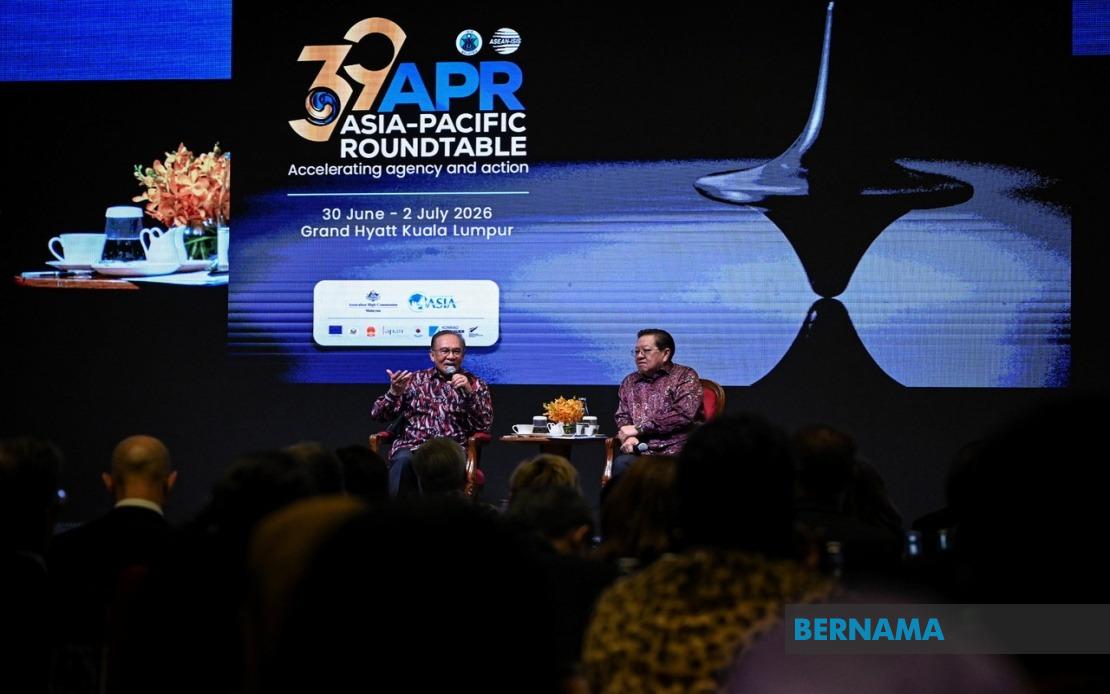
Prime Minister Datuk Seri Anwar Ibrahim has positioned strengthening Malaysia's governance framework as the nation's paramount undertaking, asserting during the 39th Asia-Pacific Roundtable in Kuala Lumpur that domestic institutional reform must precede any aspiration to shape international outcomes. Speaking in a question-and-answer forum, Anwar articulated a strategic reorientation of government priorities centred on internal transformation rather than external posturing on the world stage.
The Prime Minister's remarks reflect a deliberate recalibration of Malaysia's foreign policy lens, one that recognises the intrinsic connection between a nation's credibility abroad and the robustness of its institutions at home. By framing governance strengthening as foundational, Anwar signals that Malaysia's ability to advocate effectively for its interests or values in regional and global forums depends fundamentally on demonstrating tangible progress in areas that directly affect citizen welfare and institutional integrity.
Among the government's core focus areas, Anwar identified the systematic eradication of corruption as a cornerstone initiative. This emphasis carries particular weight in Southeast Asia, where governance challenges and perceptions of institutional weakness have historically constrained regional cohesion and economic competitiveness. Alongside anti-corruption efforts, the administration has committed to narrowing wealth disparities and universalising access to quality education and healthcare services—objectives that address long-standing concerns about equity and social mobility in Malaysian society.
Anwar's positioning of Malaysia as a model Muslim-majority democracy represents an additional strategic dimension to his governance agenda. By emphasising that his government intends to demonstrate that Islamic-majority nations can simultaneously uphold democratic principles, moderation, and inclusive governance, the Prime Minister stakes Malaysia's international reputation on the success of domestic institutional reforms. This framing transforms governance improvements from mere bureaucratic necessity into a form of soft power projection, where Malaysia's internal performance becomes a statement to both regional and global audiences about the compatibility of Islamic values with liberal democratic norms.
The Prime Minister rejected narrow interpretations of contemporary global tensions as stemming from civilisational incompatibility, a rhetorical move that carries implications for how Malaysia might position itself in an increasingly polarised international environment. Instead, Anwar attributed many international conflicts to mutual misunderstanding and prejudicial thinking, citing the late Palestinian-American scholar Edward Said in characterising global divisions as fundamentally rooted in ignorance rather than irreconcilable ideological differences. This analysis provides intellectual scaffolding for Malaysia's pursuit of a moderate international posture grounded in dialogue and mutual comprehension.
Central to this philosophy is Malaysia's MADANI framework, which Anwar described as an integrated development paradigm balancing technological progress with humanistic values. The framework's dual emphasis acknowledges recognition that material advancement divorced from ethical consideration and social cohesion produces hollow growth—a concern particularly acute in developing economies navigating rapid digitalisation and economic transformation. By anchoring technological ambition within a matrix of human-centred values, Malaysia's development strategy theoretically guards against the social fragmentation that often accompanies purely market-driven growth models.
Anwar invoked the Quranic concept of 'li ta'arafu'—often translated as 'to know one another'—to articulate an aspirational standard for Malaysian multisocial coexistence that transcends mere tolerance. This theological-philosophical reference suggests that Malaysian pluralism should aspire beyond the minimalist threshold of cohabitation to achieve genuine mutual understanding and appreciation across communal lines. For a nation with Malaysia's demographic complexity and historical experience of communal tensions, this framing represents an ambitious reimagining of intercommunal relations as requiring active intellectual and emotional engagement rather than passive acceptance of difference.
The emphasis on understanding across religious and cultural boundaries assumes particular significance given Malaysia's ongoing navigation of multicommunal politics and periodic episodes of intercommunal concern. By positioning genuine appreciation of difference as foundational to national stability and development, Anwar advances a governance philosophy that treats social cohesion not as a secondary policy outcome but as instrumental to all other institutional objectives. This approach implicitly challenges zero-sum framings of communal relations prevalent in portions of Malaysian political discourse.
Anwar's insistence that Malaysia concentrate initially on internal transformation before advancing global ambitions reflects pragmatic acknowledgment of resource constraints and institutional capacity limitations facing most developing democracies. By prioritising domestic consolidation, the Prime Minister arguably positions Malaysia to engage with global challenges from a position of greater institutional stability and domestic legitimacy. This sequencing suggests that Malaysian leadership influence in regional forums and international organisations should eventually flow from demonstrated success in managing the complex governance challenges inherent in plural, rapidly developing societies.
The Prime Minister's framing also contains implicit criticism of previous governance approaches that may have prioritised international positioning or diplomatic visibility over systematic institutional strengthening. By recasting governance reform as Malaysia's supreme responsibility, Anwar establishes a metric against which his administration's performance will be measured, creating accountability mechanisms that transcend conventional electoral cycles. This positioning raises the stakes considerably for the government's anti-corruption initiatives, service delivery improvements, and equity-focused policies, as these will increasingly be evaluated not merely as domestic reforms but as foundation stones for Malaysia's international standing and influence.

