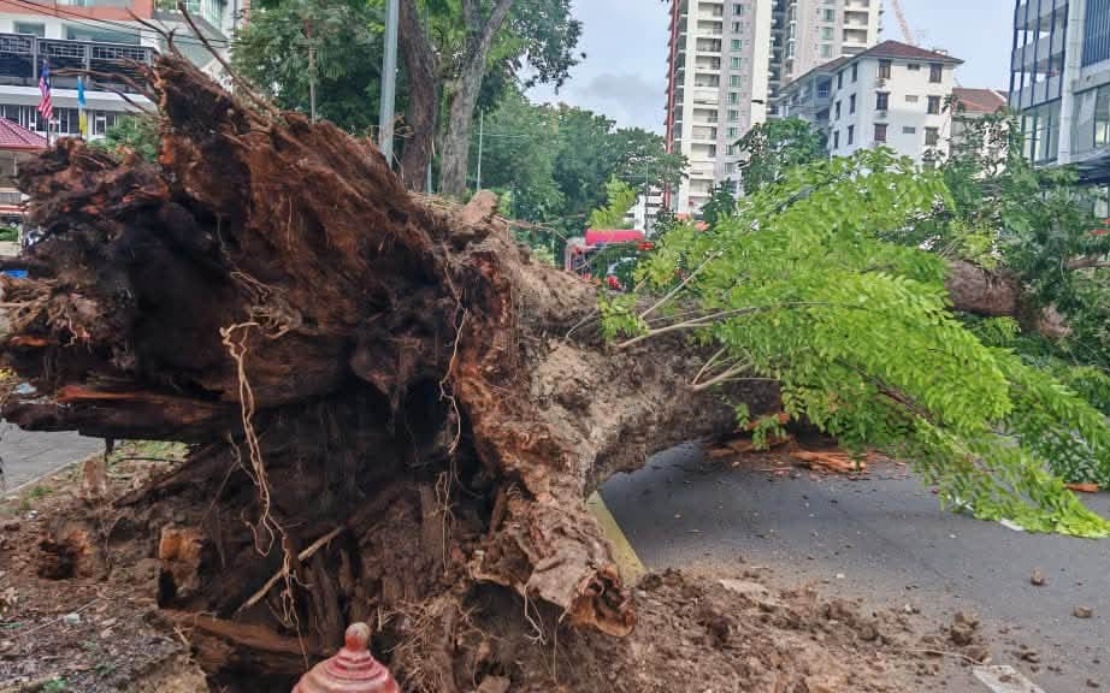
A towering 28-metre Angsana tree that has stood for nine decades along Jalan Macalister in George Town came down unexpectedly in the morning hours, striking a passing vehicle and leaving three passengers injured. The incident, which occurred around 9 am, prompted George Town City Council (MBPP) to launch an investigation into the structural failure, with municipal officials now pointing to a combination of internal decay and environmental stressors as the primary culprits.
According to MBPP Mayor Datuk A. Rajendran, the Pterocarpus indicus specimen exhibited significant deterioration typical of urban trees nearing the end of their structural lifespan. The tree's root system had decayed substantially, with approximately 30 per cent of the roots affected by rot, while the base trunk showed cavity damage accounting for roughly 40 per cent of its cross-section. These internal weaknesses substantially compromised the tree's ability to remain upright under its own weight, even without extraordinary external forces acting upon it.
Beyond the biological breakdown of the wood itself, Rajendran identified several contextual factors that collectively increased the risk of catastrophic failure. The tree had endured chronic soil compaction over the years, a common consequence of regular foot traffic, vehicle vibrations, and urban development around its base. The rooting space available to the mature tree was markedly limited, preventing the root system from extending far enough to provide adequate anchorage. Recent infrastructure upgrading work in the vicinity further stressed the already compromised specimen. Notably, there was no heavy rain or strong winds recorded at the time of the collapse, suggesting that the tree's structural integrity had already deteriorated beyond a critical threshold.
For residents and urban planners across Malaysia and Southeast Asia, the incident raises important questions about how cities manage aging trees in densely built environments. Many Malaysian urban centres inherited substantial populations of heritage trees planted during colonial periods and the early postcolonial decades. Like the Angsana on Jalan Macalister, these specimens now face unprecedented stressors—from root restriction caused by underground utilities and infrastructure to the accumulated effects of compacted soil and pollution. The George Town collapse serves as a cautionary case study in the need for proactive assessment and maintenance of mature trees that have become part of the urban fabric.
MBPP's response to the incident indicates awareness of the broader challenge. The council had already conducted a comprehensive assessment of mature and aged trees along Jalan Macalister during 2024, which identified 13 trees deemed risky enough for removal. All of these trees have since been felled. The last maintenance work on trees along the same route took place on January 29 of this year, suggesting regular attention. However, a remote sensing study conducted in the preceding year had categorized the trees as being in good condition with no warning signs. The discrepancy between that assessment and the actual state of the tree that collapsed underscores the difficulty in predicting sudden structural failures, particularly when internal decay processes like cavity formation and root rot progress unpredictably.
The municipality's broader tree management operations paint a picture of an institution grappling with the scale of urban forestry challenges in Penang. In 2024, MBPP identified 2,535 trees across various risk categories, a substantial inventory reflecting the complexity of maintaining a functional and safe urban forest. Of these, 45 cases involved trees obstructing drainage systems, 138 were classified as dead, 2,242 fell under risk or miscellaneous categories, and 110 were linked to development or infrastructure projects. The council has approved 179 high-risk trees for removal this year, of which 148 have been taken down, with a total of 247 trees felled in the first three quarters of the year.
The reasons for tree removal reveal the multifaceted pressures on urban forestry in Malaysia. Trees are felled not only because of collapse risk but also for interfering with drainage infrastructure, blocking development, and encroaching on utility corridors—particularly those operated by Penang Water Supply Corporation. This reality reflects a tension between preserving urban green space and managing the practical demands of modern city infrastructure. As cities modernize their water systems, electrical networks, and transportation infrastructure, trees that were planted decades ago often find themselves in conflict with these newer systems.
Following the Jalan Macalister incident, MBPP has moved to accelerate risk mitigation measures along the affected corridor. The council has instructed its contracted service providers to expedite work to reduce the height of remaining trees and to fell those assessed by certified arborists as presenting immediate collapse risks. This reactive approach, while necessary for public safety, highlights the ongoing challenge of balancing precaution with the desire to preserve mature specimens.
For Malaysian cities beyond Penang, the incident offers relevant lessons about tree management strategy. Urban forestry is increasingly recognized internationally as essential for livability, air quality, and climate resilience, yet the practical management of aging trees in space-constrained urban settings remains difficult. The George Town collapse demonstrates that even trees that appeared sound to remote sensing technology and recent maintenance inspections can fail suddenly when internal decay reaches critical levels. This suggests the need for more frequent, invasive diagnostics for particularly large or high-risk specimens positioned where their failure poses direct hazard to people and property.
The injured passengers in the vehicle struck by the fallen Angsana—an elderly couple and their grandchild—represent the human stakes in urban tree management decisions. MBPP's response in clearing the debris and reopening the road within hours of the incident showed operational competence, but the preventability of such incidents remains in question. Had the 2024 assessment identified this particular tree as problematic, removal before failure could have been arranged. The absence of warning indicators in the previous year's remote sensing study suggests that some forms of structural degradation, particularly cavity formation, may develop rapidly or escape detection by non-invasive methods.
Moving forward, Malaysian municipalities managing similar heritage tree populations might consider more aggressive diagnostic protocols for specimens of considerable height positioned near high-traffic areas. Visual inspection supplemented by core sampling or resistograph testing could reveal internal decay before it reaches the critical failure threshold. The challenge, of course, involves resource allocation—more intensive monitoring and diagnostic work requires budgetary commitment that not all local authorities can easily accommodate. Yet the cost of reactive removal following an incident that injures residents arguably justifies preventive investment.
The Angsana tree that fell on Jalan Macalister was a product of early twentieth-century urban planning, a time when tree planting prioritized aesthetics and shade provision without necessarily accounting for the future clash between growing root systems and increasingly dense urban infrastructure. As Southeast Asian cities continue to mature and intensify, the management of such heritage specimens will likely become more pressing. The George Town incident serves as a reminder that urban forests, while invaluable assets, require adaptive management strategies that recognize both the benefits trees provide and the genuine safety risks that aging, stressed specimens can pose in built environments.

