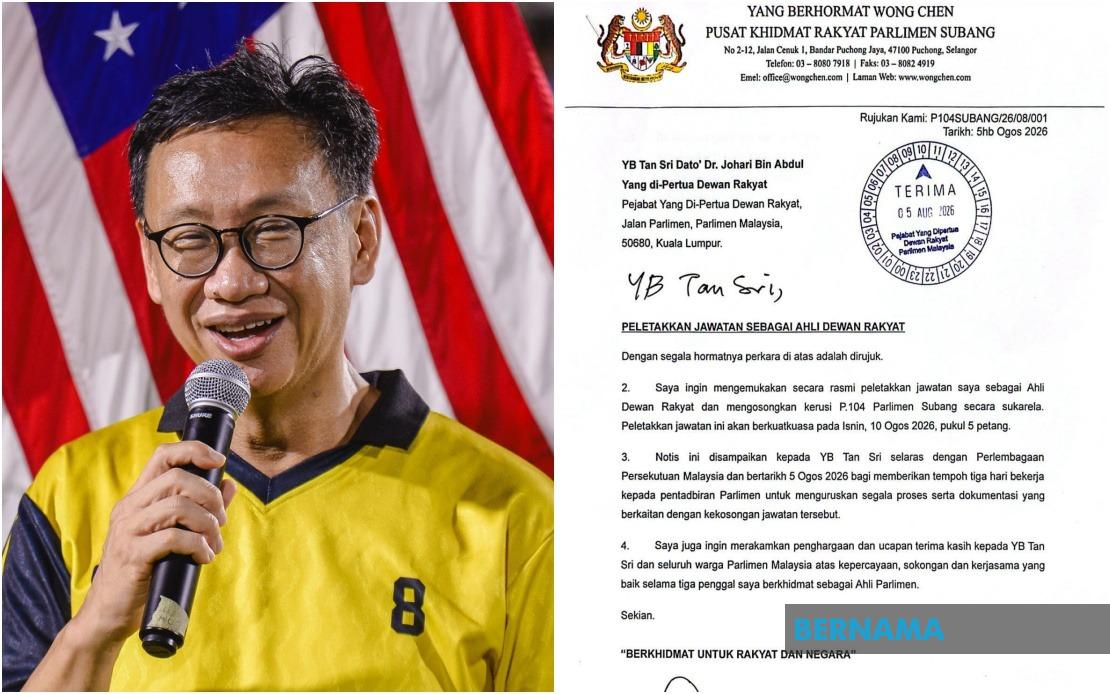
Wong Chen, the long-serving Member of Parliament for Subang, has formally exited his parliamentary seat, bringing to a close a three-term tenure in Malaysia's lower house. The Dewan Rakyat Speaker Tan Sri Johari Abdul received the resignation letter on August 5, 2026, with the vacancy taking effect at 5:00 pm the same day. In announcing the move through social media, Wong acknowledged the procedural courtesy of providing advance notice to allow Parliament's administrative machinery adequate time to process the transition and prepare for the subsequent by-election process.
Wong's decision to resign comes after representing the Subang constituency through three consecutive parliamentary cycles, a period during which he has been a visible figure in urban parliamentary politics. The resignation was conducted in accordance with constitutional protocols, as outlined in the Federal Constitution, and appears to have been executed smoothly with the Speaker's office and parliamentary staff. The MP's formal communication emphasised the voluntary nature of the departure, suggesting this was a planned decision rather than an unexpected or forced exit from elected office.
In his official resignation letter dated August 5, Wong extended formal acknowledgment to Tan Sri Johari and the parliamentary administration for the support and collaborative working relationship maintained throughout his legislative career. This gesture of gratitude reflects conventions of parliamentary decorum and potentially indicates a departure conducted without acrimony or outstanding disputes. Such formal recognition of institutional support is customary among MPs departing the chamber under ordinary circumstances, suggesting Wong's exit has been conducted with proper regard to parliamentary traditions.
The timing and advance notice provided by Wong indicate a deliberate approach to succession planning within his constituency. By submitting notice five days before the effective resignation date, the Subang MP ensured that the machinery of Parliament could begin procedural arrangements without disruption. This professional handling of the transition suggests preparation on both sides, allowing the Speaker's office to schedule by-election protocols and administrative changeovers at an orderly pace rather than managing an abrupt vacancy.
Wong has scheduled a comprehensive press conference for August 6 at 11:00 am to address his resignation and presumably to outline the reasons and circumstances surrounding his departure. This forum will likely provide Malaysian constituents and observers with clarity about his motivations, whether retirement was driven by health considerations, family commitments, business obligations, or other personal factors. The decision to hold a dedicated media engagement indicates Wong views the resignation as significant enough to warrant detailed public explanation rather than allowing speculation to dominate the narrative.
As part of his orderly transition from elected office, Wong announced the removal of the "Yang Berhormat" honorific title from all official materials, signboards, billboards, and correspondence commencing the following month. This administrative adjustment reflects parliamentary protocol whereby the YB designation applies only to sitting members of the Dewan Rakyat, and former MPs relinquish the privilege upon leaving the chamber. The deliberate scheduling of these removals demonstrates Wong's intention to cleanly separate from his parliamentary identity rather than maintaining the trappings of office beyond the formal end date.
The Subang constituency will now move toward a by-election process to fill the vacant seat. Subang is an urban constituency in Selangor encompassing parts of the Petaling Jaya and Subang areas, traditionally a competitive electoral battleground where multiple political coalitions vie for representation. The by-election will likely attract significant attention given Subang's demographic profile and political significance within the broader Klang Valley political landscape.
Wong's departure represents another turnover in Malaysia's parliamentary landscape, where MPs periodically retire or resign for various reasons. The orderly nature of his exit contrasts with some parliamentary transitions elsewhere, where departures occur abruptly or amid controversy. The advance notice, formal correspondence with proper constitutional acknowledgment, and scheduled media engagement all suggest Wong has managed his exit with professional courtesy and respect for parliamentary institutions.
For Malaysian constituents monitoring Subang politics, Wong's three-term service record becomes his parliamentary legacy. His decision to resign rather than contest another election cycle reflects the physical and mental demands of parliamentary service, compounded by the responsibilities of constituency representation, committee work, and legislative duties. Few MPs serve multiple consecutive terms without eventually choosing to step aside, and Wong's timing suggests he has determined his optimal departure point rather than overstaying his political mandate.
The implications for Subang voters are substantial, as the constituency faces the prospect of new representation following the by-election. Constituents accustomed to Wong's parliamentary office arrangements and constituency services will need to familiarise themselves with new administrative processes and a potentially different political voice representing their interests in the Dewan Rakyat. The by-election campaign will reshape local political dynamics and voter engagement within the constituency.
Wong's exit also carries broader significance for Malaysia's political ecosystem, particularly within urban constituencies where educated, middle-class voters have historically formed the electoral base. His three-term representation suggests sustained voter confidence, and his departure creates an opportunity for political parties across the spectrum to contest for control of a traditionally significant parliamentary seat. The race to succeed Wong will likely reflect contemporary Malaysian political alignments and voter priorities.

