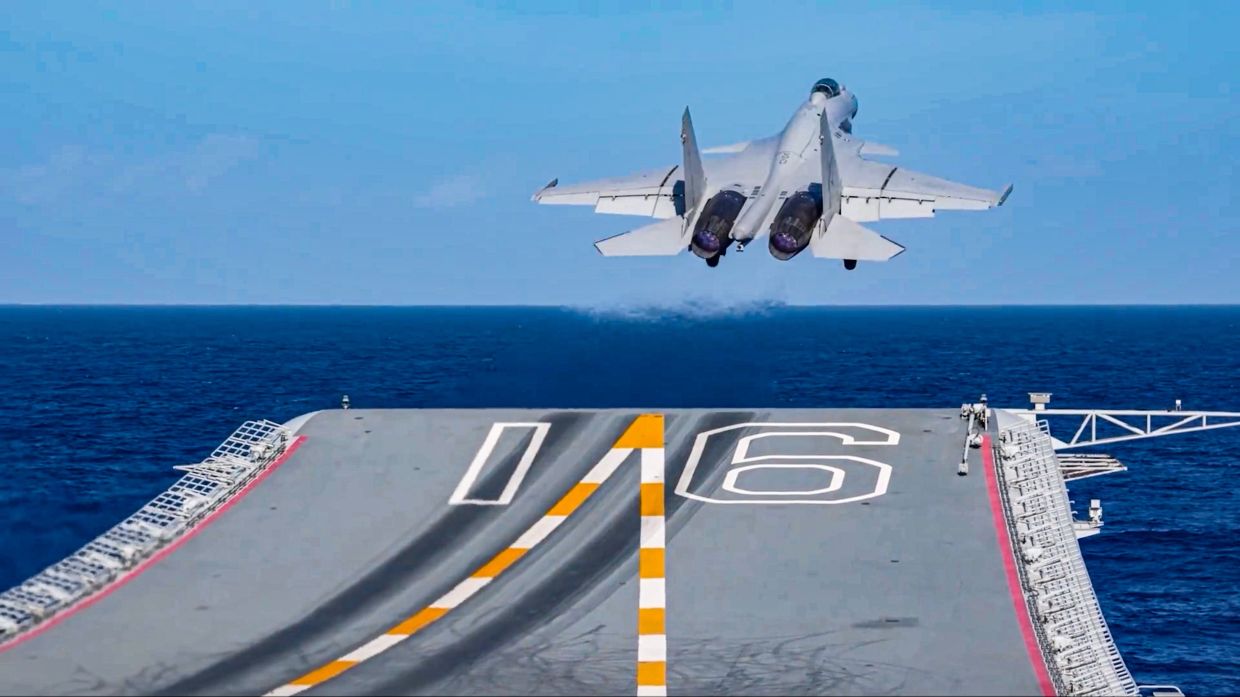
China's expanding carrier fleet represents a visible symbol of Beijing's military modernisation, yet defence strategists increasingly focus on what remains invisible beneath the waves—a potentially crippling weakness in undersea detection that could undermine the strategic value of these high-cost warships. This vulnerability has prompted fresh analysis from Washington's Centre for Strategic and International Studies, which conceptualises how adversaries might exploit gaps in Chinese naval capabilities through coordinated multi-domain attacks designed to impose unacceptable costs on Beijing's carrier operations. The analysis reveals that among several potential vectors for threatening carrier groups—including land-based missile networks, cyber operations, and drone swarms—submarine ambushes represent perhaps the most consequential challenge to Chinese naval planners.
The undersea dimension of naval rivalry assumes particular strategic weight across the Indo-Pacific, where geography naturally constrains force movements. Strategic chokepoints funnel shipping through narrow passages, creating ideal terrain for submarine interdiction. These maritime straits would become even more critical in any Taiwan contingency, forcing Chinese naval formations to traverse waters where advanced attack submarines could exact devastating tolls. American submarine capabilities in the western Pacific remain among the world's most sophisticated, characterised by exceptional stealth that complicates detection. This technological superiority, combined with Chinese acknowledged deficiencies in undersea awareness, creates an asymmetry that undermines Beijing's conventional naval advantages.
Christopher Sharman, director of the China Maritime Studies Institute at the US Naval War College, describes this submarine vulnerability as "significant" albeit not immutable. The gap between Chinese and American capabilities in oceanographic knowledge—understanding how water temperature, salinity, and other physical characteristics affect submarine operations—remains substantial despite recent Chinese investments. Chinese military-affiliated researchers have themselves acknowledged that their nation cannot adequately monitor and control the waters immediately offshore, creating what some characterise as a "wide-open door" for adversaries to manoeuvre undetected. This self-awareness among Chinese strategists underscores genuine concern about the consequences of operating at extended ranges from homeland air defences.
Beijing has responded to these vulnerabilities through sustained investment in multiple domains. The Transparent Ocean programme represents perhaps the most ambitious attempt to close the undersea awareness gap, establishing a network combining satellites, research vessels, underwater sensors, and seabed monitoring systems across strategically vital waters from the South China Sea to the Indian Ocean. This long-term initiative acknowledges that effective naval operations require not merely superior weaponry but superior knowledge of the environment itself. Chinese sources explicitly connect this oceanographic surveillance network to national security imperatives, reflecting the strategic priority assigned to understanding the submarine battlespace.
Simultaneously, China has expanded its anti-submarine warfare capabilities through procurement of maritime patrol aircraft, ocean-surveillance vessels equipped with advanced towed-array sonar, and upgraded helicopter-mounted detection systems. These incremental improvements suggest recognition that protecting carrier groups demands multi-layered defensive architectures rather than reliance on air cover alone. Yet these measures address symptoms rather than fundamental constraints. The comparative technological gap between American and Chinese submarine forces, combined with persistent Chinese deficiencies in oceanographic knowledge, means that even enhanced anti-submarine capabilities may struggle against determined adversaries employing quieter submarines operating in more complex acoustic environments.
The strategic implications extend beyond carrier protection to encompass Beijing's broader regional ambitions. Within the first island chain encircling China's coast, effective undersea operations constitute a critical component of the People's Liberation Army's vision of wartime sea control. Beyond that boundary, into the Indian Ocean and deeper Pacific waters, undersea capability becomes essential for challenging American naval dominance and complicating potential third-party intervention in any conflict over Taiwan. Chinese strategists view underwater warfare as fundamental to achieving their operational objectives across these distinct geographical zones. This fundamental dependence on undersea capabilities that remain comparatively underdeveloped creates a structural constraint on Beijing's ability to project power at extended ranges.
The Taiwan dimension pervades this strategic analysis. Beijing's official policy maintains that Taiwan constitutes an internal matter subject to potential forcible reunification, while the United States remains legally committed to providing Taiwan defensive capabilities despite declining to formally recognise its independence. Any Chinese military action would necessarily operate under conditions of potential American and allied intervention. Japanese participation in any Taiwan conflict would substantially elevate military complexity, as Japanese forces could attack Chinese warships operating near its territory. Under such circumstances, carriers deployed at extended ranges might provide valuable air cover for supporting naval forces, yet strategists warn this deployment scenario remains dangerously vulnerable to the multiple targeting options available to American and allied forces.
Timothy Heath, head of defence research firm Perceptum, articulates the fundamental dilemma confronting Chinese planners. American submarines rank among the quietest operating globally, rendering detection extraordinarily difficult even with improved Chinese capabilities. The combination of American submarine technology, allied Japanese maritime forces, and the inherent vulnerabilities of operating far from coastal air defences creates an environment where Chinese carriers face prohibitive risks. Heath contends that deploying carriers at such extended ranges would constitute poor strategy, suggesting instead that China's land-based intermediate-range ballistic missiles represent superior instruments for threatening distant naval formations. This assessment implies that despite massive investment in carrier development, these vessels may find utility restricted to relatively constrained operational zones closer to Chinese territory.
The analytical consensus suggests that Chinese carrier operations will likely remain concentrated in waters where land-based air defences and shorter-range anti-ship missiles provide layered protection. This geographical constraint fundamentally limits Beijing's ability to project sustained power across the broader Indo-Pacific. The very investments China has made in developing a modern carrier fleet may prove less strategically transformative than conventional analysis suggests, precisely because the submarine and undersea warfare dimensions create vulnerabilities that China's current technological trajectory struggles to overcome. This dynamic reflects a broader pattern in modern warfare where technological sophistication in one domain—surface naval platforms—cannot necessarily compensate for relative inferiority in another equally crucial dimension—undersea operations.
American and allied strategists have drawn specific procurement implications from this analysis, advocating increased investment in torpedoes, undersea drones, and coordinated missile production with partners including Japan and Australia. This proposed emphasis reflects confidence that the submarine dimension represents the most cost-effective means of imposing constraints on Chinese carrier expansion. Rather than matching Beijing's ship construction programmes, allied nations might achieve superior strategic outcomes through targeted investment in the underwater domain. For Southeast Asian observers monitoring the military balance, this dynamic carries direct relevance—regional security increasingly depends on whether technological advantages in undersea warfare can effectively counter the visible expansion of Chinese surface platforms. The contest between carriers and submarines will substantially determine whether the regional balance of power shifts decisively toward Beijing.

