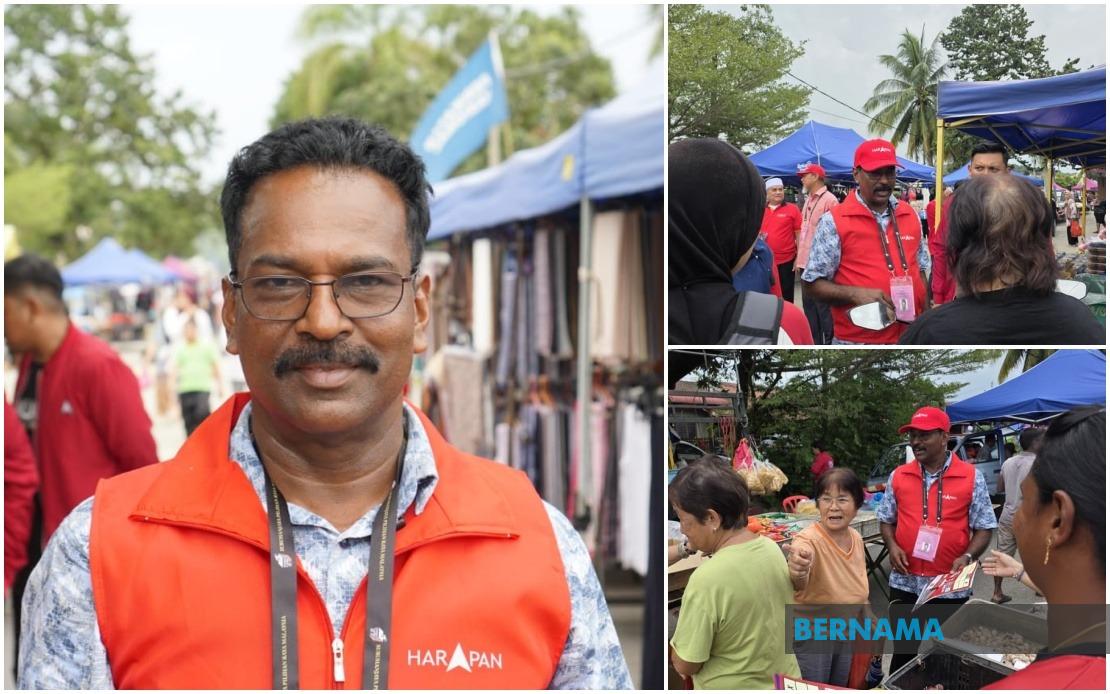
In a three-way contest that will test voter sentiment across Johor's constituencies, Pakatan Harapan candidate C. Subramani is campaigning aggressively in Bukit Kepong with confidence that residents are ready to embrace new representation. The Pagoh native, leveraging extensive ground work and community engagement during the state election campaign, believes the momentum he has generated positions him to break through against entrenched rivals from Barisan Nasional and Perikatan Nasional in a race where incumbent Datuk Dr Sahruddin Jamal holds a modest majority of 710 votes from the 2022 election.
Subramani's campaign strategy pivots on a fundamental message: that the Bukit Kepong community is seeking change, and that he has listened to their grievances across multiple visits to residential areas and Orang Asli settlements. His ground-level intelligence gathering has, according to his account, exposed significant infrastructure gaps and socioeconomic hardships that local residents contend with daily. By positioning himself as someone who has taken time to understand these challenges firsthand, rather than relying on formulaic campaign rhetoric, he is attempting to build a narrative of genuine responsiveness that contrasts with broader perceptions of political indifference to rural constituencies.
Central to his platform is the notion that improved alignment between Johor's state government and Malaysia's federal administration would unlock faster progress on local issues. This messaging carries particular resonance in constituencies where residents feel caught between administrative levels, with problems bouncing between state and federal agencies without resolution. Subramani specifically identifies education matters, irrigation and drainage problems, and challenges involving federal bodies as areas where streamlined coordination could yield tangible results. The implication is that a PH representative would leverage better working relationships with federal ministries to accelerate solutions—a subtle but pointed critique of current governance structures.
Among his concrete policy proposals is reimagining the Bukit Kepong Gallery as a heritage tourism destination capable of generating economic activity. This speaks to a broader challenge facing rural Johor constituencies: economic stagnation and limited employment opportunities for young people. By framing cultural assets as potential economic engines, Subramani is offering a development narrative that goes beyond traditional infrastructure spending and speaks to sustainability and local pride. Such an approach may resonate particularly with younger voters and community leaders seeking to revitalize their constituencies' prospects.
The candidate has also highlighted practical grievances that residents encounter routinely: inadequate street lighting that affects safety, bridges too narrow for modern transport requirements, and a shortage of affordable housing for lower-income households. These are not grand policy statements but specific complaints that voters can immediately relate to and verify. By demonstrating familiarity with such localized problems, Subramani is establishing credibility as someone who has done the homework necessary to represent the constituency effectively, rather than parachuting in with generic promises.
Subramani's previous electoral experience, including his 2022 contest in the Buloh Kasap seat, provides him with campaign infrastructure and voter contact lists that benefit his current effort. However, his shift to Bukit Kepong introduces an element of risk—he is less established in this constituency than in his former political base. This makes his investment in ground visits and community mapping all the more significant; he is essentially rebuilding his political presence in new territory while simultaneously running a state election campaign against organized opposition parties.
The broader context of the 16th Johor state election involves 172 candidates vying for 56 assembly seats, with approximately 2.7 million voters participating in a ballot that will shape the state's political trajectory for the next term. Johor remains one of Malaysia's most strategically important states, both economically and politically, and outcomes in constituencies like Bukit Kepong will have ripple effects across the nation's political balance. A strong PH performance in rural seats such as this one could signal a shift in voter preferences beyond urban centers.
Subramani's confidence in securing an upset, based on what he characterizes as positive feedback from residents, suggests he believes the appetite for change extends beyond core PH support bases. The three-cornered contest also creates tactical complexity: votes that might have been consolidated between PN and BN in a two-way race are now divided, potentially creating openings for the challenger if he can consolidate opposition consolidation. His assertion that he is not worried about facing competing candidates reflects either genuine optimism based on internal polling or a deliberate projection of momentum intended to influence undecided voters.
For Malaysian constituencies more broadly, the Bukit Kepong race encapsulates broader questions about representation, development equity, and the ability of state governments to respond to constituent needs. Johor, as a state with substantial rural areas and diverse communities including Orang Asli populations, often sits at the intersection of development priorities and social equity concerns. Subramani's emphasis on visiting Orang Asli settlements and identifying their specific challenges positions him within a tradition of outreach politics while raising questions about whether such engagement translates into meaningful policy implementation once elected.
The incumbent's slim 710-vote majority indicates that Bukit Kepong is genuinely competitive rather than a safe seat for any party. In Malaysian electoral politics, such thin margins often reflect constituencies where local issues and candidate reputation matter more than party machinery. This context makes Subramani's ground-based campaign approach strategically sound; voters in marginal seats tend to be more persuadable through direct engagement and evidence of local commitment than through mass media messaging.
Looking ahead to polling day, Subramani's campaign will likely be tested by the efficacy of his opponents' counter-narratives and by whether his promises of improved state-federal coordination resonate with voters who have heard similar pledges before. The election will reveal whether his investment in community visits and problem identification has successfully reframed him as a change agent or whether established party machinery and incumbent advantage prove decisive. For observers of Malaysian politics, the result in Bukit Kepong will provide insight into whether rural Johor voters are genuinely receptive to new political arrangements or whether traditional voting patterns maintain their hold.

