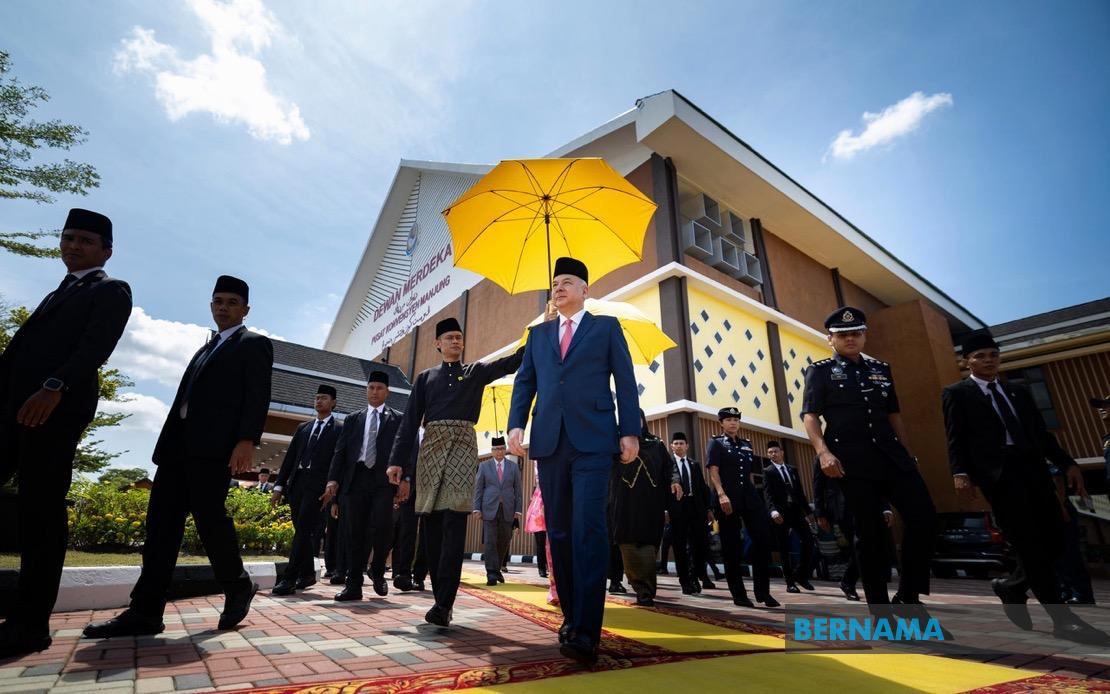
Sultan Nazrin Shah, the Sultan of Perak, has officially opened the newly constructed Merdeka Hall in Lumut, a significant infrastructure project for the Manjung Municipal Council that represents years of planning and a substantial financial commitment from federal and state authorities. The ceremony, which took place on August 4, drew attendance from senior members of the royal household alongside key figures in Malaysia's political leadership, underscoring the importance both the monarchy and government place on the facility's role in Manjung's future development.
The event brought together Tuanku Zara Salim, the Raja Permaisuri of Perak, and Raja Iskandar Dzurkarnain Sultan Idris Shah, the Raja Di Hilir, alongside Perak Menteri Besar Datuk Seri Saarani Mohamad and Higher Education Minister Datuk Seri Dr Zambry Abd Kadir. This convergence of royal and ministerial representation reflected the cross-level political cooperation that has underpinned the hall's realisation, spanning both state governance structures and federal-level budgeting decisions.
The RM12.7 million Merdeka Hall stands as a multi-purpose venue engineered to accommodate 2,500 people, positioning it as a significant gathering space for the Manjung district. Beyond merely hosting official ceremonies, the facility is designed to facilitate conferences, community activities, and various public events that require modern infrastructure. For a coastal district aspiring to greater economic prominence, such a venue becomes essential infrastructure supporting the attraction and hosting of larger events that can draw visitors and business activity.
During his address, Saarani identified three interconnected achievements represented by the hall's opening. The first involves the completion of a development initiative that originated in 2016, demonstrating the multi-year commitment required to translate urban planning aspirations into concrete facilities. Second, the opening coincides with the Manjung Municipal Council's 25th anniversary, a silver jubilee milestone that the council reached following its elevation from district council status in 1980 to municipal council standing in 2001. Third, and perhaps most strategically significant, the hall represents a tangible step toward the district's ambitious objective of achieving Tourism and Maritime City designation by 2030.
The concept of rebranding Manjung as a tourism and maritime hub reflects broader economic diversification strategies being pursued across Malaysia's coastal regions. By 2030, the district aims to position itself as a destination combining heritage, cultural attractions, maritime industries, and tourism infrastructure. The Merdeka Hall directly supports this vision by providing professional-grade facilities capable of hosting international conferences, trade exhibitions, and cultural events that can elevate the district's profile and economic competitiveness within the regional tourism marketplace.
Saarani emphasised that the project's genesis in 2016, when the previous Menteri Besar championed the hall's reconstruction, illustrates the continuity of governance priorities across different administrations. Federal government funding approval eventually materialised to support the project, demonstrating how state-level advocacy can successfully navigate federal budgeting processes. This interplay between state initiative and federal resource allocation represents a model of cooperative federalism where local development aspirations align with national economic priorities.
The completion of the Merdeka Hall project also carries symbolic weight beyond its practical function. As Saarani explained in his remarks, the hall's name itself serves as a commemorative anchor to Malaysia's independence, reminding citizens and visitors alike that the nation's autonomy represents a foundational trust requiring continuous safeguarding. By naming the facility after Merdeka, the Municipal Council embedded historical consciousness into its newest civic structure, connecting infrastructure development to national identity and constitutional values.
In articulating his vision for the hall's future utility, Saarani outlined an aspirational framework emphasising knowledge cultivation, enhanced mutual understanding, consensus-building, and community benefit. This framing positions the Merdeka Hall not merely as a physical structure but as a catalyst for social cohesion and intellectual exchange. For Malaysian communities, such multicultural gathering spaces increasingly carry importance as forums where diverse stakeholders can convene, dialogue, and collectively advance local interests.
The ceremonial opening also recognised the Manjung Municipal Council's quarter-century institutional evolution. Established initially as a district council on January 1, 1980, the municipal body underwent administrative upgrade to full municipal council status on August 1, 2001, reflecting population growth and expanding administrative responsibilities. This 25-year trajectory from municipal elevation mirrors Malaysia's broader pattern of coastal urban development and institutional maturation in response to demographic and economic change.
For the broader Malaysian context, the Manjung project exemplifies how federal-state coordination can mobilise substantial capital investment toward regional development objectives. The RM12.7 million expenditure on civic infrastructure in a district aiming for tourism prominence signals confidence in Manjung's economic potential and reflects strategic thinking about how modern facilities attract both domestic and international visitors and investors. In Perak specifically, where diversifying away from traditional mining and agricultural economies remains an ongoing priority, initiatives positioning coastal districts as tourism destinations represent forward-looking economic policy.
The Lumut location itself carries maritime significance, as the district's position along Perak's coastline naturally predisposes it toward maritime commerce and tourism. A well-appointed civic hall supporting maritime industry conferences, shipping sector forums, and international maritime trade events positions Manjung competitively within Southeast Asian maritime networks. The facility's scale and capacity enable it to host regional or even international maritime sector gatherings that previously might have gravitated toward more established centres.
Looking ahead, the success of the Merdeka Hall in advancing Manjung's tourism and maritime ambitions will depend substantially on effective programming and marketing. Municipal councils must now curate an attractive calendar of events, conferences, and activities sufficiently compelling to draw participants from beyond the district and state. The hall's existence creates necessary infrastructure, but realising the vision of Tourism and Maritime City status by 2030 requires sustained effort in destination marketing, stakeholder engagement, and continued investment in complementary tourism amenities.
The opening ceremony ultimately demonstrates how Malaysian governance structures coordinate across federal, state, and local levels to advance shared development objectives. While significant infrastructure projects require years of conception, planning, and financing, the convergence of royal patronage, ministerial participation, and civic celebration around the Merdeka Hall suggests that Manjung's aspirations enjoy substantive political backing. Whether the facility catalyses the envisioned transformation into a recognised tourism and maritime centre will become apparent as the decade progresses.

