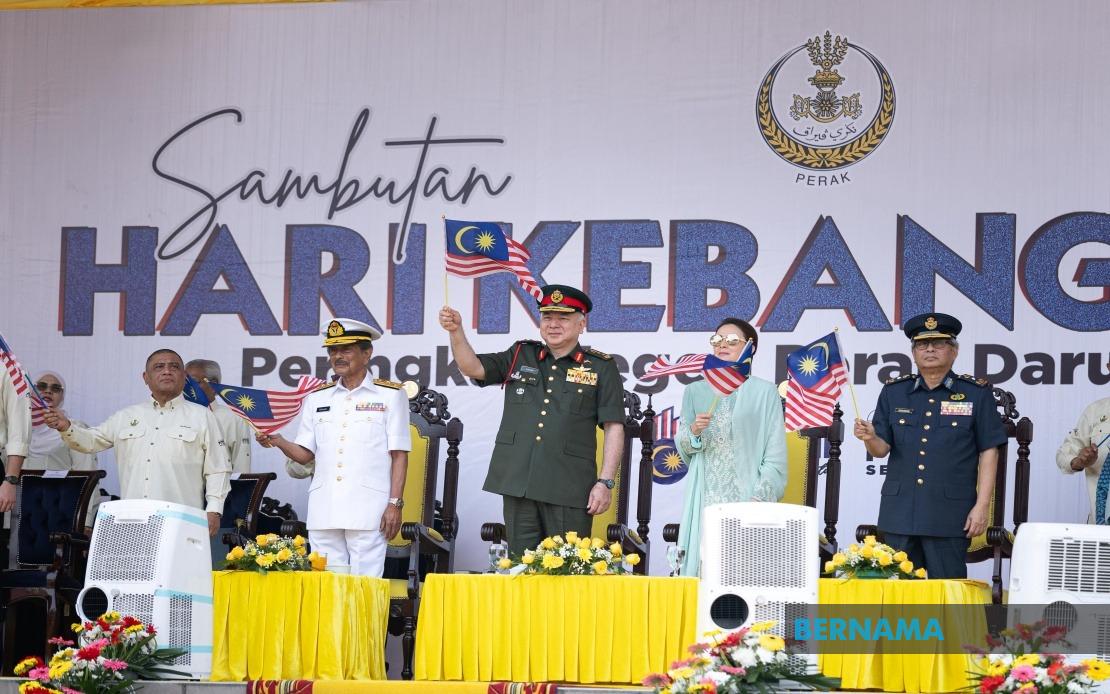
Sultan Nazrin Shah of Perak and Raja Permaisuri Tuanku Zara Salim presided over the Perak National Day 2026 Awards Presentation Ceremony at Dewan Bandaran Ipoh on August 31, marking the culmination of the state's formal Independence Day observances. The occasion brought together senior government figures including Perak Menteri Besar Datuk Seri Saarani Mohamad alongside State Secretary Datuk Ahmad Suaidi Abdul Rahim and members of the State Executive Council. The presence of Raja Muda of Perak Raja Jaafar Raja Muda Musa and Raja DiHilir of Perak Raja Iskandar Dzurkarnain Sultan Idris Shah underscored the ceremonial significance of recognising the nation's defenders.
The centrepiece of the ceremony involved the presentation of awards to eleven individuals whose careers have been defined by extraordinary service to Malaysia's security apparatus. These recipients encompassed six personnel from the Malaysian Armed Forces, two from the Royal Malaysia Police, and three from the Royal Malaysia Navy. Each honouree received RM1,000 in cash alongside an official certificate of appreciation, a tangible acknowledgement of their contribution to safeguarding the nation's territorial integrity and democratic institutions. The deliberate mix of active and retired personnel reflected a comprehensive approach to honouring service across different career stages.
Among the most poignant recognitions was that of Warrant Officer 2 Mohamad Razali Din, whose sacrifice during Operation Naga in Banding exemplified the physical cost of national defence. While conducting operations in the volatile region, Din encountered a concealed landmine that resulted in the permanent loss of his left leg below the knee. His presence at the ceremony symbolised the often-invisible consequences of military deployment, reminding citizens that security does not come without personal cost. Such recognition carries deeper significance in Malaysia, where ongoing security challenges in certain regions require sustained commitment from those willing to risk life and limb.
Warrant Officer 2 Megat Abdullah Megat Othman's commendation for his role during Operation Batu Kawah highlighted the active threat environment that continues to demand vigilance. Othman's successful elimination of three communist terrorists during operations in Sri Aman demonstrated tactical excellence and decisiveness in high-risk situations. The presentation to him of both a commando knife and certificate served to commemorate not merely a successful operation but the broader counter-insurgency efforts that have remained part of Malaysia's security landscape for decades. His recognition underscored the ongoing nature of internal security challenges that, while less prominent in media coverage than external threats, continue to shape the nation's defence posture.
The remaining Malaysian Armed Forces recipients—Staff Sergeant Idris Ismail, Corporal Mokhtar Sulaiman, Lance Corporal Khairul Anuar Abdul Hamid, and Lance Corporal Alias Abd Wahab—represented the backbone of Malaysia's defence infrastructure. These mid-ranking soldiers embody the professional standards that have characterised the Malaysian military over decades of service. Their recognition alongside more senior personnel reinforced an organisational culture valuing consistent excellence across all ranks, an approach that has contributed to the relative stability of civil-military relations in Malaysia compared to regional neighbours.
The Royal Malaysia Police contingent honoured at the ceremony comprised retired Sub-Inspector Omar Jayus and retired Sergeant Major Abdul Malek Nordin. Their inclusion recognised the critical role that law enforcement plays in national security architecture, particularly in maintaining public order and preventing threats that could destabilise communities. The decision to present awards to retired officers acknowledged that the value of their contributions extends beyond active service, recognising institutional memory and the mentorship these individuals provide to younger colleagues navigating evolving security challenges.
From the Royal Malaysia Navy, the ceremony recognised retired First Admiral Mohamad Imran Abd Hamid, retired Commander Mohd Akhbar Mohd Yusof, and retired Warrant Officer 2 Ahmad Safwi Shaari. This naval representation underscored Malaysia's maritime security priorities, particularly relevant given the nation's extensive coastlines, vital shipping lanes, and contemporary challenges ranging from piracy to territorial disputes in the South China Sea. The recognition of these maritime personnel reflected Perak's acknowledgement that national defence encompasses not merely terrestrial and internal threats but also the protection of Malaysia's sea lanes and exclusive economic zones.
Beyond honouring individual service members, the ceremony featured competitions celebrating community participation in National Day observances. The inclusion of parade and beautification competition winners demonstrated the government's effort to position patriotism as inclusive of civilian contributions to national pride and social cohesion. This approach broadened the definition of national service beyond military and police roles, encouraging all Malaysians to participate in nation-building through civic engagement and cultural expression.
Menteri Besar Saarani's address to the assembled crowd tackled the contemporary challenges facing Malaysia's multicultural society with particular relevance to Perak, a state where diverse communities coexist. Saarani stressed that Malaysia's strength derives not from homogeneity but from the deliberate choice of diverse populations to construct a shared national project. This framing proved especially significant given global trends toward polarisation and identity-based politics. He articulated the philosophical foundation of Malaysian pluralism—shared symbols including the Jalur Gemilang flag, a common constitutional framework, Malay as the unifying national language, and the stabilising institution of the Malay Rulers.
Saarani's warning about erosion of national unity carried particular weight in contemporary Malaysia, where social media and political discourse increasingly emphasise difference over commonality. His observation that unity becomes threatened when citizens categorise one another primarily through demographic characteristics rather than recognising individual humanity addressed the psychological mechanisms through which cohesion fractures. By noting that the moment communities cease perceiving neighbours and friends as such—instead filtering perception through racial, religious, or ideological lenses—social distance widens, he identified a specific psychological and social dynamic that requires active countermeasure.
The Menteri Besar's invocation of gradual erosion of shared identity represented sophisticated political communication. Rather than presenting unity as either fully intact or catastrophically broken, Saarani described a process of slow deterioration where the connecting threads of nation grow progressively harder to perceive. This gradualism matched contemporary reality in Malaysia better than apocalyptic framings, resonating with citizens' experiences of incremental social division. His emphasis suggested that reverse this trend requires conscious, sustained effort from both leadership and ordinary Malaysians.
For Malaysian and Southeast Asian observers, the ceremony demonstrated how Perak's leadership approached the balance between honouring security imperatives and strengthening social bonds. The recognition of military and police heroes legitimised state authority rooted in security provision while simultaneously articulating a vision of nationhood transcending such instrumental functions. In a region where civil-military relations and national cohesion remain contested political issues, Perak's approach offered one model for integrating security celebrations with inclusive national narratives. The event ultimately conveyed that defending Malaysia required both the specialised sacrifice of trained personnel and the daily choices of ordinary citizens to maintain unity across lines of difference.

