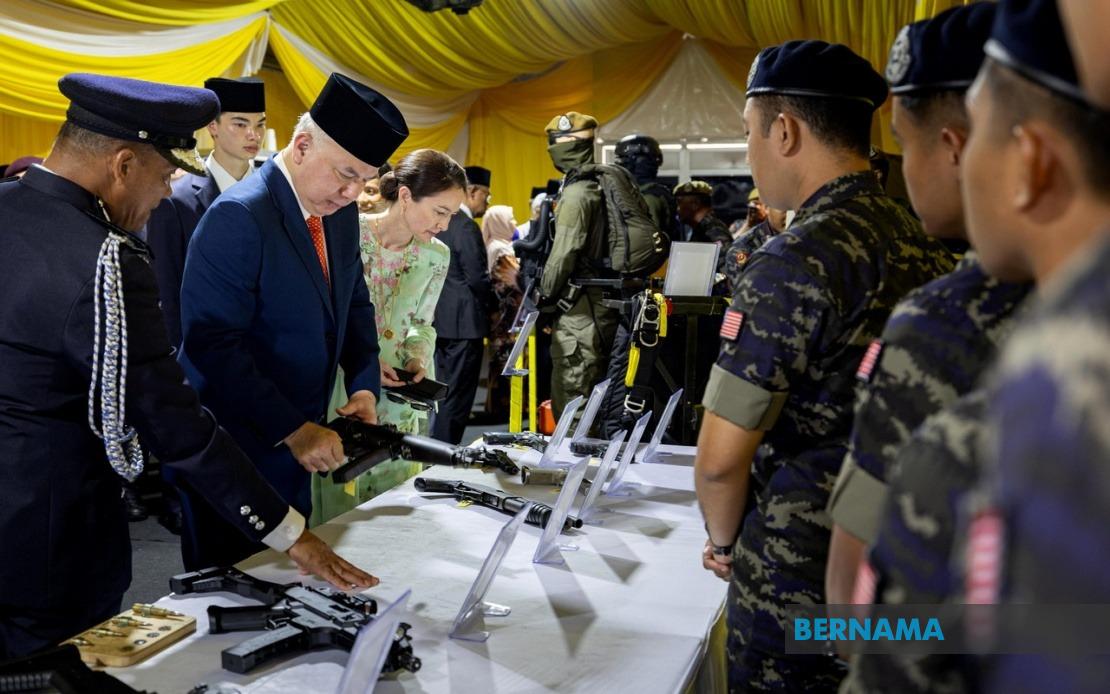
The Sultan of Perak, Sultan Nazrin Shah, has officially opened the Sultan Nazrin Shah 69 Commando Camp in Ulu Kinta, marking a significant investment in Malaysia's internal security infrastructure. The ceremony drew senior government figures and members of the royal household, underscoring the importance the state and federal government attach to strengthening the nation's security apparatus. The opening represents the culmination of a multi-year infrastructure project aimed at modernising one of Malaysia's most operationally demanding paramilitary units.
The event brought together the Raja Permaisuri of Perak, Tuanku Zara Salim, the Raja Muda of Perak, Raja Jaafar Raja Muda Musa, and the Raja DiHilir of Perak, Raja Iskandar Dzurkarnain Sultan Idris Shah, alongside key government ministers and police leadership. Menteri Besar Datuk Seri Saarani Mohamad, Home Minister Datuk Seri Saifuddin Nasution Ismail, and Inspector-General of Police Tan Sri Mohd Khalid Ismail were present, reflecting the cross-governmental coordination required for such major security infrastructure developments.
Home Minister Saifuddin Nasution Ismail framed the camp's opening within the government's broader security agenda, characterising it as evidence of the MADANI administration's determination to equip security forces with modern capabilities needed to counter contemporary threats. He emphasised that Malaysia's ability to maintain stability depends on sustained investment in personnel, equipment, and training environments that allow security agencies to remain operationally responsive. This positioning reflects a shift in how the government communicates about security spending, linking domestic infrastructure development directly to strategic outcomes and institutional resilience.
Malaysia's standing within the Global Peace Index provides quantitative context for this investment narrative. The nation's ranking as the 12th most peaceful out of 163 countries, according to the latest Global Peace Index assessment, is presented as validation of existing security policies. However, this metric also implicitly suggests that further investment is necessary to maintain and strengthen this position as regional dynamics shift and security threats evolve. For Malaysian policymakers, maintaining this ranking serves as both achievement to celebrate and baseline against which future performance will be judged.
The 69 Commando unit carries significant operational history spanning more than five decades of service. Established in 1969, the unit has been deployed across a spectrum of security operations that define modern Malaysia's threat environment. Early operations targeting remnant communist insurgencies gave way to counterterrorism missions, including the controversial Al-Maunah incident in 2000, the Lahad Datu operation in Sabah in 2013 mounted under Operation Daulat, and more recently, the special deployment related to the MH17 aircraft tragedy in 2014. This operational lineage demonstrates both the unit's adaptability to changing security landscapes and the institutional memory embedded within the commando structure.
Beyond conventional military and counterterrorism operations, the unit has undertaken hostage rescue missions and responded to high-risk security incidents requiring personnel with specialised training and tactical expertise. The breadth of the unit's operational portfolio reflects the multifaceted security challenges facing Malaysia, where transnational terrorism, separatist movements, organised crime, and regional instability all compete for attention and resources. Each operation has shaped the unit's doctrine and contributed to a professional culture centred on operational excellence under pressure.
The physical infrastructure investment undergirding the camp opening deserves careful examination. Constructed at a cost exceeding RM206 million on a 338-hectare site in Ulu Kinta, the facility was transferred to the Royal Malaysia Police in 2024 as a modern, integrated operations, training, and administrative complex. The scale of this investment reflects confidence that the 69 Commando unit will remain essential to Malaysia's security architecture for decades to come. The site's size permits realistic training scenarios, operational dispersal, and the accommodation of personnel rotation and continuous professional development programmes.
Home Minister Saifuddin Nasution characterised the camp not merely as physical infrastructure but as a strategic national asset positioning Malaysia to strengthen security force capabilities for generations ahead. This framing emphasises that such investments represent more than temporary expenditures; they constitute foundational commitments to institutional capacity building. For a nation operating within a complex regional security environment, where maritime challenges, transnational crime, and counterterrorism demands remain constant, investing in specialised elite units serves both immediate operational needs and longer-term strategic positioning.
The government's emphasis on honouring the sacrifices of officers and personnel who have served in the 69 Commando over more than five decades carries particular significance in the Malaysian context. Commando operations, whether combating communist insurgencies or confronting armed extremists, have historically involved casualty risk and demanding deployments to remote or hostile environments. By naming the facility after the reigning Sultan of Perak and securing royal patronage, the government signals that such service receives recognition extending beyond standard military honours. This gesture may also serve to boost recruitment and morale within a unit that depends on volunteers willing to undertake hazardous duties.
The camp is framed as a future training hub designed to prepare successive generations of commando personnel to maintain the unit's operational standards and strategic significance. As Malaysia confronts security challenges that differ from those of previous decades—including transnational terrorist networks operating across borders, sophisticated organised crime syndicates, and cyber-enabled threats—the training environment provided by the new facility must remain adaptive and forward-looking. Investment in infrastructure, facilities, and training capacity represents the government's wager that the 69 Commando will remain a vital institutional component addressing these evolving challenges.
For Southeast Asian observers and the broader Malaysian public, the opening of the Sultan Nazrin Shah Camp offers insight into how the government prioritises security spending during a period of budgetary constraints and competing demands from health, education, and economic development sectors. The decision to invest more than RM206 million in a single specialised unit suggests assessment that the threats addressed by the 69 Commando—terrorism, separatism, and other high-consequence security incidents—warrant capital expenditure on this scale. The location in Perak, a state situated near the Thai border and with historical significance to both counterinsurgency and contemporary security operations, underscores the strategic thinking behind facility placement.
Home Minister Saifuddin Nasution's confidence that the Sultan Nazrin Shah Camp will serve as an enduring symbol of excellence, courage, and sacrifice reflects both institutional aspirations and recognition that maintaining public support for security spending requires regular affirmation of its necessity and effectiveness. In a region where security challenges remain persistent, visible investment in elite units tasked with high-risk operations serves multiple constituencies—the personnel themselves, interested publics evaluating government performance, and regional partners assessing Malaysia's capacity to contribute to collective security arrangements. The opening ceremony itself, attended by senior political and military figures, serves as public affirmation that such investments command top-level commitment and are expected to yield strategic returns.

