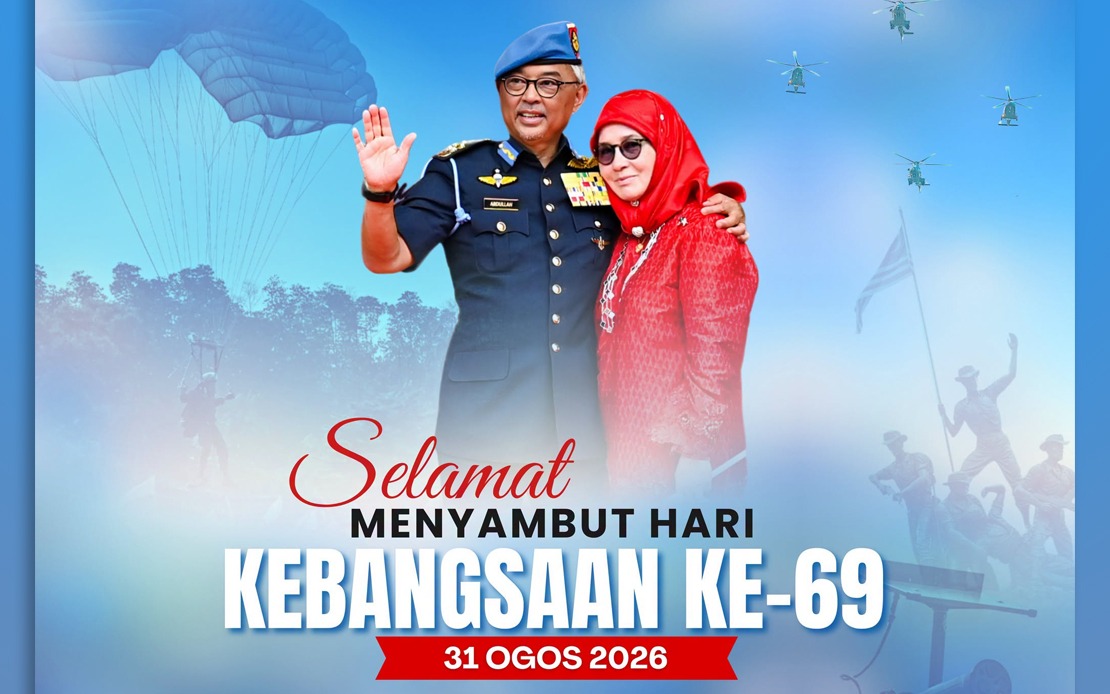
The Sultan of Pahang Al-Sultan Abdullah Ri'ayatuddin Al-Mustafa Billah Shah and Tengku Ampuan Pahang Tunku Azizah Aminah Maimunah Iskandariah have extended their well-wishes to the people of Pahang on the nation's 69th independence anniversary, emphasising themes of gratitude, unity and shared responsibility in maintaining the country's hard-won freedoms.
In their official statement released via the Pahang Sultanate's social media channels, the royal couple expressed deep appreciation for the peace, prosperity and social harmony that Malaysians have enjoyed throughout nearly seven decades of self-governance. Their message arrives amid a broader period of national reflection, as citizens across the federation mark another year of sovereignty with various commemorative events and celebrations.
Central to the Sultan and Tengku Ampuan's message is the notion that Malaysia's independence and territorial sovereignty represent a profound collective responsibility that must be actively safeguarded by all sectors of society. Rather than treating national independence as a historical achievement to be passively remembered, the royal couple framed it as an ongoing obligation requiring vigilance, commitment and mutual cooperation. This framing underscores an important principle in Malaysian governance: that the foundations established at independence—particularly the Federal Constitution and the social contract underpinning the federation—demand continuous recommitment from each generation.
The royals also stressed the indivisibility of unity, mutual respect and tolerance as the bedrock upon which national cohesion and political stability ultimately rest. In a diverse, multi-ethnic and multi-religious nation such as Malaysia, these three elements remain perpetually relevant to contemporary discourse. The emphasis placed by the Sultan and Tengku Ampuan on these pillars reflects their recognition of the persistent challenge of maintaining harmonious inter-communal relations amid competing interests and perspectives across different demographic groups.
A particularly significant aspect of their message concerned the Rukun Negara—Malaysia's foundational national principles established at independence. The royal couple called on all Pahang residents, and by extension Malaysians more broadly, to ensure these principles are not merely recited in classrooms or at formal ceremonies, but actively embedded in daily conduct, workplace interactions, family life and community engagement. The five pillars of the Rukun Negara—belief in God, loyalty to King and country, upholding the constitution, rule of law, and good behaviour and morality—arguably face fresh scrutiny in contemporary Malaysia, where political polarisation, economic pressures and social media dynamics have occasionally challenged their application.
The Sultan and Tengku Ampuan also directed their attention toward Malaysia's youth, expressing hope that younger generations would develop a deeper appreciation for the historical struggles that preceded 1957. This intergenerational dimension is particularly noteworthy, as it acknowledges a common concern among Malaysian elders regarding youth awareness of pre-independence history. By encouraging young people to engage meaningfully with national heritage, the royal message suggests that historical literacy serves as a foundation for protecting cultural identity and sustaining social cohesion. The preservation of heritage and culture is increasingly viewed by policymakers and community leaders as essential to counterbalancing the homogenising effects of globalisation and rapid technological change.
For readers in Malaysia and across Southeast Asia, the Sultan's message carries implications beyond ceremonial significance. In a region where constitutional monarchies exist in multiple forms—Thailand, Cambodia and Brunei among others—the Malaysian sultanate's emphasis on constitutionalism, rule of law and civic participation offers a particular model of institutional stability. Pahang, as one of Malaysia's largest states and a repository of significant natural resources, natural heritage and agricultural activity, has particular stakes in national continuity and prosperity. The Sultan's appeal for sustained patriotism and adherence to constitutional principles may be read as an implicit affirmation that Pahang's future advancement depends upon strengthening these institutional and civic foundations rather than pursuing narrower parochial interests.
The timing of such statements during the National Day period also warrants consideration. As Malaysia navigates contemporary challenges including economic restructuring, efforts to enhance institutional transparency, and demographic shifts, the royal reaffirmation of enduring national values serves a stabilising symbolic function. National Day itself, celebrated annually on 31 August, represents one of the few occasions when competing political factions, diverse ethnic communities and citizens across the socioeconomic spectrum ostensibly unite around shared national identity. Royal statements during this period help reinforce the notion that such unity, while sometimes tested, remains achievable and desirable.
The Sultan and Tengku Ampuan concluded their message with prayers for Pahang's continued protection and wellbeing under divine blessing. This invocation of spiritual grounding—characteristic of official statements in Malaysia where Islam holds constitutional pre-eminence and where the monarchy traditionally embodies both temporal and spiritual authority—reflects the enduring role of religious sentiment in Malaysian public discourse. For many citizens, particularly in a state like Pahang with substantial rural and traditional populations, such blessings carry genuine cultural resonance and affirm continuities between contemporary governance and established communal values.
Momentarily, as Malaysia continues implementing its various national development plans and pursuing positioning as a regional economic and cultural hub, the restatement of foundational principles by senior state leadership serves to anchor these ambitious contemporary objectives to the constitutional and social frameworks established at independence. The Sultan's message, delivered through modern social media channels yet couched in traditional values, exemplifies how Malaysia's institutions attempt to bridge historical continuity with contemporary relevance—a balancing act that will likely remain central to Malaysian governance and national identity formation in the years ahead.

