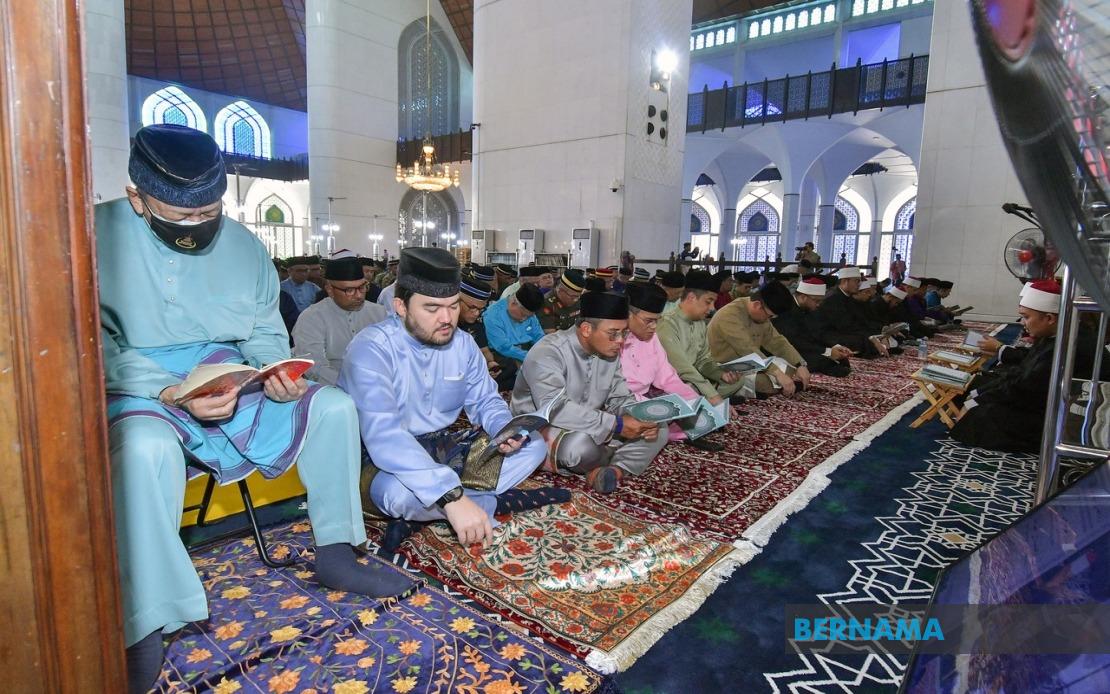
Sultan Sharafuddin Idris Shah, the reigning Sultan of Selangor, participated in a meaningful spiritual gathering on Thursday ahead of the state's imminent National Day festivities. The event, centred on the recitation of Surah Yassin at Masjid Sultan Salahuddin Abdul Aziz Shah in Shah Alam, underscored the traditional role of the Malay royal institution in preserving Islamic observances across Malaysia's most economically dynamic state. The occasion reflected the deeper connection between state leadership and religious devotion that continues to define public life in Selangor, home to nearly six million residents and the seat of Malaysia's federal administration.
Joining the Sultan in this spiritual exercise was Tengku Amir Shah Sultan Sharafuddin Idris Shah, the Raja Muda of Selangor, signifying the multi-generational commitment of the state's royal household to religious engagement. Upon arrival at the mosque, the Sultan received a formal welcome from Menteri Besar Datuk Seri Amirudin Shari, alongside Dr Mohammad Fahmi Ngah, who chairs the State Islamic Affairs and Innovation Culture Committee. The presence of senior Islamic administrative figures, including Datuk Mohd Shahzihan Ahmad from the Selangor Islamic Religious Department (JAIS) and Datuk Salehuddin Saidin, chairman of the Selangor Islamic Religious Council (MAIS), underscored the coordinated nature of the gathering.
The religious observance attracted approximately 1,000 participants, reflecting substantial public interest in the pre-National Day commemoration. Notably, the congregation included members of security forces deployed across Selangor, illustrating how such religious occasions serve to unite personnel from disparate branches of the armed and civilian protective services. This integration of uniformed personnel into civilian religious spaces demonstrates the way Malaysia's security establishments participate in national and religious traditions, strengthening bonds between military communities and civilian society ahead of significant patriotic occasions.
Following the Surah Yassin recitation, Sultan Sharafuddin led the Friday congregational prayer, a central pillar of Islamic weekly observance. The sermon, delivered by Muhammad Farhan Wijaya, the mosque's Grand Imam, carried the title "Merdeka Daripada Belenggu Kerakusan"—Independence from the Shackles of Greed. This thematic choice proves particularly resonant given contemporary discussions surrounding economic inequality and ethical governance in Malaysia. By framing national independence through the lens of spiritual freedom from material excess, the sermon connected Malaysia's historical independence struggle with timeless Islamic teachings about temperance and social justice, offering a counterpoint to materialistic contemporary pressures.
The gathering serves as a prelude to Selangor's state-level National Day celebrations, scheduled to commence at 8 pm on Sunday at Kajang Stadium. The event operates under the unified theme of "Malaysia MADANI: Kesejahteraan Dinikmati," aligning Selangor's observances with the national narrative of inclusive prosperity and shared wellbeing articulated by the federal government. This thematic coherence between religious observance and patriotic celebration illustrates Malaysia's characteristic approach to state ceremonies, wherein Islamic principles and national identity integrate seamlessly within institutional frameworks.
Selangor's positioning as the commercial and administrative nucleus of Malaysia adds particular significance to royal religious observances within the state. As the location of the federal capital Kuala Lumpur and surrounding federal territories, Selangor exerts outsized influence on national narratives and governance. The Sultan's public participation in spiritual gatherings therefore carries implications beyond state boundaries, signalling to the broader Malaysian public the compatibility between modernisation, economic dynamism, and religious observance—a message particularly important in a state experiencing rapid urbanisation and demographic change.
The mosque itself, Masjid Sultan Salahuddin Abdul Aziz Shah, holds iconic status within Malaysian Islamic architecture and religious life. Named after a former Selangor sultan, the institution represents continuity within the state's Islamic heritage whilst accommodating contemporary worshipping communities. Its capacity to host events of this scale, drawing the reigning Sultan and substantial congregations, demonstrates Malaysia's investment in modern Islamic infrastructure capable of serving large populations across diverse contexts.
Royal participation in religious ceremonies reflects constitutional arrangements specific to Malaysia's system of constitutional monarchy. Unlike purely secular monarchies, Malaysian sultans bear formal responsibilities for Islam within their respective states, a constitutional obligation that manifests through public religious engagement. Such participation therefore transcends ceremonial tradition, embodying legal and constitutional principles embedded within Malaysia's federal structure. For Selangor specifically, where demographic complexity and economic diversity characterise the population, sultanic religious leadership provides institutional reassurance regarding the state's commitment to Islamic values.
The convergence of religious observance and National Day preparation illustrates broader patterns within Malaysian public life, wherein patriotic celebrations incorporate spiritual dimensions. Rather than relegating religious expression to private spheres, Malaysian National Day observances frequently embed Islamic practices within national ceremonies, reflecting the constitutional status of Islam as the federation's official religion. This integration proves particularly pronounced in Selangor, where secular commercial interests coexist with explicit Islamic institutional frameworks.
Looking forward to Sunday's Kajang Stadium celebration, the Sultan's participation in this preparatory spiritual gathering establishes a continuity between religious devotion and patriotic expression. The "Malaysia MADANI" theme, emphasising prosperity and wellbeing, finds spiritual grounding in messages about freedom from greed and ethical living articulated through Friday sermons. This layered approach to national commemoration—combining public celebration with preceding spiritual preparation—reflects Malaysian society's resistance to complete secularisation whilst accommodating pluralistic governance and economic systems.
The event's inclusion of security personnel suggests deliberate efforts to strengthen institutional cohesion ahead of National Day, utilising religious occasions as occasions for cross-institutional community building. This practice, whilst religiously motivated, serves practical governance objectives by fostering esprit de corps among protective forces and civic personnel. Selangor's security apparatus, tasked with safeguarding the nation's economic heartland and federal administration, thereby participates in spiritual renewal preceding major patriotic occasions.

