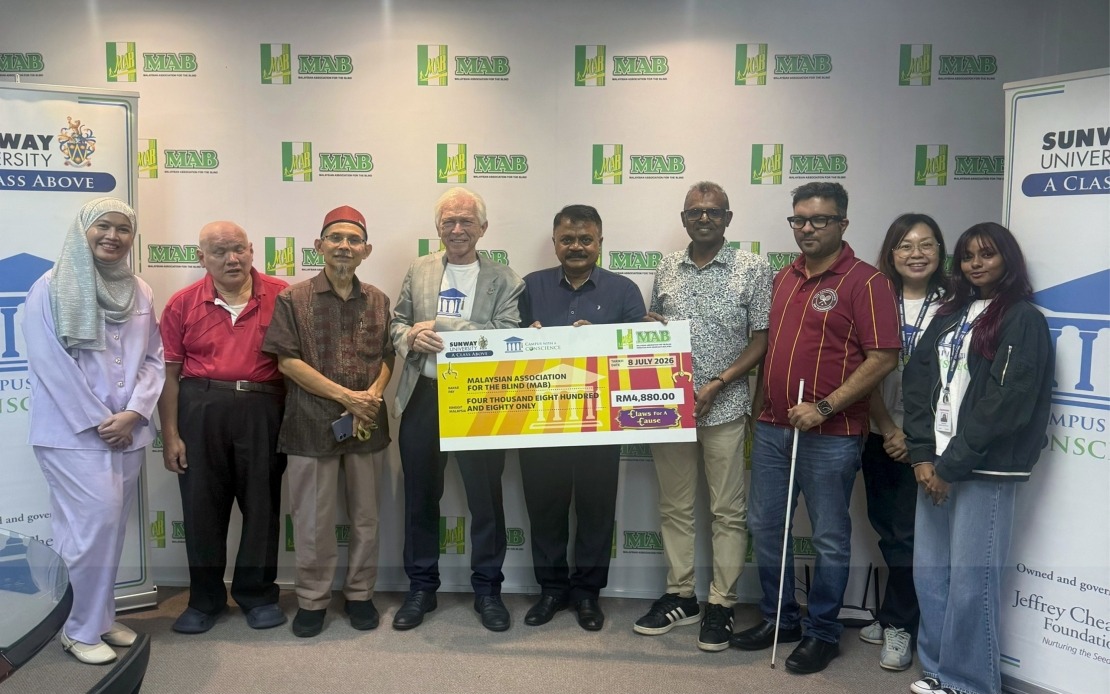
Sunway University has successfully mobilised its campus community to generate RM4,880 in donations for the Malaysian Association for the Blind through an imaginative fundraising campaign that transformed a simple arcade game into a vehicle for charitable giving. The "Claws For A Cause" initiative, executed in partnership with entertainment company Space Panda, operated throughout a designated week and saw widespread participation from both students and staff members seeking to support an organisation dedicated to empowering individuals with visual impairments across Malaysia.
The campaign was structured as part of Sunway University's broader Campus With A Conscience programme, which positions community engagement and social responsibility at the heart of institutional identity. By converting the interactive claw machine experience into a fundraising mechanism, organisers succeeded in making charitable contribution accessible and enjoyable rather than transactional, thereby lowering psychological barriers to participation and creating an atmosphere where giving felt integrated with campus social life. This approach reflects contemporary trends in nonprofit fundraising that recognise the importance of emotional connection and participatory engagement in driving sustained charitable support.
Professor Sibrandes Poppema, the university's President and Vice-Chancellor, framed the initiative within Sunway's institutional philosophy, emphasising that the campaign embodied a commitment transcending the traditional academic mission. According to Poppema's statement, the university consciously positions itself as a mission-driven institution where education, research, and innovation converge with meaningful community engagement to generate tangible social benefit. The president's public endorsement underscores how the initiative was conceived not as peripheral corporate social responsibility activity but rather as foundational to the university's identity and value proposition.
The partnership between Sunway University and Space Panda demonstrates an emerging model of collaboration between educational institutions and private entertainment companies in channelling commercial offerings toward social good. Marcus, Director of Space Panda, indicated the company's philosophical alignment with the fundraising objective, noting that the partnership reflected broader corporate recognition that even modest individual contributions, when aggregated through collective participation, generate meaningful resources for vulnerable populations. This sentiment encapsulates a growing corporate consciousness regarding social responsibility across Malaysia's private sector.
The Malaysian Association for the Blind, as the designated beneficiary, represents one of Malaysia's foremost organisations supporting individuals experiencing visual impairment. The organisation operates across multiple dimensions including advocacy, rehabilitation services, employment support, and community education, making it an institution addressing both immediate welfare needs and systemic barriers faced by persons with disabilities. The RM4,880 contribution, while specific in amount, adds incrementally to MAB's resource base and signals institutional endorsement from a major educational entity.
From a Malaysian perspective, this fundraising success carries broader implications for how tertiary institutions are positioning themselves within communities during a period when universities face increasing scrutiny regarding social relevance and civic contribution. Sunway University's explicit connection of fundraising to academic mission and its public articulation of social responsibility suggest how institutions are repositioning their narrative to stakeholders, emphasising that educational excellence and community benefit are complementary rather than competing institutional objectives.
The campaign's structure also reflects sophisticated understanding of gamification principles in nonprofit fundraising. By converting game participation into donation mechanisms, organisers removed moral weight from the transaction while maintaining clear charitable purpose, thereby creating psychological conditions where giving becomes intuitively appealing. This methodological approach has demonstrated efficacy in Southeast Asian fundraising contexts where traditional solicitation methods sometimes encounter cultural resistance or donor fatigue.
The week-long duration of the initiative balanced campaign intensity with sustainability, allowing organic word-of-mouth promotion across campus while maintaining operational feasibility. This timeline reflects practical experience in event management showing that campaigns exceeding two weeks often experience declining participation momentum, whilst shorter initiatives may struggle achieving critical mass of awareness and engagement. The selected timeframe appears calibrated for optimal participation harvesting.
Partnership models between academia and commercial enterprise in social fundraising contexts remain relatively underdeveloped across Southeast Asia compared to Western markets. Sunway University's collaboration with Space Panda therefore establishes precedent within Malaysian higher education, suggesting potential replicability across other institutions seeking to leverage corporate partnerships for charitable objectives. Such models potentially create mutual benefit where corporate entities gain community goodwill and brand association with social causes whilst nonprofits access new revenue channels.
The initiative also intersects with broader Malaysian policy emphasis on inclusive development and disability rights. By directing resources toward the Malaysian Association for the Blind, Sunway University aligned institutional charitable activity with national development priorities articulated through disability rights advocacy and social protection frameworks. This alignment amplifies the initiative's significance beyond fundraising mechanics to positioning the university within Malaysia's social development ecosystem.
Looking forward, the documented success of "Claws For A Cause" positions Sunway University to develop iterable fundraising campaigns based on proven engagement mechanics and partnership models. Should the university institutionalise similar initiatives across multiple causes and timeframes, campus fundraising could evolve from episodic activity into sustained revenue mechanism supporting diverse charitable organisations. This trajectory would consolidate the university's positioning as institutionally committed to community benefit rather than engaging in occasional philanthropic gestures.

