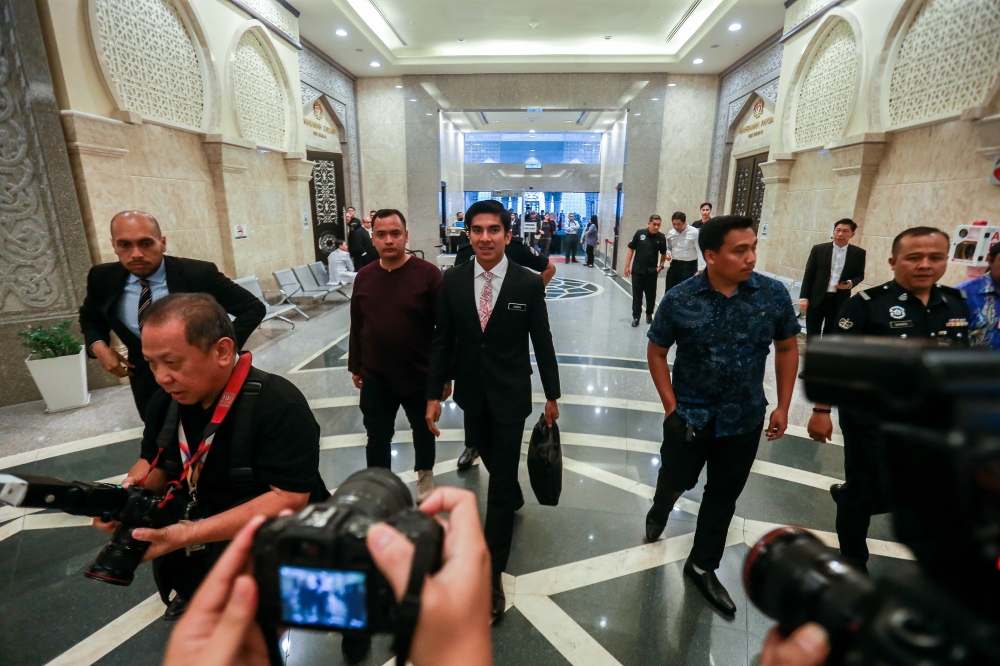
Muar Member of Parliament Syed Saddiq Syed Abdul Rahman arrived at the Palace of Justice in Putrajaya early on Thursday morning as supporters and well-wishers gathered outside to show solidarity during what may prove to be a defining moment in his political career. The young legislator, who once served as Youth and Sports Minister under the Mahathir administration, faced what observers described as a high-stakes hearing that could determine whether he would clear his name or face significant legal consequences.
The ex-minister's presence at the federal court, accompanied by his fiancée and family members, underscored the personal stakes at play. Syed Saddiq's legal battle centres on allegations related to the mishandling of party funds, charges that have dogged his reputation since his detention in 2022. His supporters have maintained his innocence throughout the legal proceedings, and their early arrival at the Palace of Justice demonstrated the depth of public backing he continues to enjoy despite the controversy.
The case against the Muar MP carries broader implications for Malaysian politics. Syed Saddiq represents a younger generation of lawmakers who rose rapidly through the political ranks, and his trajectory—from ministerial office to facing court proceedings—has drawn intense scrutiny from both supporters and critics. The outcome of this Federal Court ruling will likely influence perceptions of accountability within political circles and send a signal about how the judiciary handles cases involving sitting parliamentarians.
Background to the charges reveals a complex situation rooted in the management of funds associated with his former political affiliation. The allegations emerged following a change in Malaysia's political landscape, when several prominent figures faced renewed scrutiny for their financial dealings. Syed Saddiq's case became emblematic of broader concerns about financial transparency in political party operations, an issue that resonates throughout Southeast Asia where fund management in political structures often lacks clear oversight mechanisms.
The presence of his fiancée and extended family at the courthouse reflected the personal toll such proceedings exact on individuals and their loved ones. Legal battles of this magnitude consume considerable time, resources, and emotional energy, particularly for those in the public eye whose every move is subject to media attention. The family's visible support also carried symbolic weight, emphasising that those closest to him maintained confidence in his position.
Observers noted that the gathering of supporters outside the Palace of Justice demonstrated Syed Saddiq's continued ability to mobilise grassroots backing. Despite the legal cloud hanging over him, he has retained a following that spans beyond his Muar constituency, suggesting that sections of the electorate distinguish between allegations and conviction. This dynamic mirrors patterns seen elsewhere in Malaysian politics, where public opinion often remains divided on politicians facing accusations until legal proceedings reach conclusion.
The timing of the ruling carried additional weight given Malaysia's evolving political landscape. The country has experienced multiple shifts in government coalitions and parliamentary alignments in recent years, creating an environment where individual politicians' legal fortunes can ripple through broader political calculations. A Federal Court decision in Syed Saddiq's case could affect coalition stability, party dynamics, and the confidence voters place in parliamentary representation from Muar.
Legal analysts highlighted that Federal Court decisions on money laundering charges typically involve careful examination of evidence, the strength of prosecution arguments, and the adequacy of the defence case. Such rulings often establish precedents that influence how similar cases proceed through Malaysia's judicial system. The meticulous nature of federal court proceedings means that the judges would weigh complex financial documentation and testimonial evidence before reaching their determination.
The implications of this case extend beyond Syed Saddiq's individual circumstances. Malaysia has increasingly emphasised commitment to combating financial crimes and money laundering, with various regulatory bodies tasked with investigating suspicious transactions and fund movements. The handling of cases like Syed Saddiq's reflects how seriously the judicial system treats such allegations and whether it applies consistent standards across different defendant categories, including those with political standing.
For observers across Southeast Asia, the case underscores ongoing challenges that regional democracies face in balancing accountability for political figures with concerns about selective prosecution. Thailand, the Philippines, and Indonesia have all grappled with similar tensions between pursuing financial crimes involving politicians and ensuring that the justice system operates free from political manipulation. Malaysia's approach to the Syed Saddiq matter offers insights into how one major regional economy navigates these competing pressures.
The young politician's demeanour throughout the legal proceedings has drawn comment from political analysts. Rather than retreating from public life, Syed Saddiq has maintained his parliamentary duties and continued engaging with constituents, a posture that some view as demonstrating confidence in his exoneration while others interpret differently. The Federal Court ruling would provide clarity on whether his optimism rests on substantive legal grounds or represents political theatre.
As Malaysia's political parties prepare for eventual general elections, the resolution of cases involving current parliamentarians like Syed Saddiq takes on additional importance. Electoral calculations often factor in the integrity and legal standing of candidates, making court decisions consequential for campaign strategies. The Muar seat itself represents competitive political territory, and the outcome of this ruling could influence how both Syed Saddiq's party and opposition groups approach representation of the constituency.

