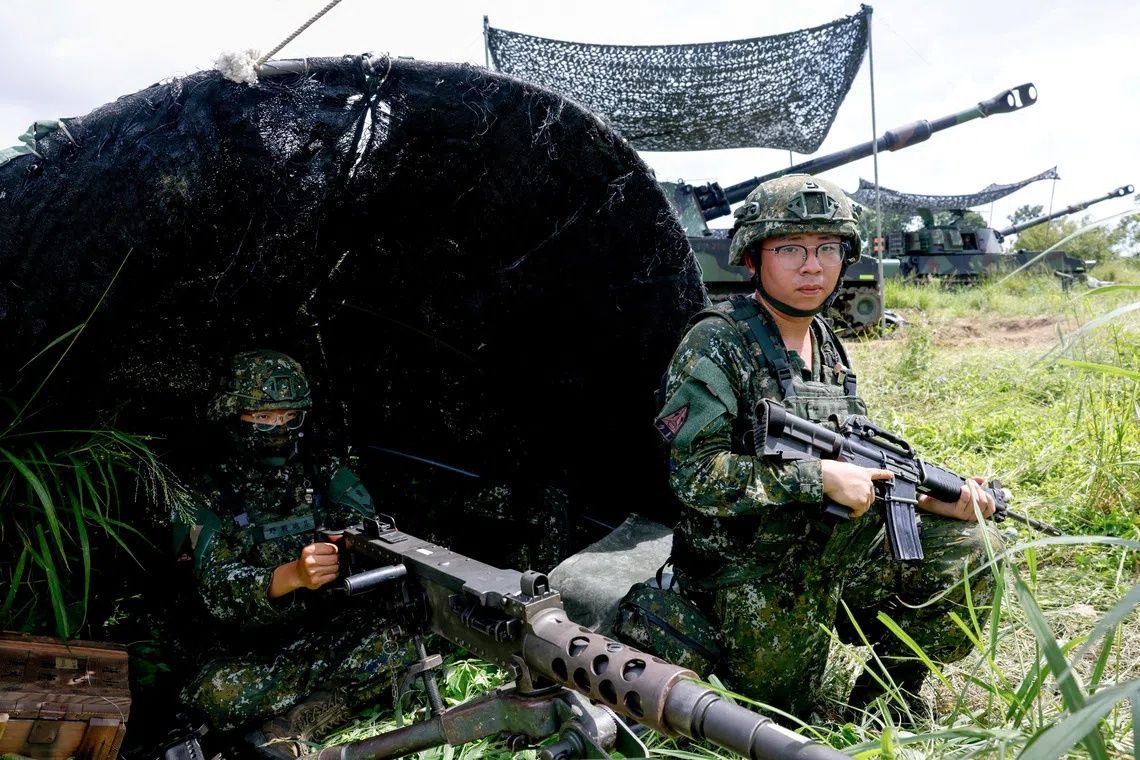
Taiwan has activated its largest military exercises in recent years, beginning a 10-day Han Kuang drill designed to evaluate whether military commanders can adapt quickly when circumstances deviate from pre-planned scenarios. The exercise, which commenced on Wednesday morning following orders issued from an underground command centre in Taipei, represents a significant evolution in how the self-governing island prepares its armed forces and civilian population for potential conflict with Beijing. Unlike previous iterations of the annual drills, which date back to 1984, this year's version introduces unprecedented elements aimed at simulating genuine wartime conditions rather than theoretical exercises conducted in controlled environments.
Among the most notable innovations is Taiwan's decision to deliberately slow mobile internet speeds across the island for the first time, creating artificial bandwidth constraints to assess how civilians and government agencies would maintain communications during an actual military crisis. This addition reflects growing recognition that modern conflicts extend far beyond military installations and battlefield tactics—they encompass entire populations facing disrupted digital infrastructure. Defence officials involved in planning the exercise emphasised that this mirrors real-world scenarios where adversaries might target communications networks as part of their opening campaign. The measure also serves a secondary purpose, allowing Taiwan to evaluate public resilience and adaptability when citizens cannot rely on the internet connectivity that now underpins daily life.
The drill's structure incorporates over 20,000 military personnel, approximately 5,000 of whom are reservists being mobilised for the first time under these conditions. Fighter jets will be dispersed to unexpected locations, naval vessels will execute emergency deployment procedures, and civilian factories will simulate wartime production shifts. These movements represent more than routine training manoeuvres; they constitute a comprehensive test of Taiwan's ability to sustain military operations when adversaries attempt to neutralise command centres, disable ports, disrupt logistics networks, and neutralise defence industry facilities. China, which claims Taiwan as a province, has never explicitly ruled out using military force to achieve unification, and recent military activities near the Taiwan Strait have intensified concerns about Beijing's preparations for potential conflict.
A particularly significant methodological change involves adopting a "backbrief" system derived from United States military doctrine. Under this approach, junior officers receiving operational orders from superiors must restate the mission objectives and tactical details back to their commanding officers before implementation. This seemingly simple procedure addresses a critical vulnerability identified in past exercises: miscommunication between different levels of the command hierarchy that could prove catastrophic during actual combat operations. By institutionalising this verification step, Taiwan aims to ensure that commanders and subordinates maintain absolute alignment on operational intentions, reducing the likelihood that confusion or misinterpretation could undermine tactical effectiveness when time is critical.
The exercise explicitly addresses a scenario that has preoccupied Taiwanese defence planners for years: a Chinese opening salvo designed to paralyse command and control infrastructure before Taiwan can effectively respond. Recent technological advances and China's expanding military capabilities have made this threat considerably more credible than in previous decades. The drill therefore devotes substantial attention to practising the rapid relocation of major weapons arsenals, simulating how the government would continue functioning after primary facilities are destroyed or rendered inoperable, and conducting escort operations along Taiwan's Pacific coastline—a particularly sensitive area given concerns that China might attempt to sever the island's supply lines from friendly nations such as Japan and the United States.
Defence officials engaged in planning the exercise acknowledged that previous iterations had suffered from criticism that they resembled carefully choreographed performances rather than authentic military operations. "These are all part of a series of toughening exercises—this is no longer a laboratory-like exercise in a vacuum," one senior official explained. The commitment to introducing unexpected scenarios, geographical dispersal of forces, and realistic constraints on resources and communications represents Taiwan's deliberate effort to move beyond the controlled environment of military bases toward genuine field conditions. Field commanders will face situations that deviate significantly from anticipated enemy patterns, requiring them to rapidly reassess tactical situations, adjust their responses, and communicate new orders without the benefit of ideal circumstances.
Beyond purely military considerations, Taiwan has expanded the drill's scope to encompass civilian government operations and public communication. New "resilience drills" test whether local officials can maintain governmental functions during multiple simultaneous crises, ranging from natural disasters to direct military conflict. Additionally, the exercise includes an innovative "embedded reporter" mechanism designed to assess how Taiwan would manage wartime media operations and counter Chinese disinformation campaigns. This recognition that information warfare forms an integral component of modern military conflict reflects evolving strategic doctrine that emphasises the total mobilisation of national resources, not merely military units, during periods of acute crisis.
The emphasis on civil-military integration and public preparedness represents a subtle but important shift in Taiwan's defence philosophy. Rather than treating military exercises as discrete military activities separated from civilian life, the current approach treats potential conflict as a whole-of-society challenge requiring coordination across government agencies, private businesses, and the general population. Defence officials have been explicit that the exercise aims to communicate to all Taiwanese citizens that warfare, should it occur, would fundamentally alter daily existence and demand contributions from every segment of society. This messaging serves dual purposes: it prepares the public psychologically for potential conflict while simultaneously conveying to international observers—and to Beijing—that Taiwan possesses not merely military capability but sustained civil resilience.
China's Defence Ministry has not responded to requests for comment on the exercises, maintaining its typical stance of neither acknowledging nor explicitly condemning Taiwan's military preparations. However, the timing and design of Taiwan's drill implicitly acknowledges that cross-strait military competition has entered a more intense phase. The drills conclude on August 14, and their results will likely inform Taiwan's defence budgeting decisions and strategic planning for coming years. For regional security analysts and officials across Southeast Asia, Taiwan's exercise offers a window into how a smaller democracy with limited resources approaches the challenge of preparing for conflict against a significantly more powerful neighbour. The lessons Taiwan derives from testing realistic scenarios, incorporating civil defence mechanisms, and improving command coordination could carry implications extending beyond Taiwan itself, particularly for other regional democracies concerned about great-power military pressure.

