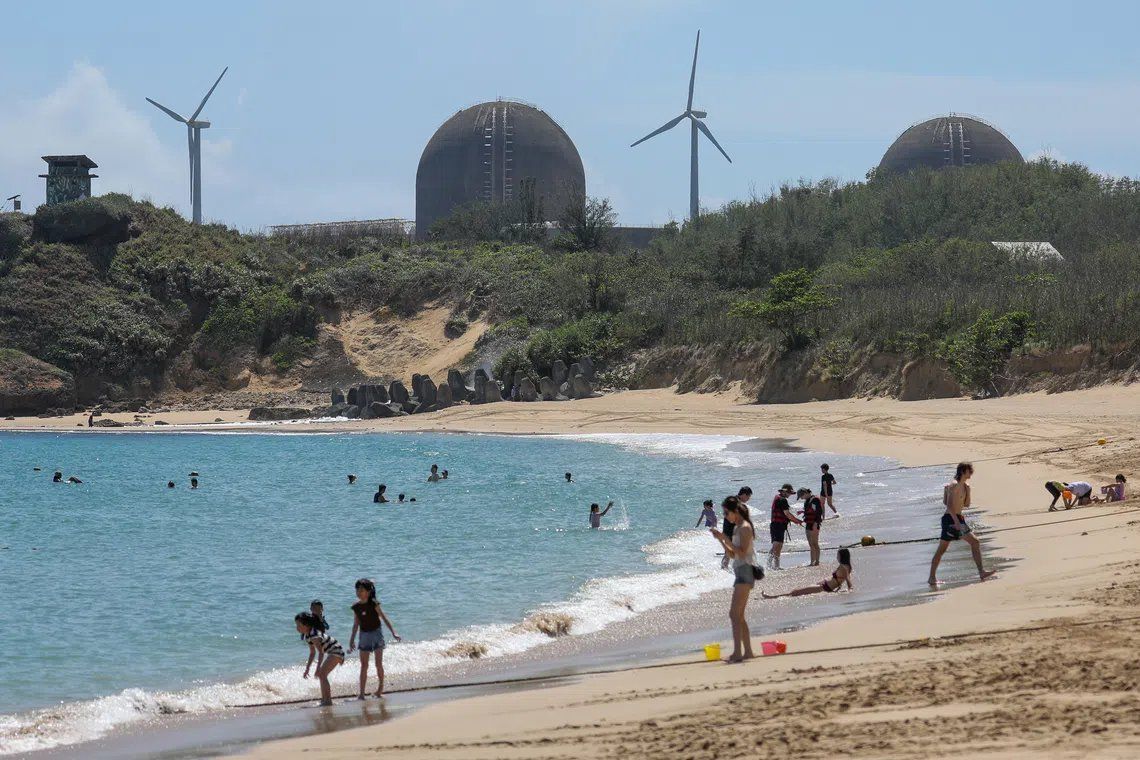
Taiwan faces yet another showdown over nuclear energy policy when voters head to the polls in November for "nine-in-one" local elections alongside a national referendum on the government's "Nuclear-Free Homeland" policy. This marks an extraordinary surge in direct democracy mechanisms, with four major referendums on nuclear matters alone occurring within just eight years—a pattern that raises fundamental questions about whether Taiwan's referendum system has evolved into a tool for partisan political warfare rather than genuine public consultation on substantive policy matters.
The upcoming referendum poses a deliberately expansive question, asking whether the government should abandon its nuclear-free stance in order to "protect public health, ensure stable and affordable electricity supplies, strengthen national defence resilience and support the development of artificial intelligence industries." The framing itself demonstrates the political calculus at work: by bundling energy security, economic competitiveness, and artificial intelligence development alongside health concerns, the question attempts to construct a broad coalition of support. When the Central Election Commission reviewed three separate referendum proposals this year, only this nuclear energy measure survived scrutiny. The commission rejected a proposal to legalise caning for serious crimes on human rights grounds, and dismissed another concerning the allocation of traffic fine revenue, suggesting some gatekeeping function remains operative despite systemic changes.
The timing and content of these referendums cannot be separated from electoral considerations. The opposition Kuomintang and Taiwan People's Party appear strategically invested in using nuclear energy, crime, and law-and-order issues to mobilise their conservative voter base during a period when local elections are generating significant political energy. Historical precedent reinforces this calculation: during the 2018 local elections, when Taiwan held ten national referendums simultaneously, the KMT achieved notably strong electoral performance. Qi Dongtao, senior research fellow at the National University of Singapore's East Asian Institute, articulates the scholarly consensus plainly: "This electoral consideration is probably at least as important as the policy substance of the referendums themselves." The correlation between conservative issue mobilisation and opposition party electoral success creates powerful incentives for repeated referendum campaigns.
The global energy landscape has shifted measurably since Taiwan's last nuclear referendum in August 2025, providing legitimate justification for revisiting the question. Supply chain disruptions stemming from Strait of Hormuz tensions, combined with surging electricity demand driven by artificial intelligence infrastructure development, represent material changes in energy economics. Taiwan's semiconductor and AI industries require substantial baseload power, and policymakers genuinely confront questions about energy independence, cost stability, and environmental sustainability. Yet scholars studying Taiwanese politics emphasise that these substantive policy considerations, however real, operate alongside deeper partisan motivations that may ultimately overshadow deliberative governance.
Beyond nuclear energy, opposition parties have deployed the caning referendum strategically, creating a broader law-and-order narrative that resonates with their political coalition. Political scientist Chong Ja Ian from NUS notes that the KMT deliberately positions itself as the party of tough-on-crime governance, implicitly contrasting with Democratic Progressive Party leadership while leveraging Singapore's reputation as a well-ordered, prosperous society. By proposing caning as referendum material, opposition politicians frame themselves as constrained by the Democratic Progressive Party's allegedly soft-on-crime ideology, thereby mobilising voters around themes of social order and security. This representational strategy transforms policy proposals into electoral weapons.
Taiwan's referendum architecture underwent radical transformation in 2017, when lawmakers dramatically lowered the threshold for holding and passing referendums. Previously, a referendum required 50 per cent voter turnout to achieve validity, a standard that proved insurmountable when former president Chen Shui-bian attempted cross-strait relations referendums in 2004 despite overwhelming support among actual voters. The contemporary system merely requires that affirmative votes exceed negative votes and that "Yes" votes comprise at least 25 per cent of the total electorate—a substantially more permissive standard that enables determined political minorities to place issues on ballots. This institutional shift directly correlates with the sharp proliferation of referendums since 2017, transforming direct democracy from occasional consultation on major constitutional questions into routine electoral mobilisation tools.
Legal scholar Lin Jia-he from National Chengchi University's College of Law identifies a critical democratic deficit in Taiwan's referendum timing and implementation. Switzerland's referendum process typically spans three to five years from proposal to vote, allowing government agencies and citizens extended periods for deliberation, technical analysis, and genuine democratic discussion of complex policy implications. Taiwan's nuclear referendum, by contrast, proceeded from announcement on 28 August to scheduled voting on 28 November—a mere three-month window entirely insufficient for rigorous public engagement with the technical, economic, and environmental dimensions of energy policy and infrastructure planning. Voters confronted with such compressed timelines lack meaningful opportunity to evaluate competing expert analyses, understand trade-offs between different energy sources, or develop considered positions on matters requiring substantial technical knowledge.
The proliferation of referendums has measurably degraded public confidence in direct democracy mechanisms. Taipei resident Sean Chang, a 39-year-old communications professional, articulated widespread voter scepticism: referendums that initially promised authentic popular voice have devolved into partisan manipulation tools. Chang recalled voting in the 2018 referendum cascade when ten separate questions appeared simultaneously, but subsequently abandoned referendum engagement altogether, recognising that relentless issue cycling demanded exhausting cognitive effort while ultimately serving partisan rather than deliberative democratic functions. This voter disengagement represents the paradoxical outcome of expanded direct democracy: as referendums proliferate beyond genuine constitutional or major policy questions, public enthusiasm for participatory mechanisms declines precipitously.
Qi Dongtao articulates the fundamental democratic problem with Taiwan's current trajectory: "This can turn referendums from an instrument of direct democracy into another arena of partisan competition." When political parties routinely weaponise referendums to mobilise specific electoral coalitions around divisive issues rather than reserving direct democracy for genuinely major questions requiring explicit popular authorisation, the institution itself becomes corrupted. Referendums should function as rare, solemn exercises of popular sovereignty on questions of constitutional significance or fundamental policy direction. Instead, Taiwan's system increasingly resembles continuous electoral campaigns disguised as direct democracy, where party strategists perpetually calculate which issues might mobilise their core constituencies rather than asking which questions genuinely warrant bypassing normal legislative processes.
The November elections, encompassing contests for eleven thousand local officials across multiple jurisdictive levels, will function as bellwethers for Taiwan's broader political trajectory heading toward 2028 national elections. Turnout patterns influenced by referendum mobilisation—particularly whether conservative voters respond to nuclear energy and law-and-order messaging—will provide signals about electoral coalition dynamics and demographic voting shifts. The Democratic Progressive Party government faces pressure to defend its nuclear-free policy while addressing legitimate energy security concerns, while opposition parties attempt to frame themselves as pragmatic, order-focused alternatives. Yet beneath these tactical electoral manoeuvres lies a substantive governance challenge: how Taiwan balances environmental commitments, energy security, economic competitiveness, and democratic legitimacy in an era when direct democracy mechanisms threaten to overwhelm deliberative policymaking.

