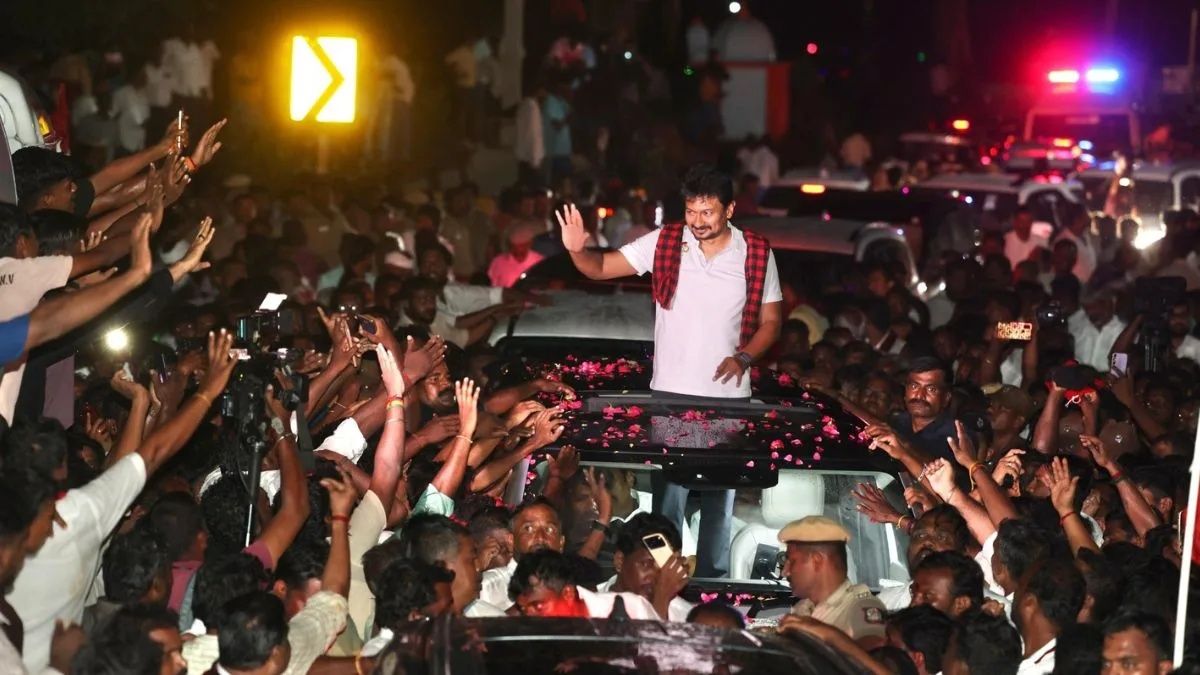
In a politically charged development that underscores deepening tensions between Tamil Nadu's ruling and opposition camps, Udhayanidhi Stalin, the Leader of Opposition in the state and former deputy chief minister, was released on station bail late Tuesday evening following an extended period of police interrogation. The DMK leader's detention related to allegedly offensive remarks made towards actress Trisha Krishnan had triggered considerable political activity, with party supporters gathering in large numbers at Sengipatti police station to welcome his release and voice their opposition to what they characterised as governmental overreach.
The incident that precipitated Stalin's arrest traces back to a DMK-organised protest in Thanjavur district, where the veteran politician was addressing supporters on issues central to his party's political agenda. While delivering remarks critical of Chief Minister Vijay's handling of the Cauvery water dispute and Karnataka's proposed Mekedatu dam project, Stalin made a statement that has since become the subject of intense scrutiny and conflicting interpretations. When supporters in the crowd invoked actress Trisha Krishnan's name—a public figure perceived to have close ties to the chief minister—Stalin responded with what would become the contentious phrase: "Wherever water comes, whether it comes or not, water should come there."
The apparent simplicity of Stalin's statement belies the controversy that erupted following his comments. The ruling TVK party and its allies swiftly characterised the remark as containing sexual innuendo and accused the DMK leader of verbal harassment and the objectification of a woman. This interpretation prompted the TVK to escalate the matter by filing formal police complaints and simultaneously approaching the National Commission for Women, actions that signaled the government's determination to pursue the matter through both legal and administrative channels. The maneuver demonstrated how political disputes in Tamil Nadu increasingly intersect with questions of propriety and respect.
Police arrested Stalin from his Chennai residence, transferring him to Sengipatti police station for interrogation that stretched across several hours. The arrest itself carried symbolic weight, occurring amid already heightened political animosity between the DMK and the TVK administration. The gathering of hundreds of party supporters outside the police station reflected the DMK's determination to mobilise its base against what it characterised as vindictive governance, with protesters chanting slogans specifically targeting the chief minister and his political administration.
Following his release, Stalin addressed assembled media to articulate his perspective on both the original remarks and his arrest. He categorically denied that his statement contained any malicious intent or disrespectful undertones directed at any woman, reframing the entire episode as a calculated diversion by the ruling government away from substantive policy failures. Stalin emphasised that his remarks emerged from the context of agricultural advocacy and water management concerns—issues that have long constituted central pillars of DMK political messaging. His assertion that he harboured no wrongful intentions attempted to reclaim the narrative from the government's interpretation.
Crucially, Stalin rejected the characterisation that his words carried double meaning, insisting that their significance lay solely in their surface-level reference to water distribution and resource management. This distinction between single and multiple meanings became central to his defence strategy, positioning the controversy as an attempt by the TVK government to manufacture outrage where none was warranted. By framing the arrest as a manifestation of governmental intolerance toward opposition voices, Stalin attempted to transform a potentially damaging incident into evidence of authoritarian tendencies within the ruling administration.
The political context amplifies the significance of this episode. Tamil Nadu's recent political landscape has witnessed substantial realignment, with the emergence of the TVK as a challenger to both traditional parties. Vijay's ascension to the chief minister's office represented a significant shift in the state's political dynamics, and tensions between his administration and the long-dominant DMK remain pronounced. This particular incident reflects how such tensions can manifest through disputes over language, propriety, and the bounds of acceptable political discourse.
For Tamil Nadu watchers and broader South Indian political observers, the affair illustrates the hazardous terrain of contemporary political communication, where statements made in the context of policy advocacy can be reinterpreted through alternative lenses and weaponised within factional disputes. The involvement of the National Commission for Women represented an effort to elevate what might otherwise remain a localised controversy into a matter of national concern regarding women's dignity, adding another layer to the political calculations involved.
The release of Stalin on station bail rather than more stringent detention measures suggested that investigating authorities may have found insufficient grounds for pursuing more serious legal consequences, at least at this initial stage. Nonetheless, the episode demonstrates how opposition leaders in Indian states navigate a complex terrain where political expression, institutional power, and questions of social propriety intersect. For Malaysian observers of South Indian politics, the incident underscores persistent patterns wherein regional political rivalries frequently manifest through disputes over language and cultural sensitivities, with state institutions sometimes becoming entangled in partisan conflicts.
Moving forward, the case may face continued judicial scrutiny, with the TVK government potentially pursuing further action while the DMK mobilises both its legal resources and political messaging apparatus. The broader implications extend beyond this single episode, signaling the intensity with which Tamil Nadu's political actors currently contest for dominance and the willingness of state institutions to intervene in political disputes. For Southeast Asian observers, the affair provides insights into Indian federalism's regional dimensions and the manner in which state-level political competition shapes governance and institutional functioning.

