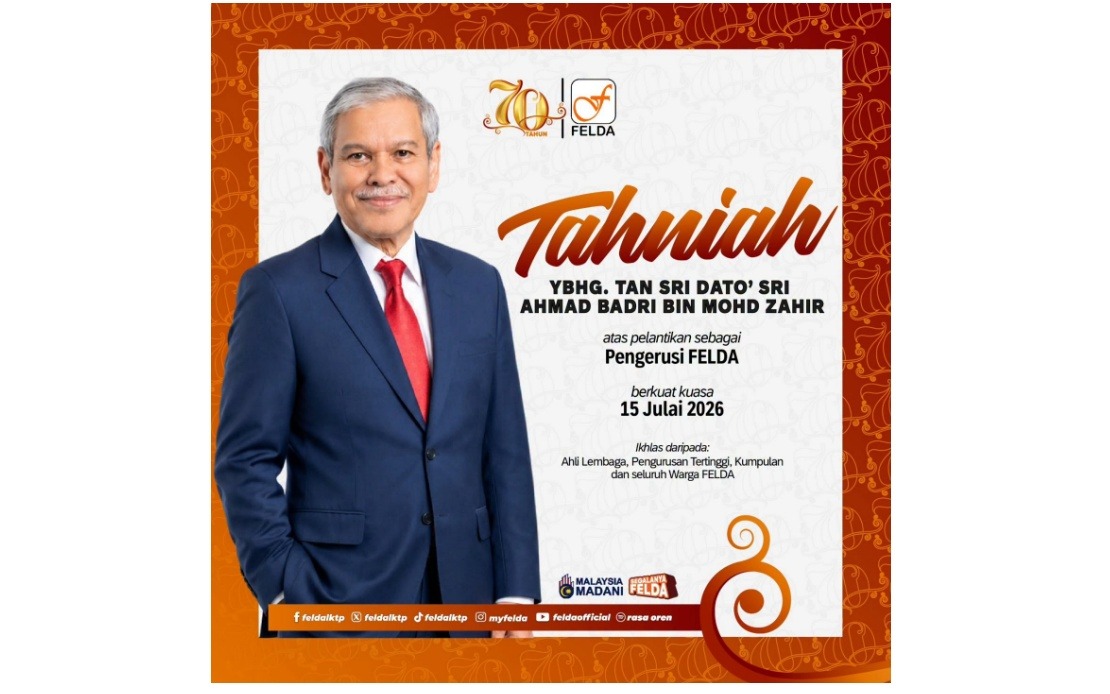
Tan Sri Ahmad Badri Mohd Zahir has taken the helm of the Federal Land Development Authority (FELDA) in a major leadership appointment that underscores the government's confidence in his track record of stewarding Malaysia's most consequential state-linked enterprises. The positioning reflects deliberate strategy to inject fresh momentum into the organisation as it navigates the pressures of agricultural modernisation and the need to safeguard the livelihoods of more than three million settlers who depend on FELDA's operations across the country.
Ahmad Badri's appointment signals FELDA's commitment to realigning operations with Malaysia's broader sustainable development objectives. The authority, which has long served as a cornerstone of rural economic policy, faces mounting challenges in balancing agricultural productivity, environmental stewardship, and the welfare expectations of settlement communities. His arrival carries expectations that he will accelerate governance improvements and introduce management practices benchmarked against international standards while remaining attentive to FELDA's foundational social mission.
The new chairman arrives with credentials spanning more than three decades across both public administration and private enterprise. His tenure began in 1989 at the Ministry of Finance, where he accumulated progressively senior responsibilities over a career that exposed him to fiscal policy, public financial management, and the intricacies of managing state assets. This lengthy foundation in the government system provides him with institutional knowledge of how FELDA interfaces with broader policy frameworks, regulatory bodies, and budgetary processes that shape operational capacity.
Among his most prominent prior roles, Ahmad Badri served as Treasury Secretary-General from 2018 to 2020, a position that places him at the apex of Malaysia's fiscal administration during a period of significant economic adjustment. That tenure coincided with recovery from the global pandemic, putting him at the centre of debates over public spending priorities, debt management, and resource allocation across competing national interests. The experience equipped him with perspective on how agricultural authorities like FELDA fit within comprehensive economic strategy.
His leadership of the Employees Provident Fund (EPF), the nation's largest retirement savings institution with assets exceeding RM800 billion, demonstrated his ability to manage enormous fiduciary responsibilities and navigate the complexities of institutional governance in an environment where investment decisions affect millions of Malaysians. That role required balancing returns generation against stability, a discipline directly relevant to stewarding FELDA's substantial land holdings and diversified business interests.
Ahmad Badri's presence on the boards of Bank Negara Malaysia, Permodalan Nasional Berhad, and Tenaga Nasional Berhad situates him within the inner circles of Malaysia's financial and economic establishments. These positions expose him to macroeconomic policy discussions, development financing debates, and the strategic considerations that shape how state institutions coordinate. His current chairmanship of RHB Bank Bhd and the Malaysian Rubber Board (LGM), alongside his directorship at Sime Darby Bhd, indicates active engagement with commercial pressures and agricultural commodity markets, areas fundamental to FELDA's core business model.
FELDA itself confronts a complex operational landscape. The organisation manages approximately 819,000 hectares of plantations and supports communities in peninsular Malaysia, Sabah, and Sarawak. It generates revenue through palm oil, rubber, cocoa, and coconut production while maintaining schools, healthcare facilities, and infrastructure in rural settlements. Rising global scrutiny of palm oil production practices, volatile commodity prices, and generational shifts in how younger settlers view agricultural livelihoods all demand strategic recalibration. Ahmad Badri's appointment suggests the government recognises that previous management approaches require evolution.
His educational background, including a Master of Business Administration from the University of Hull and estate management credentials from Universiti Teknologi MARA (UiTM), indicates familiarity with both contemporary management theory and Malaysia's specific land development traditions. This combination positions him to draw on international best practices while respecting the institutional history and social commitments that define FELDA's purpose.
The appointment carries significance for Malaysian agricultural policy writ large. As global demand for sustainable palm oil intensifies and Malaysia seeks to strengthen its competitive position amid international environmental standards, FELDA's transformation trajectory influences national capacity to deliver certified, responsible production. Ahmad Badri's task extends beyond financial performance to encompassing how FELDA contributes to Malaysia's broader sustainability credentials—critical for market access and investor confidence in export sectors.
For the three million settlers and their families, the transition represents both opportunity and uncertainty. Ahmad Badri's mandate explicitly encompasses strengthening the FELDA Group's transformation agenda while safeguarding settler welfare and ensuring long-term prosperity across generations. This dual emphasis reflects persistent tension between commercial imperatives and social obligations—a balance his leadership will substantially determine.
Regionally, FELDA's evolution resonates across Southeast Asia, where land-based agricultural authorities in other nations face comparable pressures regarding sustainability, smallholder incomes, and commodity market volatility. Ahmad Badri's approach to governance and transformation may offer lessons for agricultural development models across the region, particularly as commodity producers seek to integrate environmental compliance with rural income security.

