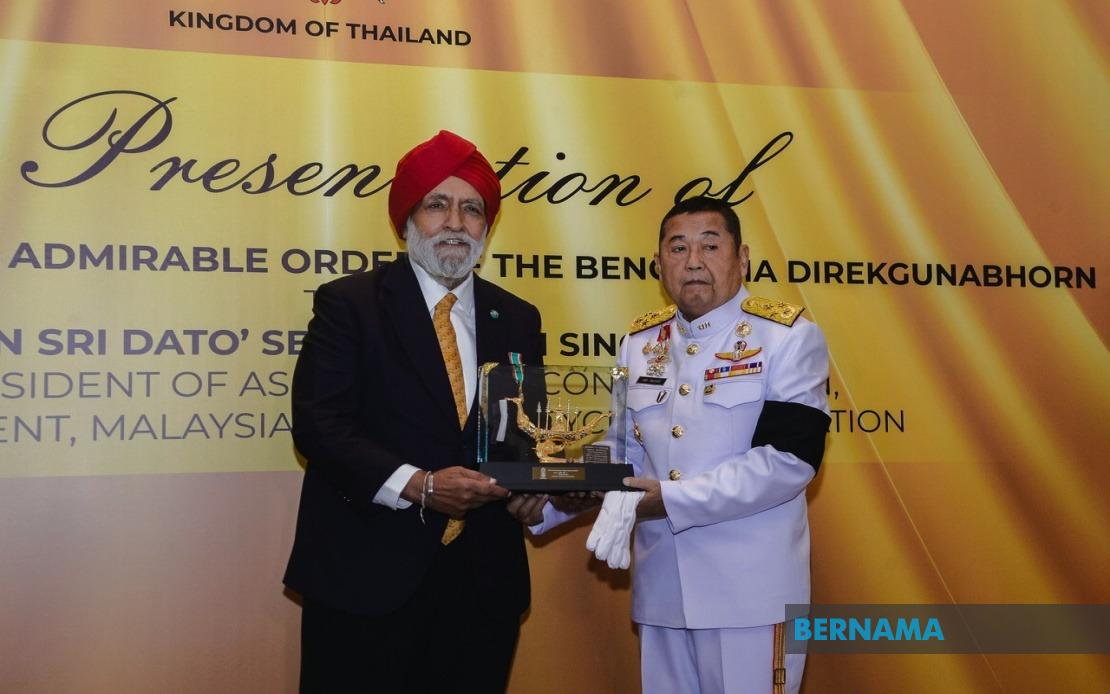
Tan Sri Darshan Singh Gill, who stewarded Malaysian cycling through formative decades as both national and continental federation leader, has received one of Thailand's highest royal honours in recognition of his enduring impact on the sport. The decoration, formally known as The Most Admirable Order of the Direkgunabhorn (Fifth Class - Benjama Direkgunabhorn), was conferred in Kuala Lumpur on August 6 and carries the prestige of royal patronage under Thailand's monarchy. The presentation underscores the respect that regional cycling bodies hold for administrators who have shaped the sport's institutional development across Asia.
General Decha Hemkasri, serving as senior vice-president of the Asian Cycling Confederation (ACC), formally presented the insignia on behalf of the Thai royal establishment. The honour originally emanated from His Majesty the late King Bhumibol Adulyadej The Great, Rama IX, whose longstanding patronage of regional sporting excellence extended to recognising transformative figures in cycling governance. Such royal decorations are seldom bestowed on foreign administrators, signalling the exceptional esteem in which Darshan's career is held across Southeast Asia's cycling community.
Darshan's tenure spanned pivotal periods for Malaysian and Asian cycling. During his presidency of the Malaysian National Cycling Federation from 1988 to 1990, he presided over a transitional era when the sport was beginning to professionalise and expand beyond domestic competition. His subsequent leadership of the Asian Cycling Confederation from 1996 to 2005 placed him at the helm during a critical phase of continental development, when cycling was gaining prominence as an Olympic and Commonwealth Games discipline across the region. His decision to accept the Thai recognition carries weight not merely as a personal tribute but as validation of Malaysia's cycling infrastructure and administrative credentials on the Asian stage.
Speaking to journalists following the ceremony, Darshan characterised the award as meaningful validation extending beyond individual achievement. He contextualised the honour within Malaysia's broader trajectory in cycling, observing that the nation's rise in competitive standing merits institutional recognition. The award, he suggested, reflects not just his personal stewardship but the competence of Malaysian cycling administrators to operate at international standards. This perspective reveals how senior federation officials view individual honours—not as personal trophies but as reflections of national capacity and institutional maturity within global sporting governance structures.
Darshan drew attention to Malaysia's track record in producing world-class cyclists. He referenced the achievements of earlier generations including M. Kumaresan and Rosman Alwi, who represented Malaysia during the formative era of his federation leadership. Yet he emphasised that contemporary Malaysian cycling has transcended those historical benchmarks through the emergence of elite performers capable of competing at the highest international levels. This generational comparison underscores how Malaysian cycling has evolved from regional competitiveness to genuine global representation, a transformation that occurred substantially during the institutional foundations Darshan helped establish.
The most immediate exemplar of Malaysian cycling excellence that Darshan highlighted is Datuk Mohd Azizulhasni Awang, whose recent triumph at the Commonwealth Games in Glasgow represents a watershed moment for the sport nationally. Awang's gold medal in the men's keirin event terminated a 16-year drought in Commonwealth Games cycling medals for Malaysia, achieved at the prestigious Sir Chris Hoy Velodrome. The achievement assumes heightened significance given that Awang competes in track cycling, a discipline requiring not only individual talent but sophisticated training infrastructure, coaching expertise, and institutional support—all elements that reflect decades of federation-level investment in athlete development programmes that administrators like Darshan championed.
Paralleling Awang's athletic achievement is a parallel advancement in Malaysian cycling administration. Datuk Amarjit Singh Gill, the incumbent MNCF president, was elected as International Cycling Union (UCI) vice-president for the 2025-2029 term following the 194th UCI Congress held in Kigali, Rwanda, the previous year. This elevation represents a historic breakthrough—Amarjit stands as the first Malaysian ever to ascend to the UCI vice-presidency, an influential position within global cycling governance. The significance of this appointment extends beyond Malaysia; it signals the international cycling community's confidence in Malaysian administrative capability and provides the nation with substantive influence over continental and global cycling policy development.
Darshan's observation linking his own award to Amarjit's ICC appointment reveals a coherent narrative about Malaysian cycling's institutional maturation. The honour bestowed upon Darshan validates the foundational work of his generation, whilst Amarjit's elevation demonstrates that subsequent leadership has successfully built upon those foundations to achieve global recognition. Together, these developments suggest that Malaysian cycling has transitioned from a regionally-significant but internationally peripheral entity to one capable of influencing global sport governance and producing medal-winning athletes. This progression spans approximately three decades, a timeframe that encompasses Darshan's most active period in federation leadership.
The timing of the Thai royal honour also reflects broader regional dynamics in Southeast Asian cycling. Thailand itself maintains substantial cycling traditions and has invested significantly in track cycling infrastructure and athlete development. The bestowal of a Thai royal decoration upon a Malaysian cycling figure suggests active cross-border cooperation and mutual respect within ASEAN's sporting community. Such recognition implicitly endorses Malaysia's standing within regional sporting circles and acknowledges the interconnected nature of cycling development across Southeast Asia, where shared challenges, talent exchange, and institutional learning drive collective progress.
For Malaysia's cycling fraternity, Darshan's recognition carries implications extending beyond ceremonial honour. It validates the administrative approaches and governance philosophies that characterised his federation leadership, suggesting that the strategic choices made during the 1988-1990 MNCF period and the 1996-2005 ACC tenure yielded enduring institutional benefits. Administrators currently navigating Malaysian cycling's governance will likely interpret this royal recognition as affirmation of continuity with proven leadership models. It also positions Malaysia as a nation capable of producing administrators worthy of international recognition, potentially enhancing the nation's profile when candidates from Malaysian cycling seek election to continental and global sporting bodies.
Darshan's characterisation of the award as reflecting Malaysia's cycling progress demonstrates how individual honours function within sporting diplomacy. Rather than treating the decoration as a purely personal achievement, he repositioned it as emblematic of Malaysian cycling's transformation from a developing cycling nation to one with credible international standing. This framing elevates the significance of the Thai royal honour beyond biographical notice into a statement about Malaysian sporting capacity and institutional development. For other Southeast Asian administrators and for Malaysian sports bodies more broadly, Darshan's recognition establishes a precedent that sustained, strategic leadership in sporting governance can yield regional acknowledgement and international standing.
The award also arrives at a moment when Malaysian cycling is experiencing measurable momentum across multiple dimensions—elite athlete performance through Awang's Commonwealth Games success, administrative representation through Amarjit's UCI vice-presidency, and historical validation through Darshan's Thai royal recognition. These concurrent developments create a narrative of sustained upward trajectory that positions Malaysian cycling as a regional force and emerging global presence. The convergence of these achievements suggests that earlier institutional investments made during Darshan's federation presidency have matured into tangible, internationally-recognised results that extend across athlete development, administrative credibility, and diplomatic standing within Asia's sporting community.

