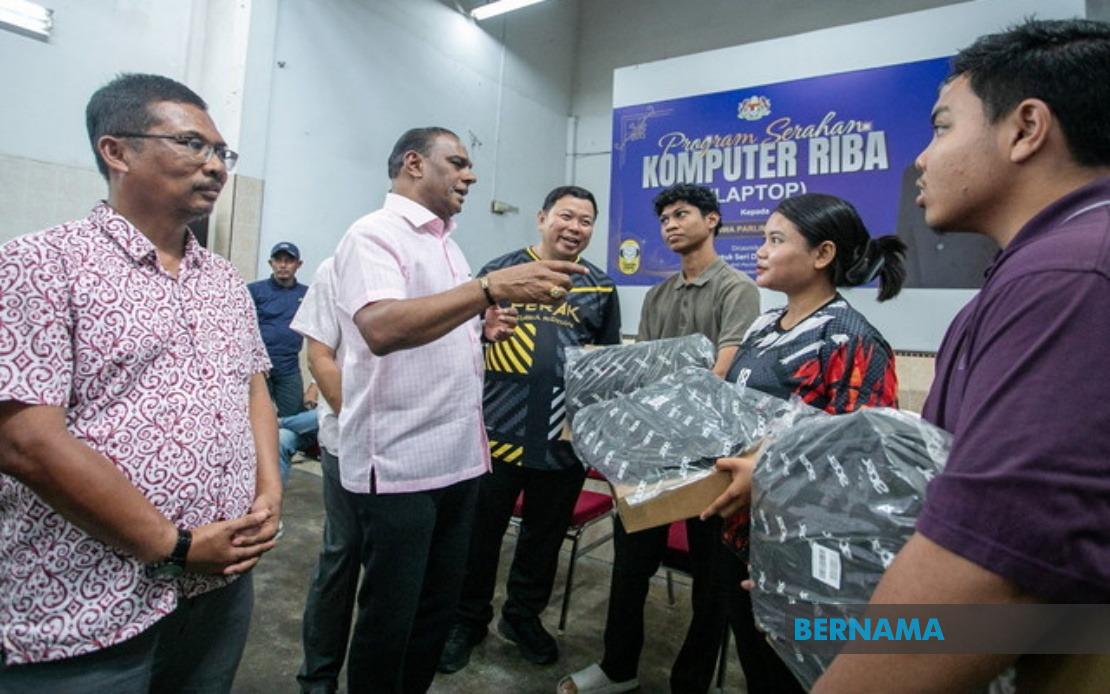
Forty-five university students from lower-income households in the Tapah parliamentary constituency have received laptops as part of an ongoing support scheme designed to remove financial barriers to tertiary education. The initiative, which dates back to 2008, has now distributed equipment to more than 1,000 beneficiaries across the constituency, representing a sustained commitment to educational equity in the region.
Tapah Member of Parliament Datuk Seri M. Saravanan oversaw the distribution ceremony at Mahatma Gandhi Hall, emphasising that digital devices are no longer supplementary tools but fundamental requirements for modern university life. The 2024 cohort of recipients included 30 diploma-level students, five pursuing certificates, four enrolled in matriculation programmes, and three degree students, alongside individual recipients from SPM, STPM, and foundation-level courses. This diverse composition reflects the breadth of educational pathways available to young people in the constituency.
The provision of laptops addresses a critical gap in access to learning infrastructure, particularly for families earning below RM4,850 monthly—the B40 income threshold in Malaysia. As higher education increasingly integrates online learning platforms, virtual libraries, and digital submission systems, students lacking personal computing equipment face distinct disadvantages in keeping pace with coursework and completing assignments on schedule. The initiative recognises that financial constraint should not determine academic potential or limit educational mobility.
Saravanan stressed that a rigorous selection process underpins the distribution, with a dedicated committee evaluating each application to ensure resources reach genuinely eligible families. The assessment incorporates input from the District Education Office and grassroots community leaders, creating a verification mechanism that guards against misallocation while maintaining transparency. This structured approach has likely contributed to the programme's longevity and acceptance within the Tapah constituency.
Beyond immediate resource provision, the scheme reflects broader policy acknowledgment that education serves as the primary mechanism for intergenerational mobility among lower-income groups. Saravanan highlighted the visible transformation within Tapah's Orang Asli community, where sustained educational investment has yielded practitioners across medicine, law, and other professional sectors over the past two decades. These success stories function as inspirational models, signalling to younger cohorts that educational attainment remains achievable despite socioeconomic starting points.
One beneficiary, Aidil Iskandar Ramlan, 18, will commence studies in Public Administration at Universiti Teknologi MARA Raub with the device alleviating immediate financial pressure on his household. His father works as a school security guard while his mother manages domestic responsibilities, positioning the family within the B40 category where discretionary spending capacity is limited. For Aidil, the laptop represents not merely convenience but genuine necessity for submitting assignments, accessing course materials online, and participating in institutional digital systems expected of contemporary undergraduates.
Another recipient, Ea Endry Iana Aslan, 19, will apply the equipment toward her Diploma in Early Childhood Education at FELCRA College, noting that the assistance materially reduces financial strain on her household. Her gratitude extended explicitly to the MP, reflecting how localised advocacy within the parliamentary system can translate into tangible support for individual families navigating constrained economic circumstances. This personalised dimension underscores the political value of constituency-level programmes that connect elected representatives directly with beneficiaries.
The laptop programme exemplifies how targeted assistance can function within Malaysia's broader B40 support architecture. Unlike blanket subsidies or universal provisions, constituency-based schemes allow MPs to identify specific sectoral needs—in this case, the transition to technology-dependent tertiary education—and deploy resources accordingly. The 16-year operational history suggests the initiative has weathered multiple political cycles and budget pressures, indicating institutional embedding within Tapah's governance structure.
For Malaysia's lower-income student population, particularly those in rural constituencies like Tapah, such interventions carry outsized significance. Access to digital infrastructure remains unevenly distributed across urban-rural divides, and household income disparities translate into technology gaps that compound educational disadvantage. By frontloading equipment provision at the moment students enter tertiary institutions, the programme removes one mechanical barrier to successful course completion and credential attainment.
The scheme also acknowledges that digital literacy and infrastructure access have become markers of educational inequality equivalent to prior-generation concerns about textbooks or classroom facilities. As Malaysian universities accelerate online and hybrid delivery models—a trend accelerated by pandemic-era adaptations—students without reliable computing access face systematic disadvantage in accessing core educational resources. The Tapah initiative responds to this reality by treating laptops as educational necessities rather than discretionary purchases.
Broader implications extend beyond individual beneficiaries to workforce development outcomes. Early-career professionals entering practice with completed tertiary credentials acquired through disadvantaged circumstances demonstrate resilience and institutional navigation capacity that employers increasingly value. The visible professional advancement of Orang Asli graduates from previous laptop programme cohorts creates positive feedback loops, encouraging younger household members to pursue further education and signalling that educational investment yields measurable returns.
As Malaysia continues navigating economic pressures on lower-income households, the sustainability of such targeted programmes becomes increasingly important. The consistency of Tapah's initiative across 16 years suggests political will and budgetary prioritisation at the constituency level, yet similar schemes elsewhere remain vulnerable to fiscal constraints or shifting political priorities. Documenting and evaluating outcomes from successful models like Tapah's provides evidence for potential replication or expansion within other constituencies experiencing comparable demographic profiles and educational infrastructure gaps.

