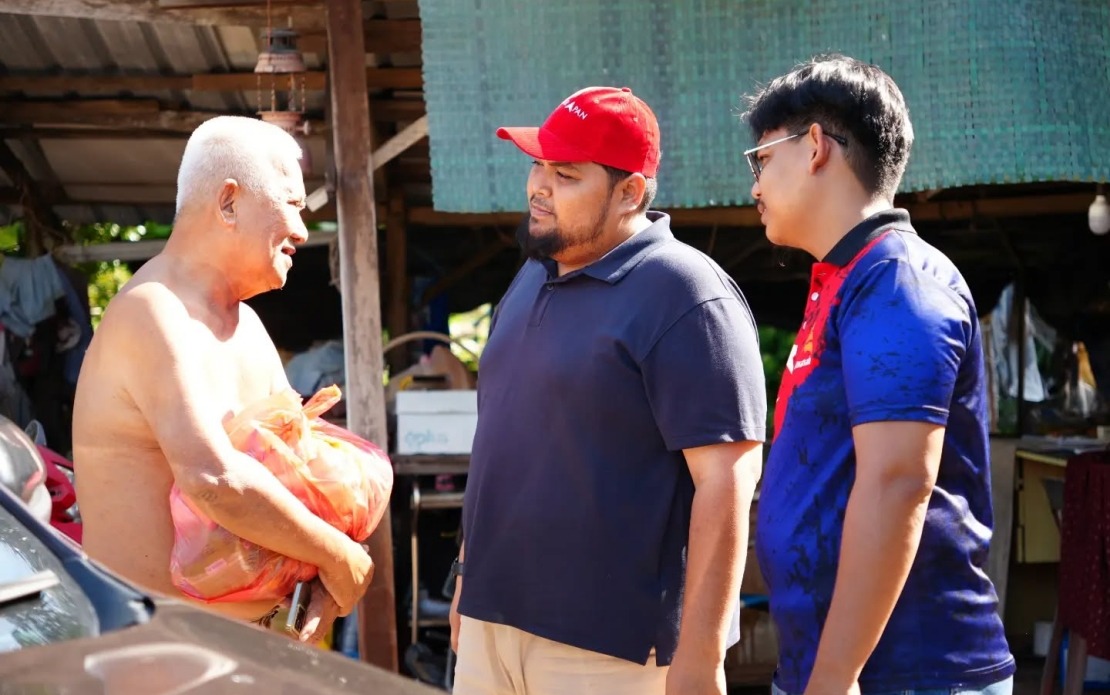
The Maharani state seat contest is shaping up as a critical battleground for youth sentiment in Johor's 16th state election on Saturday, July 11, with Pakatan Harapan candidate Muhammad Taqiuddin Cheman recalibrating his campaign message in the final stretch to address the economic anxieties of younger voters. Known widely as Taqi, the former Pulai Sebatang assemblyman (2018-2022) has diagnosed a fundamental challenge facing Muar: the steady exodus of young people seeking opportunities elsewhere, leaving the district increasingly defined by retirees rather than economic dynamism.
With only four days of campaigning remaining, Taqi is deploying a ground-level strategy centred on direct engagement with youth communities throughout the Muar district. Rather than relying solely on traditional rallies and media appearances, he is conducting a series of listening sessions designed to extract concrete information about what young people actually need to build their lives locally. This approach reflects a broader recognition across Malaysian politics that younger voters increasingly demand evidence-based policy commitments rather than rhetorical flourishes about their importance to the nation's future.
The employment challenge in Muar extends beyond simple joblessness. Speaking with young entrepreneurs recently, Taqi identified a specific bottleneck: approximately 70 traders operating within District 84 lack adequate commercial space, forcing them to rotate shifts rather than maintaining permanent trading positions. These business operators have already identified suitable alternative locations throughout the district but lack the institutional support to navigate licensing and site allocation procedures. Taqi positions himself as precisely that champion—someone with political standing to cut through bureaucratic obstacles and facilitate access to available commercial real estate within Muar's administrative boundaries.
The semiconductor industry has created a particular employment dynamic in Muar, attracting young workers to shift-based manufacturing roles that, while providing income, offer limited career progression and are vulnerable to cyclical downturns. This dependency on a single industrial sector creates structural fragility in local employment patterns. Taqi's emphasis on diversifying business opportunities and supporting entrepreneurs directly addresses this vulnerability by proposing to build a broader-based economy less dependent on multinational manufacturing anchors.
Pakatan Harapan's campaign platform offers material incentives to back these pledges. The coalition's "Johor For All" manifesto allocates RM500 million specifically for young entrepreneur support and business expansion schemes. This represents a substantial commitment, though the mechanics of implementation—application procedures, approval criteria, and actual disbursement timelines—remain subject to the detailed policy framework that typically emerges only after electoral victory. For young business operators in Muar currently operating in suboptimal conditions, the promise carries tangible weight.
Infrastructure projects under development may amplify these economic opportunities. The Maharani Energy Gateway (MEG) project, expected to be completed in the near future, promises to generate spillover effects throughout the local economy. Energy infrastructure projects typically catalyse activity in neighbouring sectors—logistics, services, accommodation, and retail—providing entry points for young entrepreneurs and employment pathways for workers seeking alternatives to semiconductor manufacturing. Taqi's campaign frames this as a structural advantage that a state government champion can maximise through proactive local engagement.
Skills development emerges as the third pillar of Taqi's youth-focused platform. He advocates for establishing quality Technical and Vocational Education and Training (TVET) institutions within the Maharani constituency itself. The current situation, where young people must travel elsewhere for technical qualification, creates friction that potentially accelerates outward migration. Local TVET provision aligned with industry needs—particularly the semiconductor, energy, logistics, and fishing sectors—would reduce barriers to skill acquisition and encourage workers to remain and build careers within the district.
Fishing represents a historically significant but economically stressed sector in the Muar area. Taqi's manifesto specifically addresses second-generation fishermen, recognising that traditional fishing income has contracted and that younger practitioners require alternative livelihood pathways. Rather than abandoning the sector entirely, his approach seeks to upgrade its economic viability through training and market access improvements. This reflects sophisticated understanding of how constituencies like Maharani contain diverse occupational communities whose interests sometimes diverge—a recognition that youth employment strategy cannot be monolithic.
Infrastructural deficits compound these economic challenges. Poor drainage systems affecting oil palm plantations create agricultural productivity constraints affecting rural communities, many of whom have young family members weighing whether to pursue agricultural futures or seek urban employment. Similarly, the shallow river mouth at Parit Raja Laut directly hampers fishing boat operations, literally reducing access to traditional fishing grounds. Taqi's acknowledgment of these specific infrastructure problems signals awareness that youth economic prospects are partly determined by factors—water management, port infrastructure—seemingly unrelated to direct job creation.
Taqi faces a formidable four-way contest in Maharani. Mohamad Anuar Hayan represents Perikatan Nasional, Datuk Ashari Md Sarip carries Barisan Nasional's standard, and Muhammad Amir Fiqri contests for Parti Ikatan Demokratik Malaysia (MUDA). This fractionalised field suggests that youth voters in Maharani have multiple entry points for electoral choice. MUDA's presence particularly reflects the possibility that younger voters may opt for political newcomers rather than established coalitions, creating additional pressure on Taqi to demonstrate differentiated value.
The Maharani contest ultimately tests whether Pakatan Harapan can translate broad coalition promises into locally tailored economic narratives that resonate with younger voters' lived experience of limited opportunity. Taqi's campaign strategy—emphasising concrete commercial site access, manifest infrastructure projects, skills development, and sectoral uplift—represents an attempt to move beyond abstract appeals to youth potential. Whether this ground-level engagement translates into electoral support will signal whether young Johoreans view traditional coalition politics as responsive to their economic anxieties or whether they increasingly expect alternatives.

