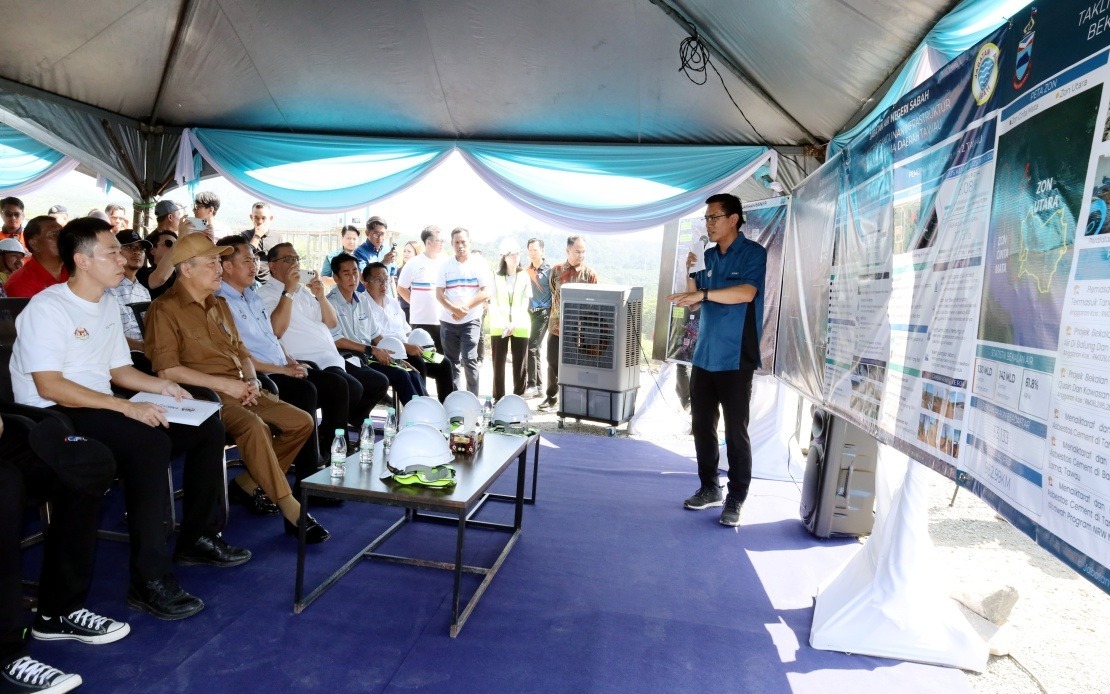
Tawau residents may finally see an end to their decades-long water supply struggles, with the RM450.5 million Tawau Water Supply Scheme Phase III expected to deliver relief before the final months of 2027. The project represents one of Sabah's most significant infrastructure commitments to address the chronic shortfall that has plagued the eastern Sabahan district, where current production of 130 million litres daily falls short of the 142 million litres needed to meet existing demand.
Sabah Chief Minister Datuk Seri Hajiji Noor characterised the scheme's progress as steady despite a contractor request for additional time, emphasising that the administration remains committed to meeting the end-2027 completion target. His comments during an inspection of the Tawau Dam and Cinta Mata 2 Water Treatment Plant construction sites revealed the state government's resolve to tackle a problem that predates the current administration but remains its responsibility to solve. The chief minister also signalled flexibility on budget, indicating willingness to approve supplementary funding if technical assessments from the Sabah State Water Department and the Department of Irrigation and Drainage justify it.
The centrepiece of this massive undertaking is the Tawau Dam itself, which had achieved 74.04 per cent physical completion as of late July. According to Rodney Tinggas, senior assistant director of the JANS Monitoring Branch and project manager, this engineered structure will serve dual purposes: storing 30 million cubic metres of raw water while simultaneously reducing flooding threats that periodically affect downstream communities. The dam's strategic importance extends beyond water security to encompass broader risk management for the Tawau region, making it a cornerstone infrastructure asset for decades to come.
The distribution network being constructed in parallel with the dam represents equally critical infrastructure. Engineers are installing 11.6 kilometres of 700-millimetre diameter raw water pipelines designed to feed three water treatment facilities: the existing Cinta Mata 1 and Utara plants alongside the newly constructed Cinta Mata 2. This tri-facility approach ensures redundancy and flexibility in operations, allowing the Tawau Water Board to manage seasonal variations and maintenance cycles without leaving consumers without service. The combined treatment capacity across all three facilities will reach 161 million litres daily, substantially exceeding current demand and providing substantial headroom for population growth and economic expansion.
The Cinta Mata 2 Water Treatment Plant, carrying a RM299.9 million price tag, represents the most substantial single component of Phase III. This facility alone will contribute 30 million litres of treated water daily once operational, explicitly designed to serve approximately 42,000 consumers across Tawau and surrounding districts. As of late July, the plant had progressed 16.08 per cent of the way through its construction schedule, with full completion targeted for July 22, 2028. The slightly later completion date for this facility compared to the overall scheme deadline suggests careful project management, with planners allowing buffer time for commissioning and quality assurance protocols before declaring the plant fully operational.
Tawau's water account base encompasses 53,133 registered consumers, a figure that underscores the scale of the infrastructure challenge facing planners and engineers. The gap between current supply and demand, though modest in absolute terms at 12 million litres daily, creates persistent shortages that force the water authority to implement rationing during peak periods and low-rainfall seasons. This deficit has constrained economic development and residential expansion, as businesses and households cannot reliably depend on consistent water availability for operations and daily life. The new capacity will eliminate this constraint and position Tawau for accelerated growth comparable to other developed Malaysian cities.
From a regional perspective, Tawau's water scheme reflects broader challenges facing smaller Malaysian cities that have experienced rapid urbanisation without corresponding infrastructure investment. Unlike Kuala Lumpur or Penang, which benefit from established distribution networks and multiple redundant supply sources, towns like Tawau have historically received episodic attention from federal and state authorities. The decision to commit such substantial resources now indicates a shift in policy priorities toward ensuring equitable service delivery across the entire country, not merely in major metropolitan zones. This scheme may serve as a template for addressing similar shortfalls in other under-served regions.
The project timeline merits scrutiny given Malaysia's track record with large infrastructure schemes, many of which encounter delays and cost overruns. The contractor's request for time extension, while noted by the chief minister as manageable, raises questions about underlying technical challenges or supply chain disruptions affecting construction progress. However, the 74 per cent completion rate for the dam as of late July suggests momentum remains positive. If the project maintains this velocity, the end-2027 deadline appears achievable, though project managers will require sustained focus and efficient troubleshooting to prevent further delays.
The financial commitment of RM450.5 million, while substantial, must be evaluated against the long-term economic returns and social benefits. A water-secure Tawau will attract manufacturing enterprises, tourism development, and residential investment that currently seeks locations with assured infrastructure. The reduction in flooding risk offers separate economic benefits by protecting existing properties and enabling development in previously vulnerable areas. For residents enduring regular water rationing, the completion of Phase III will represent transformative quality-of-life improvement, ending a frustration that has persisted for too long.
The scheme also demonstrates evolving cooperation between state agencies in executing major projects. The involvement of JANS, DID, and the state government working in concert suggests institutional capacity has improved since earlier phases encountered difficulties. This coordinated approach, combined with clear political support from the chief minister's office, establishes conditions for successful delivery. The explicit mention of ongoing monitoring and willingness to adjust budgets based on technical assessments indicates a pragmatic rather than rigid approach to project management.
Looking ahead, Tawau residents and business operators should anticipate the dam becoming operational first, with full system capacity arriving once Cinta Mata 2 reaches production status in 2028. The transition to reliable water supply will require customer education on conservation practices, as abundant water often leads to wasteful consumption patterns. Water pricing structures may also require adjustment to reflect the true cost of this enhanced infrastructure and to maintain consumption at sustainable levels. Nevertheless, the end of supply-side scarcity will represent a fundamental shift in Tawau's development trajectory, removing a constraint that has limited progress for years.

