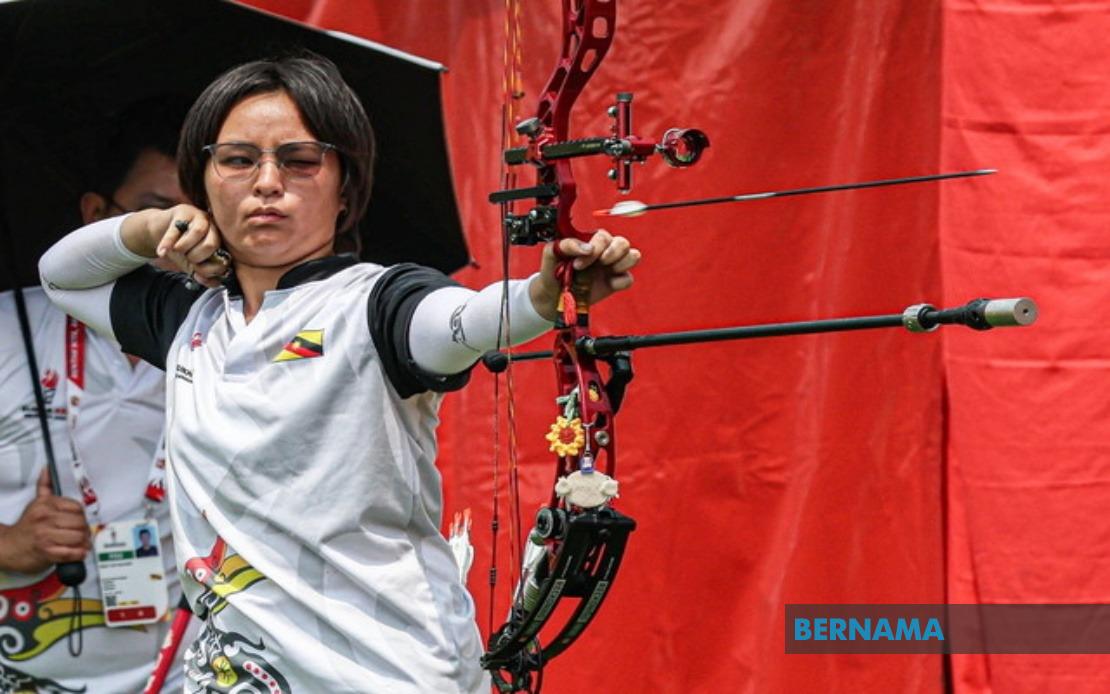
At just 17 years old, Wee Yee Qi has announced herself as a rising force in Malaysian archery by claiming two gold medals on her debut appearance at the SUKMA Games here in Bangi. The Miri-born archer's impressive showing at the National Institute of Valuation (INSPEN) Stadium underscores the mounting competitiveness within the sport at the regional level and represents a significant early achievement for the Sarawak contingent competing in the multi-sport biennial event.
Yee Qi's pathway to this breakthrough performance took an unconventional route. She first made her mark in the mixed team competition, partnering with Eason Lau Hui Wan to capture the mixed pair gold medal. The Sarawak duo edged out Kedah's Muhammad Zaim Ahmad and Ili Nabihan Shafizan with a narrow victory, scoring 151-150 in a tightly contested final. The single-point margin illustrated the razor-sharp competition within compound archery at Malaysia's premier inter-state sporting showcase.
Her maiden SUKMA gold proved merely the opening act. Yee Qi subsequently secured a second medal by anchoring Sarawak's women's team alongside teammates Aira Nadirah Aizuddin and Nur Zara Aisyah Khairul Fadly. The trio combined effectively to overcome Terengganu in a women's team final that required composure under pressure. After trailing through the opening three rounds of shooting, the Sarawak contingent executed a dramatic recovery in the final end, ultimately prevailing 217-213 against their East Coast opponents Airazalia Azrai, Nur Shafiena Mohd Shuhamri and Putri Aqiera Issandra Ismayuddin.
What renders Yee Qi's achievement particularly noteworthy is the timing of her equipment transition. She switched from recurve archery to the compound discipline only late in 2025, meaning her SUKMA triumph arrived within roughly eight months of making this significant technical and tactical shift. Such rapid adaptation and immediate competitive success at national level competition represents an encouraging sign for Malaysia's archery development pipeline and suggests that targeted investment in coaching and athlete support can yield swift returns.
Speaking after her victories, Yee Qi demonstrated the reflective maturity typical of successful young athletes. She credited her coaching team for facilitating her successful transition and acknowledged the competitive experience gained through participation at various tournaments throughout her relatively brief archery career. Having discovered the sport just six years ago through a school talent identification program, she has progressed from casual participant to national medalist, a trajectory that owes significantly to sustained family encouragement and institutional support.
Despite her current focus on archery, Yee Qi must now balance her sporting ambitions with academic responsibilities. She will sit for the Sijil Pelajaran Malaysia (SPM) examination in November, making the examination period a crucial transition point where she must compartmentalise her energies between final-year secondary schooling and her emerging athletic career. Many Malaysian sporting talents have faltered at precisely this juncture, unable to manage competing demands, yet her measured approach suggests strategic awareness.
Looking beyond her immediate academic obligations, Yee Qi has articulated a clear long-term sporting vision centred on national representation at senior level. This aspiration aligns with Malaysia's broader efforts to strengthen its performance across Olympic and international archery circuits. The nation has historically struggled to maintain consistent medal pipelines in archery at major competitions, making the emergence of technically proficient young shooters like Yee Qi genuinely significant for medium-term competitive prospects.
Her trajectory also highlights an important dynamic within Malaysian sport: the comparative advantage that smaller states can occasionally derive from concentrated investment and coaching excellence. Sarawak's two golds in compound archery suggest that the state has developed coaching infrastructure capable of producing competitive shooters, a finding that could inform national talent management strategies across other sports and disciplines.
Beyond Yee Qi's personal success, the broader compound archery competition at SUKMA 2026 demonstrated healthy competitive depth. Selangor's mixed pair of Muhammad A'rif A'fiq Suhaimi and Nur Alyaa Nazurah Fadzil Fairuz captured the mixed team bronze medal with a 154-152 victory over Sabah's Hiew Ichin and Catherine Looi Mei Qi Abdullah. Similarly, Selangor's women's team comprising Amira Batrisyia Mohamad, Nur Alya Sofrina Mohd Sarif and Nur Alyaa Nazurah Fadzil Fairuz secured women's team bronze by defeating their opponents 219-212. This distribution of medals across multiple states indicates that archery capability in Malaysia extends beyond traditional powerhouses, suggesting broader grassroots development is occurring.
For emerging athletes in Malaysian sport, Yee Qi's story carries instructive lessons about the value of strategic transitions and the willingness to shift disciplines when circumstances demand. Her decision to abandon recurve, where she had struggled to achieve distinction, in favour of compound archery demonstrates the importance of honest self-assessment and flexibility in pursuit of excellence. Such pragmatism, combined with supportive coaching and family backing, creates conditions for rapid advancement that benefit both individual athletes and national sporting aspirations across Southeast Asia's broader competitive landscape.

