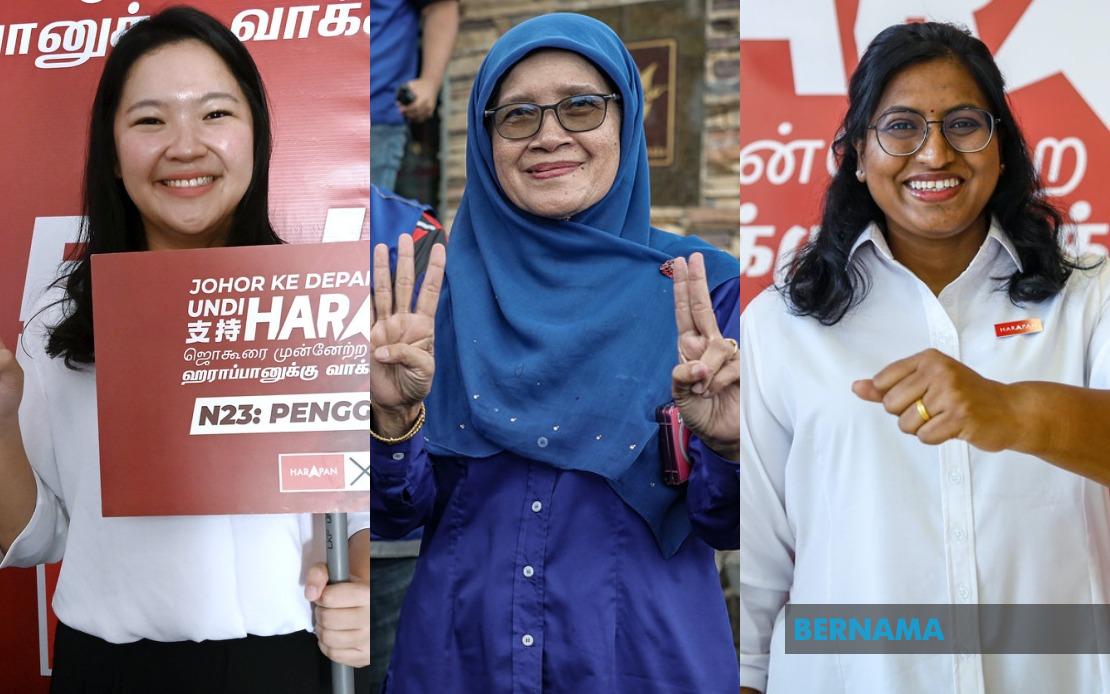
The 16th Johor State Election has returned ten women to the State Legislative Assembly, a result that reflects the state's willingness to support female political candidates despite women comprising less than one-fifth of the total contestant pool. Seven of the successful candidates represented Barisan Nasional, while Pakatan Harapan secured three seats through its female representatives. This outcome provides a mixed narrative about gender representation in Malaysian state politics—while women's electoral success demonstrates their viability as political leaders, their underrepresentation in candidate nomination processes remains a persistent challenge across both major coalitions.
Barisan Nasional's female representatives present a varied profile of political experience and electoral performance. Nadhirah Afiqah Abdull Rahim, making her debut in the Serom constituency, secured a commanding majority of 9,406 votes against both Perikatan Nasional and Pakatan Harapan challengers. Her victory is particularly notable given that she was contesting for the first time while holding the position of Ledang Puteri UMNO chief, suggesting that organizational support and party machinery backing can substantially assist new female candidates in their inaugural electoral campaigns.
The performance of other BN women candidates underscores the coalition's electoral dominance in Johor, though with varying margins of success. Nor Rashidah Ramli's victory in Parit Raja delivered significantly expanded support compared to the 2022 state election, with her majority more than tripling from 4,219 votes to 13,576 votes. This dramatic swing indicates that the electorate either grew more convinced of her capabilities or that local issues worked substantially in BN's favour during this cycle. Similarly, Norlizah Noh in Johor Lama recorded a substantial majority of 16,344 votes, defeating the youngest candidate in the entire election—a symbolic representation of generational change within Malaysian politics where age remains a secondary consideration to party affiliation and local standing.
Some of BN's female representatives delivered outcomes that defied conventional political expectations. Chan San San's capture of the Johor Jaya seat represented a genuine upset, as this constituency had long been regarded as a stronghold of the Democratic Action Party, which traditionally appeals to urban Chinese voters. Her accumulation of 35,971 votes across a four-candidate field suggests either a significant shift in voter preferences or exceptional individual appeal that transcended normal partisan alignments. This breakthrough is particularly consequential for BN's efforts to expand its urban support base, an area where it has historically faced challenges in Malaysian electoral politics.
Incumbent representatives also demonstrated resilience in their re-election bids. Alwiyah Talib secured her third consecutive term in Endau with a majority of 3,041 votes, albeit against a four-candidate field that included candidates from Perikatan Nasional, the Malaysian Orang Asli Party, and Pakatan Harapan. The closer margin in her victory compared to some other BN women suggests that while she retains constituent loyalty, competition for the seat has intensified. Hasrunizah Hassan's successful defence of Pulai Sebatang against Pakatan Harapan's challenge saw her majority expand by 6,325 votes compared to 2022, indicating that her representation has deepened rather than eroded local support.
Pakatan Harapan's three successful female candidates each represent different political circumstances and strategic positions within the coalition. Felicia Poh Rui Ling, at just 28 years old, achieved a maiden victory in Penggaram with a majority of 4,137 votes in a direct contest against the Barisan Nasional incumbent. Her youth and successful debut suggest that Pakatan Harapan is cultivating a new generation of female political talent capable of competing effectively in state-level contests. Chu Poh Yee retained the Mengkibol seat for the coalition with a majority of 4,213 votes, indicating a more modest but still decisive popular mandate.
The most electorally dominant female performer from Pakatan Harapan was Kartiyaini Jeyapalan, a lawyer representing Skudai, who secured a substantial majority of 15,280 votes in a four-cornered contest. Her professional background in law aligns with broader trends in Malaysian politics where legal expertise has become an increasingly valuable asset for candidates seeking to project competence and credibility. Skudai's characterization as a traditional Pakatan Harapan stronghold provided her with a more favourable electoral landscape, yet her majority was substantial enough to suggest personal popularity beyond mere party affiliation.
The numerical context of women's participation in this election warrants closer examination. The 34 female candidates represented approximately one-fifth of the total 172-candidate field, a proportion that remains disproportionate to women's representation in the general population. This nomination gap means that regardless of how successfully individual female candidates perform, their aggregate political influence remains constrained by their limited numbers in candidacy. Malaysian political parties have not yet achieved parity in candidate selection, despite rhetorical commitments to gender inclusion.
The performance differential between Barisan Nasional and Pakatan Harapan's female candidates reflects broader electoral dynamics in Johor. With BN capturing 48 of 56 total seats while PH secured only eight, the coalition's female representatives benefited from the wave of BN support that swept through the state. The three Pakatan Harapan women who won their contests did so by narrower margins in most cases, and primarily in constituencies where the coalition retained residual strength despite the broader statewide swing toward Barisan Nasional.
For Malaysian political analysis, this election illustrates that female candidates can compete effectively and win electoral mandates across different party affiliations and constituency types—from rural seats to urban strongholds. However, progress remains incremental rather than transformative. The consistency of results across both major coalitions suggests that women's electoral viability is increasingly accepted as a principle, yet their nomination rates indicate that party leadership structures continue to reserve the majority of winnable seats for male candidates. Future electoral cycles will need to demonstrate whether the parties are genuinely committed to expanding female representation through nomination strategies, or whether women's political advancement will remain dependent on individual candidate qualities rather than systemic organizational change.

