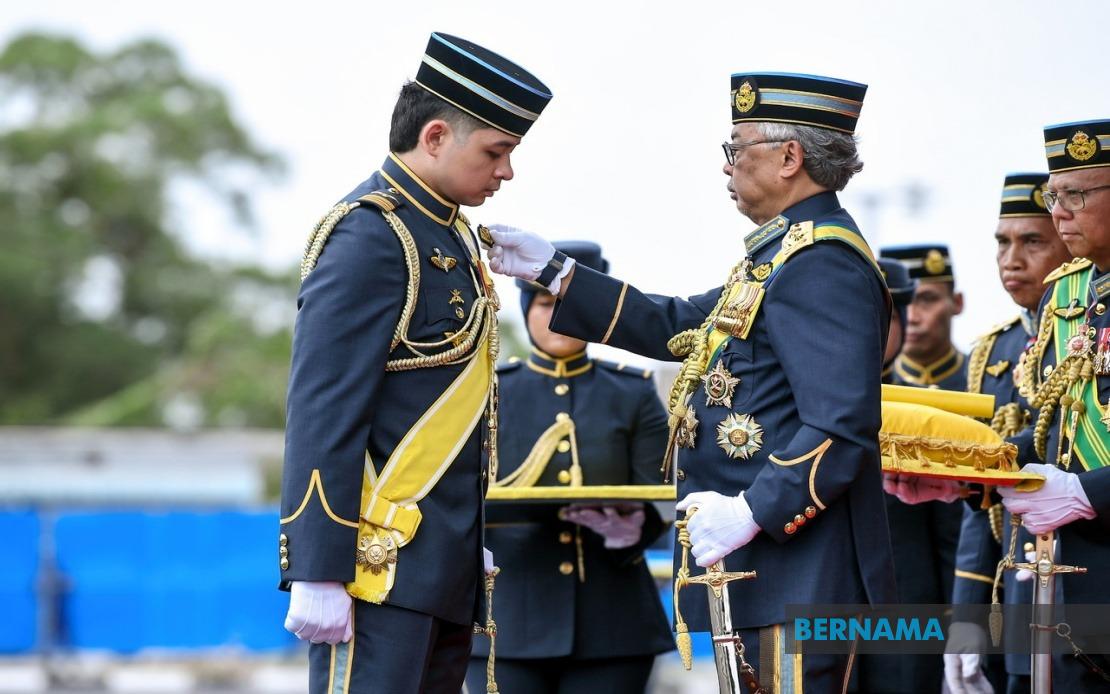
In a ceremonial milestone for Malaysia's monarchy, the Tengku Mahkota of Pahang, Tengku Hassanal Ibrahim Alam Shah Ibni Al-Sultan Abdullah Ri'ayatuddin Al-Mustafa Billah Shah, has etched his name into aviation history by successfully completing the Basic Helicopter Flying Course at the Royal Malaysian Air Force Air College in Alor Setar. The distinction marks the first occasion that any member of the Pahang royal household has undertaken and graduated from this demanding military aviation programme, underscoring a deepening engagement between the royal institution and the nation's defence services.
The flying wings were formally presented during a ceremony held at the Air College parade ground, where 40 graduates received their prestigious insignia in recognition of their accomplishments. Beyond the Tengku Mahkota's achievement, the gathering honoured 39 personnel drawn from Malaysia's three armed forces branches, including 37 student pilots and two weapons systems specialists. The breadth of the intake reflects the rigorous recruitment and training standards maintained by the air force in developing its next generation of aviation personnel across multiple operational specialities.
The Tengku Mahkota's participation in the 67(A)/26 Basic Helicopter Flying Course spanned a concentrated two-month intensive programme commencing in early June and concluding at the end of July. Throughout this period, trainees operated the EC120B Colibri helicopter, an aircraft selected for its suitability in teaching fundamental flying techniques. His completion encompassed a comprehensive battery of assessments that measured different dimensions of pilot competency: the Basic Handling Test evaluated fundamental aircraft control and manoeuvring, the Instrument Flying Test confirmed proficiency in navigating by reference to cockpit instruments alone, the Final Navigation Test demonstrated route-finding and situational awareness capabilities, and the Final Handling Test provided the ultimate examination of integrated flying ability.
The formal bestowal of wings came from Sultan Al-Sultan Abdullah Ri'ayatuddin Al-Mustafa Billah Shah, the reigning Pahang monarch who simultaneously holds the appointment of Colonel-in-Chief of the Royal Malaysian Air Force. This dual role positions the Sultan as both ceremonial head of the state and senior patron of the air force, a connection that lends particular significance to his presentation of these symbols of achievement. The Sultan's presence and active participation in the ceremony reinforced the institutional bond between the monarchy and the armed forces, a relationship that remains central to Malaysia's constitutional and military framework.
The graduation cohort encompassed participants from four distinct flying training streams, each designed to prepare personnel for different roles within the air force's operational structure. The concentration of helicopter courses—with two separate basic helicopter programmes represented—reflects the sustained importance of rotary-wing aviation to Malaysia's defence posture, whether for transport, reconnaissance, or maritime operations. The inclusion of a basic weapon systems officer course acknowledges the increasingly technical nature of modern air operations, where specialists operating sensors and targeting systems prove as crucial as pilots themselves.
Air Force Chief General Tan Sri Muhamad Norazlan Aris addressed the assembled graduates and spectators, attributing their success to a constellation of personal qualities cultivated throughout their training regimen. He emphasised that perseverance, fighting spirit, mental resilience, and rigorous discipline formed the bedrock upon which these achievements rested. His remarks extended recognition beyond the graduates themselves to the families and relatives whose sustained prayers and encouragement constituted an invisible but vital support structure underpinning each individual's progression through the demanding course.
In his address, the Air Force Chief delivered a perspective that transcended the immediate celebration of training completion. He characterised the presentation of flying wings not as a conclusion but rather as a commencement, the opening chapter of a far more consequential narrative in which graduates would shoulder expanded responsibilities and trust within the service. This framing reflects a measured institutional understanding that technical qualification represents merely the initial qualification for roles demanding ongoing development, judgment refinement, and deepening operational experience.
The symbolic significance of the flying wings themselves—worn prominently on the uniform chest—received particular emphasis in the Chief's remarks. These insignia embody not merely personal achievement but rather concentrate within themselves the collective honour, aspirations, and confidence that the air force and the broader nation have invested in their recipients. This characterisation elevates the wings beyond a decorative credential, positioning them as tangible reminders of the solemn obligation that accompanies their wearing.
For Malaysia's aviation community and defence establishment, the Tengku Mahkota's successful completion carries implications beyond the personal achievement of a single individual. The royal family's demonstrated engagement with military aviation training sends a signal regarding institutional continuity and the monarchy's active interest in the defence sector's development and modernisation. His presence alongside 39 other graduates from operational units underscores that military aviation remains a serious, professionally demanding domain where individuals regardless of background must satisfy identical technical and fitness standards.
The ceremony also recognised outstanding performers through the presentation of six awards distributed among graduates demonstrating excellence across flying proficiency, academic achievement, disciplinary record, and leadership qualities. These distinctions serve the practical function of incentivising high performance whilst simultaneously identifying personnel demonstrating potential for accelerated responsibility and advancement within the air force's career structures.
The successful completion of this training intake occurs within a broader context of Malaysian military modernisation and the air force's ongoing efforts to maintain operational readiness across its diverse mission portfolio. The diversity of training courses represented—from basic helicopter flying through to weapons systems officer specialisation—illustrates the multi-faceted skill sets that contemporary air operations demand. Each graduating cohort contributes incremental but essential capability reinforcement to the service's personnel establishment.
Looking forward, these newly winged personnel will disperse across the Royal Malaysian Air Force's operational units, bringing their recently acquired skills and fresh qualifications to squadrons and bases nationwide. The Tengku Mahkota's integration into this professional continuum, despite his distinguished status, carries broader symbolic weight regarding the meritocratic principles that underpin military institutions. His successful progression through identical assessment protocols as his fellow graduates affirms that the armed forces maintain uniform standards of competency and professionalism, a principle fundamental to institutional cohesion and public confidence.

