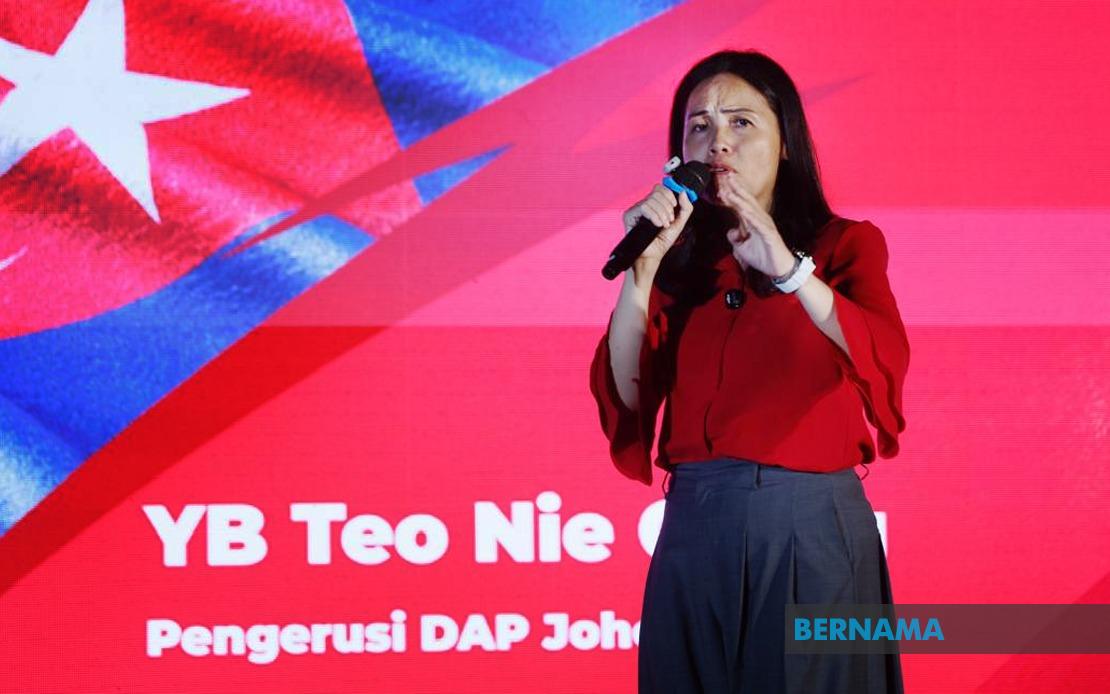
Johor DAP chairman Teo Nie Ching launched a pointed challenge to the state government's plan to create appointed state assemblymen positions, questioning the underlying motives behind a mechanism that she argues could compromise democratic transparency. Speaking at a Pakatan Harapan rally in Paloh ahead of Saturday's state election, Teo raised concerns about how appointed representatives would circumvent the electoral scrutiny that elected officials must face. Her comments highlight growing debate within the coalition about the constitutional amendments passed in May that authorise the appointment of up to five state assemblymen, a development critics fear could weaken accountability in the legislative process.
The appointment framework, endorsed by the Johor State Legislative Assembly in May, marks a notable departure from purely electoral representation. Teo, who also serves as National DAP Wanita chairman and Deputy Communications Minister, pressed the state government to clarify precisely who would be appointed and under what criteria. Her line of questioning pointedly referenced the ruling coalition's reliance on PAS support in the state, suggesting that political calculations rather than administrative efficiency might be driving the reform. The implications are significant for Malaysia's regional democratic standards, as Johor's approach could establish precedent for other state assemblies considering similar measures.
Teo's fundamental objection centres on the democratic deficit created when legislators bypass electoral accountability. Appointed representatives, she noted, would not have undergone the rigorous public scrutiny of voters at the ballot box, creating a structural weakness in the transparency that underpins representative democracy. She called on the state government to furnish comprehensive explanations to the public, arguing that failure to do so would inevitably fuel suspicion and erode public confidence in state administration. This concern resonates beyond Johor's borders, as Southeast Asia's democracies grapple with balancing institutional flexibility against the fundamental principle that legitimacy flows from popular mandate.
Despite her criticism of the appointed assemblymen mechanism, Teo mounted a vigorous defence of the Unity Government's broader reform agenda, particularly emphasising achievements in education and social policy. She acknowledged that the MADANI administration remains imperfect and falls short of ideal governance standards, but contended that meaningful, measurable changes have been implemented across critical portfolios. Her willingness to critique specific policies while defending the broader coalition reflects the tension within the unity framework, where component parties maintain policy autonomy whilst maintaining electoral solidarity. This balancing act will be crucial as the coalition seeks to retain support in Saturday's elections and beyond.
Among the educational reforms Teo highlighted was the guarantee of matriculation placement for all SPM students achieving ten As, regardless of socioeconomic background—a shift that addresses longstanding equity concerns in Malaysia's tertiary education pipeline. The expansion of university access for Unified Examination Certificate holders represents another significant opening, extending opportunities to students from Chinese independent schools who previously faced restricted pathways into public higher education. These changes signal a deliberate attempt to broaden educational access beyond traditional hierarchies, addressing grievances that have simmered within Malaysia's multicommunal education system.
Budgetary allocation increases underscore the government's stated commitment to substantive rather than rhetorical reform. The allocation to Chinese independent schools has more than doubled from RM12 million in 2019 to RM20.16 million in the current year, a trajectory that demonstrates measurable resource commitment to previously marginalised educational institutions. For Chinese-medium education advocates, particularly within DAP's constituency, such figures carry symbolic and practical weight, validating the party's participation in a coalition that was initially viewed with suspicion by portions of the Chinese community. Teo's invocation of these numbers serves both as accomplishment summary and implicit argument for continued coalition governance.
The timing of Teo's remarks—delivered during a state campaign rally just days before voting—reflects the strategic calculations governing coalition messaging in Johor. As a Deputy Communications Minister and sitting federal legislator, Teo's comments carry weight beyond local faction politics, signalling how the national unity framework evaluates its own performance and priorities. Her simultaneous critique of one policy mechanism whilst championing systemic reforms demonstrates how the coalition navigates internal disagreements without fragmenting public messaging. This delicate equilibrium becomes increasingly important as parties position themselves for the 2026 general election, which Teo invoked directly.
The election context provides essential background for understanding both Teo's criticisms and her defence of the government. Approximately 2.7 million voters will cast ballots Saturday to select 56 state representatives, making this a significant test of coalition cohesion in Johor—the nation's second-most populous state and a critical battleground in Malaysia's political competition. The presence of DAP National chairman Gobind Singh Deo alongside Teo at the Paloh rally underscores the centrality of this state contest to federal coalition dynamics. PH candidate for Paloh, Dr Ruban Arumugam, embodied the coalition's multiethnic composition, further illustrating the deliberate representation balancing that characterises the unity framework.
Teo's invocation of democracy as a long-distance endeavour positions incremental reform within a temporal framework that extends beyond immediate electoral cycles. Her characterisation reflects the coalition's implicit argument that institutional transformation cannot occur overnight and that patience with imperfect progress represents the rational response to Malaysia's complex governance challenges. This framing attempts to counter both opposition criticism from more radical reform constituencies and internal scepticism about whether the unity government genuinely represents transformative change. For Malaysian voters assessing the coalition's stewardship, such arguments must be weighed against visible frustrations with implementation pace and the persistence of structural inequities despite policy innovations.
The appointed assemblymen controversy specifically raises questions about whether reform efforts extend sufficiently into the mechanisms of political power concentration. Critics might contend that while education and welfare represent important domains, they remain secondary to questions about how elected positions themselves are allocated and protected. Teo's challenge to the Johor government suggests that even within the coalition, concerns persist about whether component parties are surrendering oversight to executive branches in ways that ultimately undermine the democratic gains the coalition claims to champion. This internal tension will likely persist throughout the coalition's remaining tenure and shape debate surrounding proposed institutional reforms.
Looking forward to Saturday's election and the 2026 general election cycle Teo explicitly referenced, the outcomes in Johor will signal whether voters reward the coalition's systemic reforms or punish perceived governance shortcomings. The state has historically served as a bellwether for national political trends, making its electoral trajectory consequential for coalition confidence and opposition strategy. For Malaysian readers assessing the nation's political direction, Teo's simultaneous defence of achievements and critique of concerning mechanisms offers a window into how the coalition's internal negotiations are proceeding and where tensions between parties remain unresolved. The assigned assemblymen question ultimately reflects broader uncertainty about whether Malaysia's unity framework represents a stabilising transition or an unstable equilibrium masked by policy accomplishments.

