The controversy surrounding the use of a state-organised technical education programme for political purposes has thrust election conduct into the spotlight just days before Johor voters go to the polls. Johor DAP chairman Teo Nie Ching levelled serious questions at Menteri Besar Datuk Onn Hafiz Ghazi following reports that students attending the Johor MARA TVET Roadshow at the Inland Revenue Board Hall in Kluang on July 4 were allegedly directed to support the Barisan Nasional candidate, raising concerns about the blurred line between government activities and party campaigning.
The timing of the incident—occurring midway through the state election campaign—has amplified concerns over how state resources and institutions may be deployed during electoral contests. According to complaints received by the DAP, vocational training students were reportedly informed that attendance at the TVET roadshow was mandatory, with non-participation potentially recorded as absenteeism. This framing transforms what would ordinarily be an educational or developmental initiative into something bearing the hallmarks of compulsion, creating potential legal and ethical complications around the use of state power during an election period.
What distinguishes this allegation from routine campaign activity is the institutional context. The roadshow was framed as a government programme rather than an explicitly political event, yet Teo's account suggests it served a dual purpose. By operating under the banner of vocational education promotion while simultaneously channelling students toward support for a specific BN candidate, the event blurs the essential democratic distinction between state apparatus and party machinery. This distinction carries particular weight in Malaysia's constitutional framework, where the neutrality of public institutions during elections is supposed to be preserved to ensure fair contest among contending parties.
Teo's articulation of the complaint emphasised the democratic principle at stake rather than mere partisan grievance. She stressed her concern as a mother and citizen about students being compelled to attend a programme and subsequently subjected to partisan messaging. The possession of supplementary evidence—including the programme itinerary, attendance directive letters, and video recordings allegedly capturing campaign-oriented remarks—suggests this is not speculation but rather documented concern. Such documentation may prove relevant should the Election Commission conduct any investigation into potential violations of electoral guidelines.
The question of whether a government facility can be appropriated for party campaigning extends beyond Onn Hafiz's individual conduct to encompass institutional practice. If the LHDN Hall was indeed used for a political campaign event, this raises broader questions about the protocols governing allocation of public venues during election periods. Malaysian electoral law contemplates a separation between campaign activities and state machinery; when government buildings become venues for party messaging, that separation erodes. Teo's call for clarity on whether this was truly a government programme or a disguised party event cuts to the heart of the matter.
The Deputy Communications Minister also addressed a secondary dimension of the Menteri Besar's recent conduct—his public criticism of federal government policies as burdensome to Johor residents. Teo countered that such criticism employs selective attribution: state leaders claim credit for popular policies while distancing themselves from unpopular ones, invariably attributing blame upward to the federal government or opposition coalition partners. She underscored that major policies require Cabinet approval, meaning the state government is complicit in implementing them rather than a passive victim of federal imposition. This argument frames Onn Hafiz's policy critique as politically opportunistic rather than substantively reasoned.
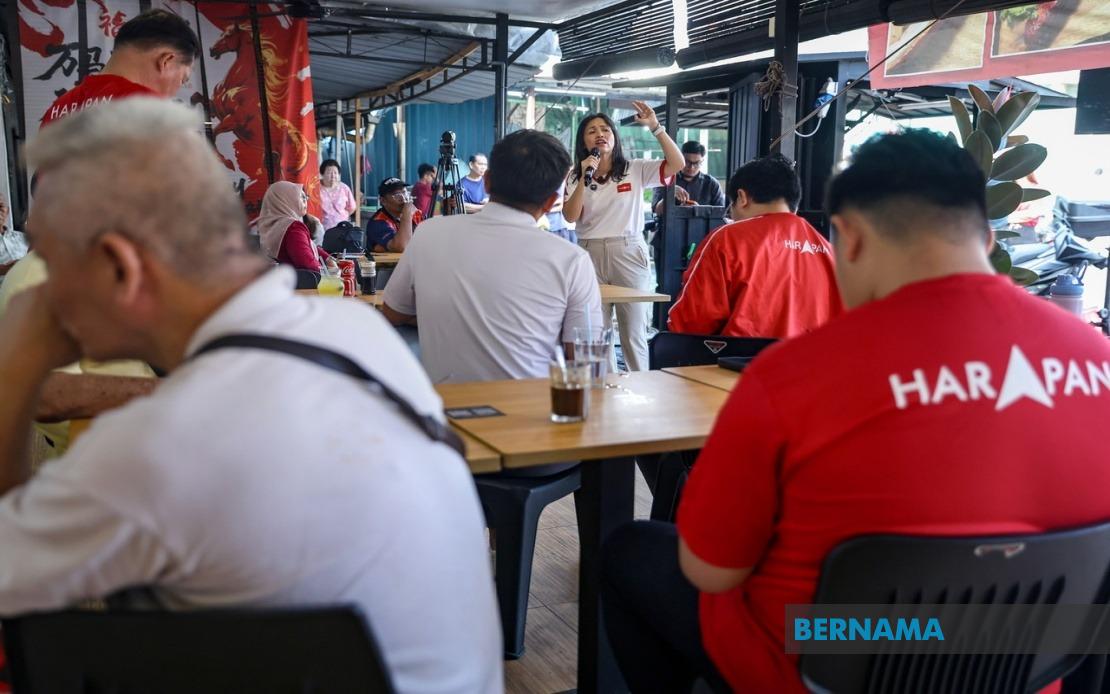
Lim Kit Siang's parallel intervention at the Kedai Kopi forum centred on a broader appeal to Malaysian voters to move beyond racial and communal lines of division. The Pakatan Harapan veteran articulated a vision of unity predicated on shared values of equality, freedom and prosperity rather than ethnic or religious identity. His call for voters to consolidate rather than fragment their support carries particular resonance in a state election where demographic complexity and coalition dynamics create temptations for strategic voting across different electoral tiers. His framing positions the election not merely as a contest for state seats but as a referendum on Malaysia's political direction.
The Johor election itself represents a significant electoral test in a state long considered a Barisan Nasional stronghold. With 172 candidates competing across 56 state seats, the contest encompasses multiple dimensions: the performance of the BN coalition under Onn Hafiz's leadership, the capacity of Pakatan Harapan to consolidate opposition support, and the appeal of alternative political narratives to voters. The allegation of improper campaign conduct, if substantiated, could inflict reputational damage on the incumbent administration at a critical juncture. Even if the legal consequences prove limited, the perception of institutional impartiality—crucial to election legitimacy—would be compromised.
The procedural path forward remains open. Teo indicated that Pakatan Harapan candidates could lodge formal complaints with the Election Commission should they deem the evidence sufficient. The EC would then investigate whether the conduct contravened electoral guidelines regarding state resources and institutional neutrality. Such investigation, while potentially time-constrained given the imminent polling date of July 11, would establish an official record and potentially lead to remedial measures or sanctions. The early voting occurring on the day of Teo's statement means that the controversy unfolds against a backdrop of accelerating electoral activity.
The broader implications for Malaysian electoral practice merit consideration. If state institutions and resources are routinely commandeered for campaign purposes, the principle of free and fair elections becomes substantially compromised. Opposition parties typically possess fewer resources and institutional advantages than governing coalitions; allowing government facilities and student populations to be deployed for campaigning further tilts the playing field. The challenge facing electoral regulators and political stakeholders is establishing and maintaining clear boundaries between legitimate government activity and partisan campaigning, particularly when such boundaries may not always be self-evident.
For Southeast Asian observers, the Johor incident reflects familiar tensions in the region's electoral democracies. Many states grapple with questions of how to prevent governing parties from exploiting institutional advantages, how to ensure neutrality of public facilities and personnel, and how to maintain meaningful electoral competition when state resources can be mobilised for campaign purposes. Malaysia's experience, while distinctive in its constitutional arrangements and political traditions, intersects with broader regional challenges in consolidating democratic practice beyond the formal machinery of elections themselves.

