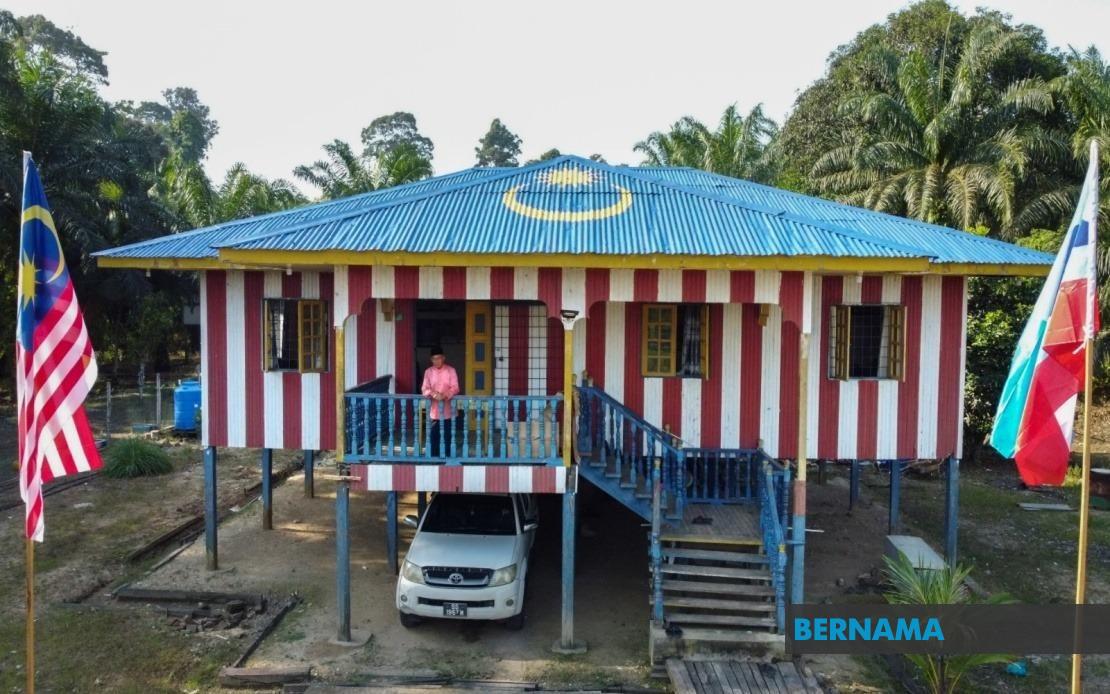
In the Sandakan neighbourhood of Batu 15, Jalan Labuk, a distinctive residence stands as a testament to personal devotion to nation and country. The house, christened Teratak Gemilang, belongs to 68-year-old entrepreneur Mohd Halikin Angga, who over two decades ago embarked on an unconventional journey to express his patriotism through architecture and colour. What began as a personal creative endeavour has evolved into a recognisable landmark that stops visitors in their tracks, particularly during the National Day period when Malaysian flags and symbols take on heightened significance across the country.
Mohd Halikin's decision to paint his wooden residence in the distinctive red, white, blue, and yellow hues of the Jalur Gemilang emerged from a simple yet profound emotional experience. The conception of Teratak Gemilang traces back to 2004, when the entrepreneur reflected on his observations during National Day celebrations. He grew disheartened each time flags were dismantled after the festivities concluded, but his sadness deepened when he witnessed discarded flags littering roadsides—blown away by wind or fallen from vehicles—a sight that troubled his sense of national reverence. This emotional catalyst prompted him to consider a more permanent expression of patriotic sentiment, one that would endure beyond the annual calendar of national commemorations.
The visual impact of Teratak Gemilang extends far beyond a simple paint job. The deep-blue roof crowns the structure with a golden-yellow crescent moon and 14-pointed star, replicating the core symbolic elements of Malaysia's flag. Below, the walls display bold red and white horizontal stripes, while multiple Jalur Gemilang flags wave proudly throughout the compound. Every architectural detail has been thoughtfully incorporated to maximise the patriotic effect, demonstrating Mohd Halikin's meticulous attention to translating national symbolism into tangible, three-dimensional form. The house has become instantly recognisable within Sandakan, standing apart from its surroundings through its unapologetic display of national identity.
Beyond its exterior transformation, Teratak Gemilang functions as a personal museum of Malaysian leadership and history. Visitors entering the home encounter a curated mini gallery featuring portraits of the Yang di-Pertuan Agong, the Yang di-Pertua Negeri Sabah, and a comprehensive collection of prime ministerial portraits spanning from Tunku Abdul Rahman Putra Al-Haj to the present incumbent. This chronological display serves as a visual narrative of Malaysia's post-independence evolution, allowing visitors to trace the succession of national leadership across generations. The living room has been deliberately designed as a space for contemplation and education, where Malaysian history becomes tangible through carefully selected imagery.
Among Mohd Halikin's most prized possessions is a historical photograph documenting Tunku Abdul Rahman meeting with twenty North Borneo leaders in 1961 during discussions that would ultimately lead to the formation of Malaysia. The acquisition of this image reflects the entrepreneur's determination and reverence for historical documentation. During a flight to perform Umrah in 2005, Mohd Halikin encountered the photograph in a newspaper and requested permission from cabin crew to retain it. This small act of initiative transformed what could have been a fleeting moment into a permanent fixture of his collection, demonstrating how personal agency and genuine interest can preserve national heritage.
Mohd Halikin's patriotism extends into the intimate sphere of family nomenclature, revealing how his love for country permeates every life decision. Among his seven children, three bear names directly connected to prominent national figures and respected statesmen. His eldest son carries the name of Tun Dr Mahathir Mohamad, his second child honours Tun Abdullah Ahmad Badawi, while his sixth child, Nur Zahirah, was named after the 13th Raja Permaisuri Agong. Rather than viewing names as arbitrary designations, Mohd Halikin conceptualises them as vessels of aspiration and remembrance. He articulates this philosophy with clarity: names function as bridges connecting successive generations to the contributions and legacies of past leaders, embedding historical awareness into the fabric of family identity.
The impact of Teratak Gemilang has transcended the private sphere, becoming a cultural landmark that attracts visitors and photographers particularly during Malaysia's National Month. The house functions as an informal tourist attraction within Sandakan, drawing attention from locals and visitors alike who recognise its symbolic significance. During August and the lead-up to Malaysia Day celebrations, the residence experiences increased foot traffic as citizens seek tangible expressions of national pride and patriotic sentiment. This spontaneous social phenomenon suggests that Mohd Halikin's personal expression has resonated with broader Malaysian society, indicating a hunger for visible manifestations of national identity and collective pride.
Mohd Halikin remains steadfast in his commitment to maintaining Teratak Gemilang's distinctive appearance indefinitely. He views the continued preservation of the house's patriotic colour scheme not merely as aesthetic choice but as an active contribution to sustaining national consciousness. The entrepreneur harbours a specific aspiration for the residence's long-term significance: he envisions Teratak Gemilang functioning as a continuing source of inspiration for Sabah's multiracial and multicultural community. In an era when national unity faces various pressures and social fragmentation persists, symbolic gestures that transcend ethnic and religious boundaries become increasingly valuable. Mohd Halikin explicitly hopes that his colourful home will strengthen bonds of unity across Sabah's diverse population, particularly during significant national observances.
Looking toward 2026, when Malaysia will commemorate both National Day and Malaysia Day, Mohd Halikin positions Teratak Gemilang as a potential focal point for renewed patriotic consciousness. The double celebration presents an opportunity for reflection on Malaysia's journey—both as an independent nation and as a federation incorporating diverse states and peoples. In this context, Teratak Gemilang represents more than one man's creative expression; it embodies a philosophy that patriotism need not be confined to official ceremonies or government initiatives. Rather, grassroots expressions of national sentiment, when executed with genuine intention and maintained with consistency, can contribute meaningfully to social cohesion and shared national purpose.
The significance of Teratak Gemilang extends beyond Sandakan's borders, offering insights relevant to Malaysian and Southeast Asian political culture more broadly. In a region where nation-building remains an ongoing process and where multiethnic and multireligious societies continue navigating questions of identity and belonging, individual contributions to collective national consciousness carry particular weight. Mohd Halikin's initiative demonstrates how personal resources, creativity, and dedication can generate public goods—in this case, a tangible reminder of national identity accessible to all visitors. The house implicitly argues that patriotism is not exclusively the domain of politicians or institutional actors; ordinary citizens possess agency to shape how their nation represents itself in public space.
Mohd Halikin's motivation, rooted partly in honouring his parents who lived through colonial subjugation, adds temporal dimension to his patriotic expression. His parents' generation directly experienced the transition from colonial rule to independence, making their lived experience particularly relevant to understanding Malaysian national formation. By naming his children after national leaders and transforming his residence into a patriotic monument, Mohd Halikin attempts to transmit intergenerational consciousness of national sacrifice and achievement. This represents a deliberate counter-narrative to forms of historical amnesia that can afflict rapidly modernising societies, where contemporary concerns may obscure appreciation for foundational national struggles and accomplishments.
The phenomenon of Teratak Gemilang also raises questions about how communities express civic engagement and patriotic sentiment in contemporary Malaysia. Rather than confining patriotism to official state occasions or formal political participation, Mohd Halikin's approach suggests alternative channels through which citizens can contribute to national discourse and cultural production. His home functions simultaneously as private residence, personal museum, and public monument—a hybrid status that challenges conventional categories while serving multiple social functions. The voluntary transformation of private property into semi-public cultural space demonstrates innovative thinking about how ordinary citizens can contribute to nation-building activities without requiring government endorsement or institutional support.

