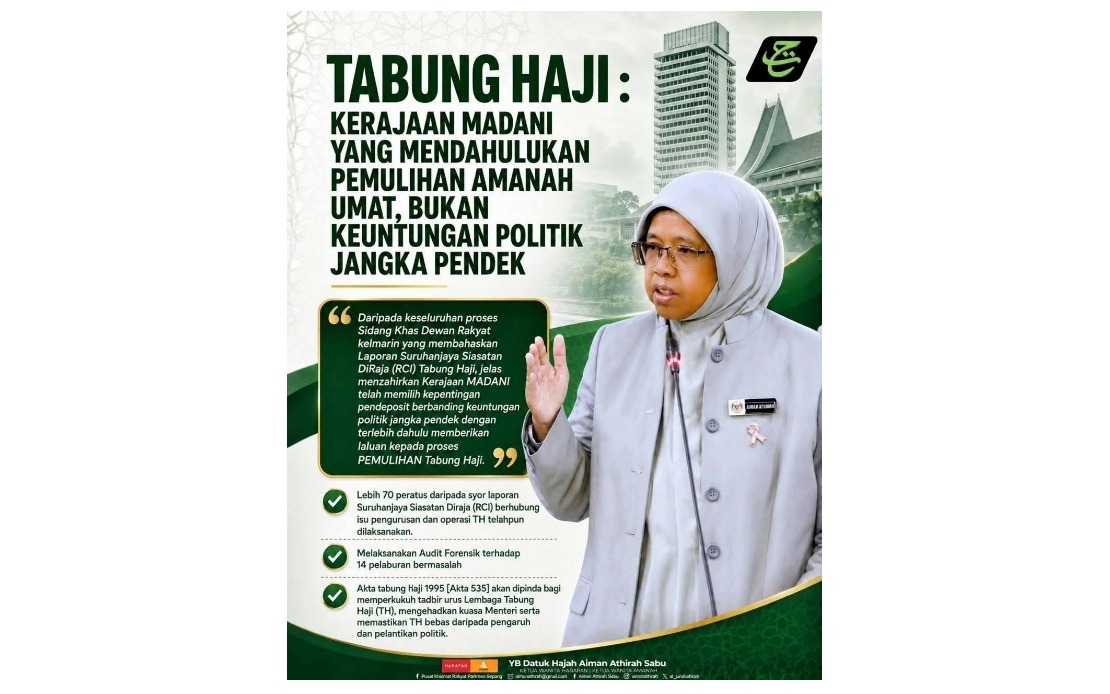
The Malaysian government is deliberately moving cautiously with the disclosure of the Tabung Haji Royal Commission of Inquiry report to protect the financial wellbeing of more than 10 million depositors rather than chase immediate political advantage, according to Datuk Aiman Athirah Sabu, Deputy Minister of Housing and Local Government. Her statement represents a direct pushback against critics who have questioned the timing and manner in which authorities have handled the sensitive findings regarding governance failures at the Islamic pilgrimage savings institution.
The strategic restraint reflects broader concerns about the fragility of public confidence in Tabung Haji, which manages the accumulated savings of millions of Malaysians intent on fulfilling the hajj pilgrimage. Any abrupt or poorly managed revelation of the RCI's findings risks triggering large-scale withdrawals that could destabilise the institution's operations. The government is acutely aware of precedent: in 2018, withdrawals exceeding RM6 billion were recorded after serious governance issues surfaced, demonstrating how rapidly public anxiety can translate into financial crisis.
Aiman Athirah emphasised that Tabung Haji occupies a unique position within Malaysia's financial landscape. It is far more than a conventional investment or savings vehicle—it represents a repository of religious aspiration and economic security for Muslim Malaysians. This dual character as both spiritual facilitator and financial guardian demands governance approaches grounded in institutional stability rather than political scoring. The deputy minister argued that responsible leadership requires prioritising the long-term viability of the organisation over short-term reputational or partisan gains.
Her remarks were directed partly at opposition parties, notably PAS and Parti Wawasan Negara, which have questioned why the RCI report has not been released immediately. Aiman Athirah contended that such criticisms should be addressed through factual explanation and transparent reasoning rather than political theatre. The timing of her defence—following a special Dewan Rakyat sitting where the government provided fresh details about the RCI findings—suggests a deliberate effort to frame the government's approach as measured stewardship rather than evasion.
King Sultan Ibrahim's earlier statement calling for thorough investigation into Tabung Haji's governance failures signalled that the issues involved were neither routine nor minor. The Royal acknowledgment elevated the RCI's work beyond mere administrative review, framing it as a matter of institutional integrity that requires careful handling. This royal dimension underscores why hasty or politically-motivated disclosure could prove counterproductive, as it might be perceived as dismissive of the seriousness involved.
During the special parliamentary sitting, Second Finance Minister Datuk Seri Amir Hamzah Azizan provided sobering details: Tabung Haji had suffered nearly RM13 billion in losses from 14 troubled investments, with seven of these recording complete loss. The government absorbs RM10.2 billion of this through a 2018 rescue mechanism involving Urusharta Jamaah Sdn Bhd, while Tabung Haji itself carries RM2.6 billion in impairment losses from 2018 to 2025 on still-managed investments. These figures illustrate the magnitude of the financial damage and the extended period over which recovery must occur.
The government has implemented over 70 per cent of the RCI's recommendations relating to Tabung Haji's management and operations, according to Minister in the Prime Minister's Department (Religious Affairs) Dr Zulkifli Hasan. The initiation of forensic audits on the 14 troubled investments represents a substantive commitment to transparency and accountability. These audits are designed to answer depositor questions comprehensively and identify governance weaknesses with precision. This methodical remediation work is expected to take time, which partly explains the government's measured approach to public disclosure.
Recent financial performance figures offer some reassurance to depositors and policymakers. Tabung Haji's investment income reached a record RM4.64 billion in 2025, demonstrating resumed profitability after years of recovery efforts. The profit distribution increased substantially from 1.25 per cent in 2018 to 3.5 per cent in 2025, signalling improved returns for members. These indicators suggest that governance improvements and operational changes are yielding tangible benefits, which the government wishes to emphasise as the broader narrative around Tabung Haji.
The government has also maintained the hajj pilgrimage cost at RM33,000 across three consecutive seasons despite facing rising operational expenses—a deliberate policy choice to protect accessibility for Malaysian Muslims. This commitment, combined with demonstrated improvements in governance, professionalism, and management quality, forms the foundation of the government's case that Tabung Haji is stabilising and recovering. Aiman Athirah framed the cautious approach to RCI disclosure as part of this broader stabilisation strategy.
Planned amendments to the Tabung Haji Act 1995 will further strengthen institutional governance by limiting ministerial powers and reducing political influence over appointments and operations. These legislative changes are designed to insulate Tabung Haji from political cycles and ensure that management decisions rest with professional, qualified personnel. For Malaysian depositors—particularly those in rural and lower-income communities for whom Tabung Haji represents their primary savings mechanism—such structural reforms carry profound significance for long-term security.
Aiman Athirah criticised opposition lawmakers who walked out of the special Dewan Rakyat sitting as acting irresponsibly by treating the Tabung Haji issue as a political football rather than a serious institutional matter. Her characterisation reflects the government's broader position: the RCI findings and subsequent reforms are too important to be weaponised for partisan advantage. This argument resonates with the principle that certain matters—especially those affecting millions of ordinary citizens' savings—warrant cross-party seriousness rather than opportunistic posturing.
The broader Malaysian context matters here. Southeast Asian nations have experienced financial institution crises triggered by governance failures, and the reputational damage ripples across entire economies. The government's emphasis on methodical recovery, transparent implementation of reforms, and measured communication represents a counterweight to sensationalism. Whether this strategy fully satisfies public demand for accountability remains to be seen, but the government is betting that demonstrable institutional improvement will ultimately vindicate the cautious disclosure approach more effectively than hasty revelation followed by prolonged uncertainty.

