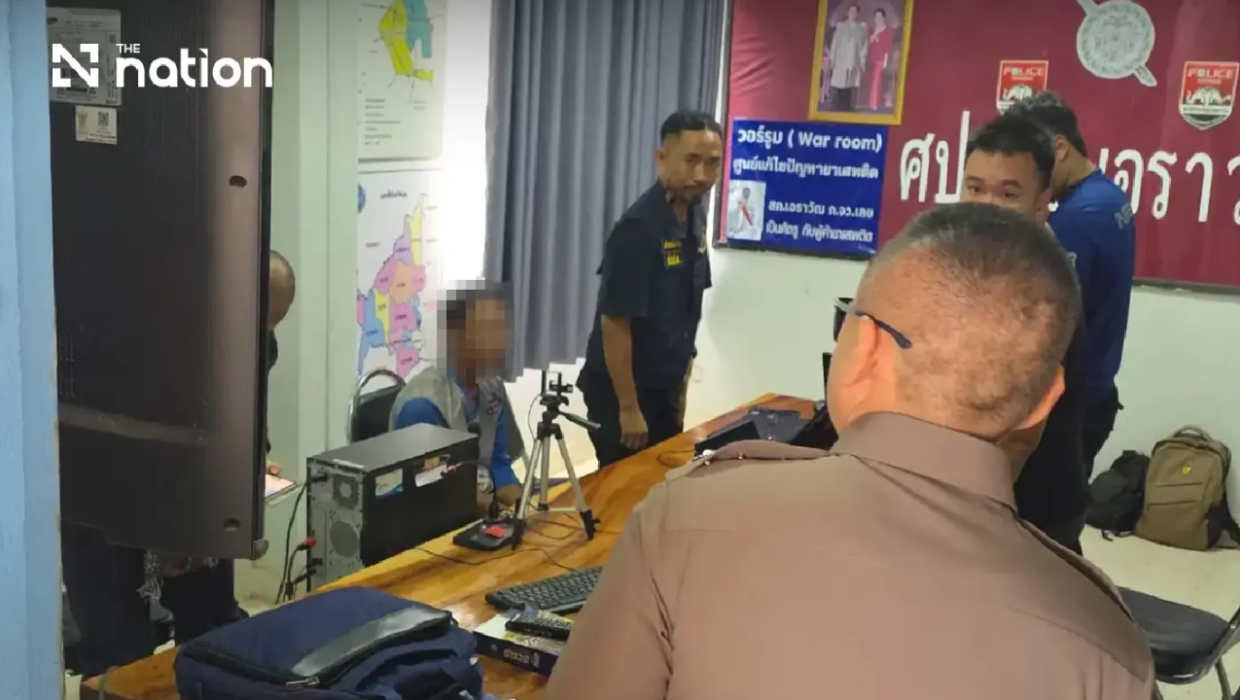
Thai law enforcement has moved swiftly to dismantle what officials describe as a sophisticated international drug smuggling operation, detaining a married couple in the northeastern province of Loei following the arrest of a Thai Airways flight attendant in Melbourne, Australia. The investigation, coordinated between Thai police and the Office of the Narcotics Control Board (ONCB), represents a significant breakthrough in efforts to combat cross-border narcotics trafficking affecting Southeast Asia and beyond.
The chain of events began when Australian authorities apprehended a Thai Airways cabin crew member known in Thai media reports as Mina at Melbourne Airport. Airport security discovered approximately one kilogram of heroin concealed within her luggage, prompting an immediate investigation that would ultimately reach across multiple provinces in Thailand's Isan region. This discovery triggered Thai officials to launch a parallel investigation aimed at identifying the source of the contraband and the network responsible for orchestrating the smuggling attempt.
Thailand's narcotics enforcement agencies systematically traced the parcel's origins through the region, eventually identifying suspects in Loei province. On the afternoon of July 2, officers from Chiang Khan Police Station conducted an initial search operation in That subdistrict of Chiang Khan district, seeking two individuals: Athit, aged 43, and Thatsaphon, aged 42. When the pair proved unavailable at their registered address in Pak Tom subdistrict, authorities learned they were engaged in rubber tapping work in Erawan district.
The manhunt escalated when investigators, including specialized narcotics officers, pursued leads to a Buddhist temple in Sri Songkhram subdistrict of Wang Saphung district. Athit was located while working on temple roof repairs and taken into custody at Erawan Police Station for questioning. During preliminary interrogation, he provided a crucial admission that would expand the case considerably. Athit acknowledged receiving payment to courier parcels to Bangkok on six separate occasions, earning 8,000 baht—roughly US$240—per delivery from an individual identified as a Lao national.
According to police records, the parcels were dispatched through various channels within Chiang Khan district and surrounding areas. Three shipments departed via a commercial parcel service based in Chiang Khan itself, with two originating from Ban That in That subdistrict and one from Erawan district. The final consignment was allegedly sent on June 28, 2026, suggesting the network was actively operating until very recently. The methodical nature of these deliveries indicates a well-organized operation designed to avoid detection through repeated use of different dispatch points and couriers.
Authorities subsequently detained Thatsaphon, identified as a Lao national and Athit's wife, after discovering a black Mitsubishi Triton pickup truck registered in Loei parked in a rubber plantation within the Pha Nang-Pha Koeng area of Pha In Plaeng subdistrict in Erawan district. Following her transfer to Erawan Police Station, Thatsaphon denied involvement in or knowledge of the alleged smuggling activities during her initial questioning. However, law enforcement officials maintain that the couple's coordinated movements and proximity to the pickup truck suggest a more integrated role in the operation than she has acknowledged.
The case exemplifies a pattern increasingly observed by regional law enforcement: international drug syndicates deliberately employ individuals across multiple jurisdictions and organizational levels to create separation between decision-makers and operatives. By distributing roles among numerous parties—some aware of the true nature of their work, others innocently facilitating logistics—criminal networks hope to insulate senior members from detection and prosecution. The ONCB secretary-general has publicly acknowledged this tactical approach, emphasizing that dismantling such networks requires investigation extending far beyond the immediate couriers to encompass those who ordered shipments, provided financial support, and coordinated movements.
Cross-border cooperation emerged as instrumental to the investigation's success. Thai authorities benefited substantially from immediate information sharing with Australian counterparts following Mina's arrest, enabling them to work backwards through the supply chain with geographic precision. This collaborative approach—still developing across Southeast Asia—demonstrates that unilateral enforcement, however robust, proves insufficient against trafficking operations that routinely traverse international boundaries. The ONCB's statement regarding cooperation between Thai and foreign agencies underscores a growing recognition that drug networks respect no borders and therefore cannot be effectively countered by single-nation responses.
The investigation remains ongoing as both suspects face processing within the ONCB's formal interrogation protocols. Authorities explicitly signal their intention to expand the case against additional individuals suspected of involvement at various levels. This approach suggests investigators have identified other members of the network beyond Athit and Thatsaphon—potentially including the Lao national who reportedly distributed payment, persons in Bangkok who received parcels, and possibly higher-level organizers orchestrating the overall trafficking scheme. Each successive layer of accountability that investigators penetrate strengthens the prosecution's case and undermines the network's operational capacity.
The ONCB has pledged intensified enforcement targeting transnational narcotics rings, with specific emphasis on disrupting established transport routes and severing financial channels supporting drug movements through Thailand and the region. Enhanced cooperation agreements with foreign authorities aim to intercept contraband before it reaches airports or border checkpoints. For Malaysia and other Southeast Asian nations contending with similar trafficking threats, the Thai operation illustrates both the challenges posed by sophisticated international smuggling networks and the potential effectiveness of determined cross-border law enforcement partnerships.
The case also highlights how legitimate industries, particularly international air transport, can be exploited by criminal organizations seeking to move contraband. Airlines and airport security agencies across the region face ongoing pressure to identify personnel compromised through coercion, financial incentive, or other means. This Melbourne case demonstrates that even routine personal searches can yield significant intercepts when border authorities maintain heightened vigilance, underscoring the importance of consistent, rigorous screening protocols at international gateways throughout Southeast Asia.

