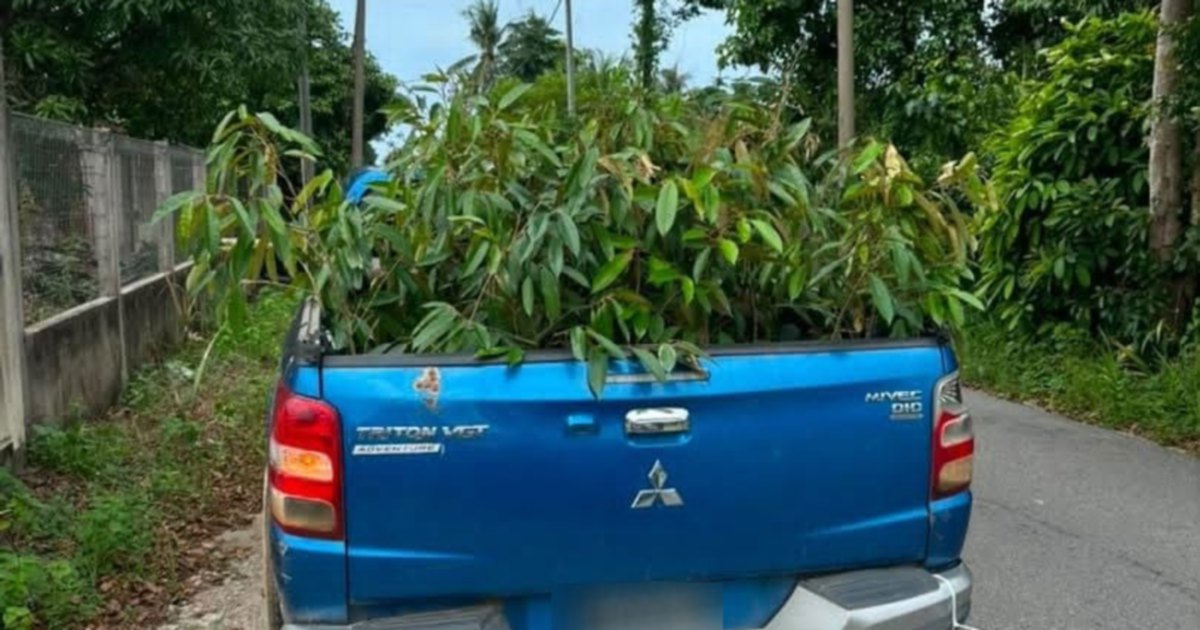
The General Operations Force apprehended a 55-year-old man during a crackdown on agricultural smuggling in Tumpat, Kelantan, following the discovery of 52 durian saplings believed to have originated from Thailand. The operation, which took place yesterday, represents the latest enforcement action against the illegal plant trade that has become increasingly problematic along Malaysia's northern frontier.
The seizure underscores a growing issue in the region where high-value agricultural commodities, particularly fruit saplings and seeds, are trafficked across porous land borders. Durian saplings command premium prices in both legitimate and illicit markets, given global demand for the "king of fruits" and Malaysia's prominence as a major cultivation hub. The saplings discovered during this operation would have represented a significant financial value, though authorities have not yet disclosed the estimated worth of the haul.
Smuggling of plant material from Thailand into Malaysia occurs through established networks that exploit the extensive Kelantan-Thailand border. Such operations typically involve deliberately circumventing agricultural quarantine procedures that exist to protect Malaysia's horticultural sectors from pests, diseases, and unregistered genetic varieties. By bypassing official channels, smuggled saplings pose biosecurity risks while also depriving legitimate growers and government authorities of regulatory oversight and tax revenue.
The detainee's involvement in this smuggling operation suggests connections to wider trafficking networks that operate across the Thailand-Malaysia corridor. Law enforcement agencies have long acknowledged that agricultural smuggling represents a sophisticated enterprise, often involving multiple parties across different jurisdictions. The arrest of a single individual typically represents just one link in a longer supply chain that may extend from cultivation sites in Thailand through distribution networks in Malaysia.
Kelantan's geographic position as a major gateway between Thailand and peninsular Malaysia makes it particularly vulnerable to smuggling activities. The state's porous border, lengthy coastline, and established trade relationships with Thailand create conditions that facilitate both legal commerce and illegal trafficking. Agricultural smuggling has become especially prevalent in recent years as global market prices for specialty fruits have surged, making the contraband trade increasingly profitable despite enforcement risks.
The General Operations Force seizure operation reflects intensified border security efforts aimed at combating smuggling in all its forms. These enforcement activities typically target known smuggling routes and are often coordinated with intelligence gathered from previous operations. However, the persistent recurrence of similar smuggling cases suggests that current enforcement levels, while important, may not fully deter determined smugglers who calculate that profits outweigh the risks of apprehension.
For Malaysia's durian industry, uncontrolled importation of foreign saplings represents both a competitive threat and a phytosanitary concern. Local growers invest substantially in cultivating recognised varieties suited to Malaysian soil and climate conditions, and unauthorised foreign saplings could introduce diseases or inferior genetics that undermine the quality of Malaysia's durian output. Furthermore, smuggled saplings bypass the certification processes that guarantee genetic purity and disease-free status, introducing unpredictability into supply chains.
The case also illustrates the broader challenge facing authorities in monitoring Malaysia's extensive borders. With thousands of illegal entry points and limited enforcement resources, border agencies must prioritise operations based on intelligence and pattern analysis. The successful seizure in Tumpat demonstrates that enforcement is occurring, yet the continued volume of smuggling cases suggests that illegal trade remains commercially viable despite these interventions.
Authorities have not disclosed details regarding the intended distribution network for these saplings or whether the arrested individual faced additional charges beyond smuggling. Subsequent investigation may reveal connections to commercial growing operations or retail networks within Malaysia. Such intelligence becomes crucial for disrupting the broader ecosystem that enables agricultural smuggling to flourish.
Looking ahead, combating agricultural smuggling will require strategies beyond operational seizures. Enhanced cooperation with Thai authorities, improved intelligence sharing with border communities, and more robust penalties for trafficking may be necessary to meaningfully reduce the flow of contraband plant material. Additionally, supporting legitimate growers with marketing assistance and quality assurance programs could reduce the economic incentives that draw some operators toward smuggling networks.
The detention of this individual serves as a reminder that Malaysia's borders remain active zones of illicit commerce despite official regulatory frameworks. Whether this particular case represents part of a larger dismantling of smuggling infrastructure or simply another interdiction in an ongoing cat-and-mouse game between enforcement agencies and trafficking networks remains to be seen.

