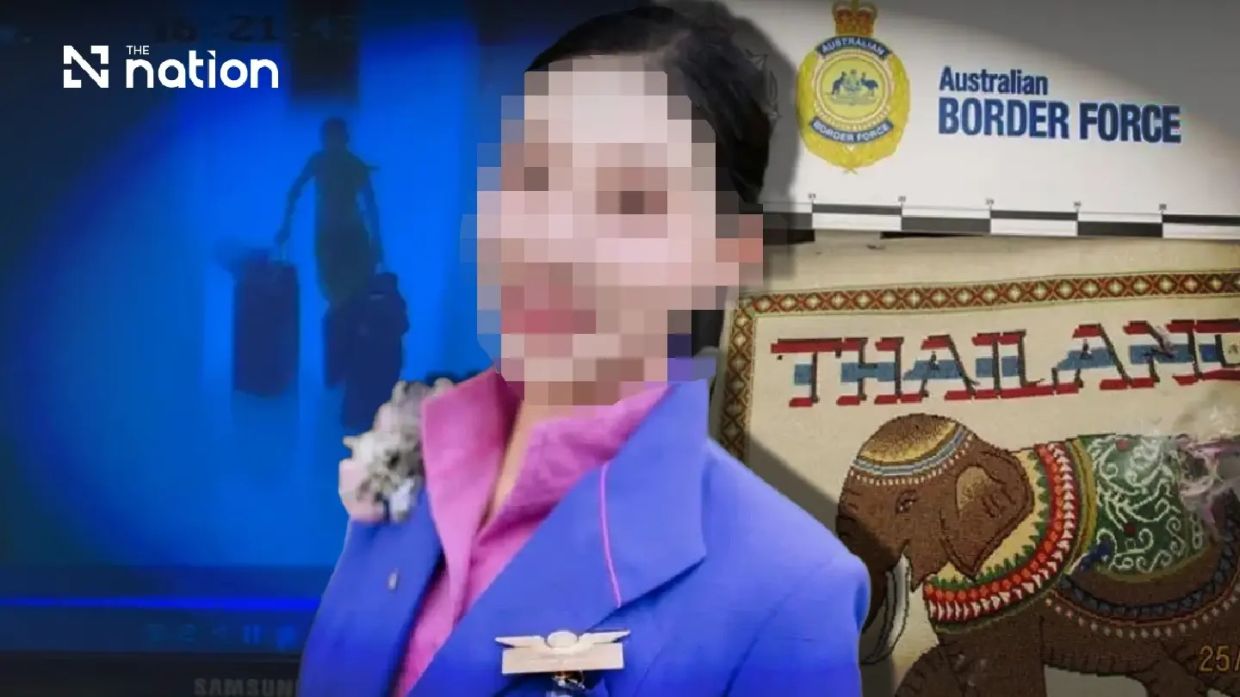
The Office of the Narcotics Control Board (ONCB) is conducting a sweeping investigation into the detention of a Thai flight attendant apprehended with 900 grammes of heroin at Melbourne Airport, working in coordination with Australian law enforcement and security agencies across multiple countries. Deputy ONCB secretary-general Areepak Ngernbamroong clarified that the woman currently holds the legal status of detainee rather than accused person, while Thai authorities have dispatched evidence to Australian counterparts and diplomatic staff to assist her potential legal defence. The inquiry has uncovered what officials describe as a sophisticated operation involving transnational scammers who may have deceived the attendant into transporting narcotics across international borders, with preliminary findings pointing toward syndicates operating in the Golden Triangle region along Thailand's northern frontier.
The investigation has split into parallel strands across different agencies as authorities recognised the scope and complexity of the criminal operation. The Department of Special Investigation (DSI) has assumed responsibility for handling three to four related arrests made in Bangkok that yielded more than 26 kilogrammes of heroin, as officials determined the network operates on a large transnational scale rather than as a simple isolated case. These Bangkok arrests involved a delivery rider who received heroin from a foreign national, as well as a Lao couple, revealing a distribution structure utilising both postal channels and direct hand-to-hand exchanges. Metropolitan Police Bureau deputy commissioner Pol Maj-General Theeradet Thumsuthee identified the criminal organisation's recruitment methodology, explaining how the group creates social media avatar profiles to contact flight attendants and other frequent international travellers, offering financial incentives for transporting parcels across borders without disclosing their true contents.
Central to the expanding investigation is a figure known as "Dear", identified as a Thai national with a legitimate identity who has resided in Australia for approximately a decade, though authorities remain uncertain whether this individual holds Australian citizenship. Thai officials have established that Dear functioned as the intended recipient of the intercepted heroin shipment in Melbourne, representing what investigators believe to be a significant nexus within a larger Australian-based network encompassing multiple nationalities beyond Thai nationals alone. The Australian Federal Police (AFP) has assumed investigative lead on the local dimension of the case, tasked with identifying the ultimate end-users and the broader distribution chain operating within Australia. Multiple pieces of evidence connecting Dear to the operation have already been transferred to AFP, with Thai authorities convinced this person has participated in similar receiving operations repeatedly over an extended period rather than engaging in an isolated incident.
The mechanics of the smuggling operation reveal how the flight attendant appears to have been manipulated through a carefully orchestrated deception. According to her boyfriend's account to investigators, the woman received a parcel box decorated with elephant-pattern bags delivered by a rider who visited her residence. She then transferred these bags into her travel luggage, with the boyfriend confirming that all bags were opened and thoroughly examined before packing and that nothing was discovered inside at that stage. The suitcase subsequently passed through Thai airport security X-ray screening without detection of irregularities, suggesting the heroin may have been concealed with sophisticated techniques or inserted at a subsequent stage unknown to the attendant. This sequence of events provides circumstantial evidence potentially supporting claims that she was unaware of the drugs' presence, though investigators acknowledge they cannot yet determine the extent of her knowledge or complicity.
The financial dimension of the case remains murky and requires deeper investigation to establish facts. Australian police identified a figure of 8,800 baht (approximately US$264) through mobile phone evidence discovered during their examination of the case, though this amount differs from Thai investigators' findings. Reports indicate two separate transfers of 1,700 baht each may have occurred—one allegedly upon receipt of the parcel and another upon acquisition of her airline ticket—totalling 3,400 baht. However, examination of the flight attendant's bank records has not confirmed these transactions, and the account balance remained modest, preventing Thai authorities from validating the figures with certainty. The discrepancies necessitate more detailed questioning of the suspect to reconcile conflicting information, yet these gaps equally suggest a scenario wherein the attendant received minimal compensation, further supporting contentions that she may have been exploited rather than willingly participating as a knowing conspirator.
The delivery rider who brought the parcel to the flight attendant has provided statements indicating he had executed similar deliveries on three or four previous occasions, though this particular delivery to this specific individual represented his first interaction with her. This detail carries significant investigative weight, potentially suggesting the attendant was deliberately selected as a new, less-suspected target rather than being part of an established distribution relationship. The scam's operational model—targeting flight crew with social engineering and financial inducements while maintaining compartmentalised knowledge across the supply chain—demonstrates criminal sophistication designed to exploit the unwitting compliance of transportation workers who, by profession, regularly traverse international borders.
Authorities cannot yet definitively establish what degree, if any, the flight attendant understood regarding the drug-smuggling operation. Her status as detainee rather than accused reflects this evidentiary ambiguity, and officials acknowledge substantial factual gaps requiring resolution before determining whether her participation resulted from deliberate complicity or systematic deception. Thai authorities plan to transmit all accumulated investigative findings to the AFP, the Royal Thai Embassy in Australia, and the Thai consulate to support her legal proceedings, recognising that evidence of potential victimisation could factor into her defence strategy.
The broader geographical and organisational context reveals a sophisticated trafficking network adapting to enforcement pressures across Southeast Asia. The Golden Triangle, the opium-producing region spanning northern Thailand, Laos, and Myanmar, remains the suspected source of the narcotics involved in this particular case. Historically, trafficking networks attempted to transit drugs through Thailand's northern border regions, but intensified interdiction efforts prompted criminals to shift routes toward north-eastern Thailand, which adjoins Laos and offers lengthy, difficult-to-monitor border segments along the Mekong River. Key transit points now include Nakhon Phanom, Bueng Kan, Loei, and Nong Khai provinces, where the river narrows and border terrain complicates continuous security deployment.
This geographic shift reflects adaptive criminal behaviour in response to law enforcement concentration. The widening of the Mekong and the extended length of riverine border across these north-eastern provinces create enforcement challenges, enabling narcotics to penetrate Thai territory despite cooperation between Thai and Lao authorities. Areepak emphasised that the strategic realignment does not indicate Laotian governmental negligence, noting that Thailand and Laos maintain active coordination and intelligence-sharing mechanisms targeting trafficking organisations. The heroin seized in connection with the flight attendant's case represents merely one operational strand within what officials believe constitutes a far larger, geographically dispersed criminal enterprise connected to Golden Triangle production and distribution networks.
Most intercepted narcotics arrive in Thailand already packaged for end distribution, passing through multiple intermediaries and storage points before reaching street-level retailers or international smuggling routes. The flight attendant's alleged recruitment illustrates how these networks have evolved to exploit aviation infrastructure and personnel to extend their reach globally. By targeting flight crew with social media recruitment and financial incentives, trafficking organisations reduce the risk of detection while expanding distribution into distant markets including Australia, where the AFP is now investigating the network's local operational capacity.
The investigation's expansion across multiple jurisdictions underscores the challenges confronting individual nations attempting to interdict sophisticated transnational smuggling operations. Thai officials continue gathering evidence while maintaining coordination with Australian counterparts and diplomatic channels to ensure the detained flight attendant receives adequate legal support. The case exemplifies how criminal networks exploit human vulnerability through deception, targeting individuals whose occupations provide them access to international transportation networks. As investigators piece together the full organisational structure, supply chain mechanics, and recruitment methodologies, the emerging picture suggests vulnerability across aviation systems to exploitation by trafficking enterprises operating from the Golden Triangle and extending through multiple Asian nations toward distant international markets.

