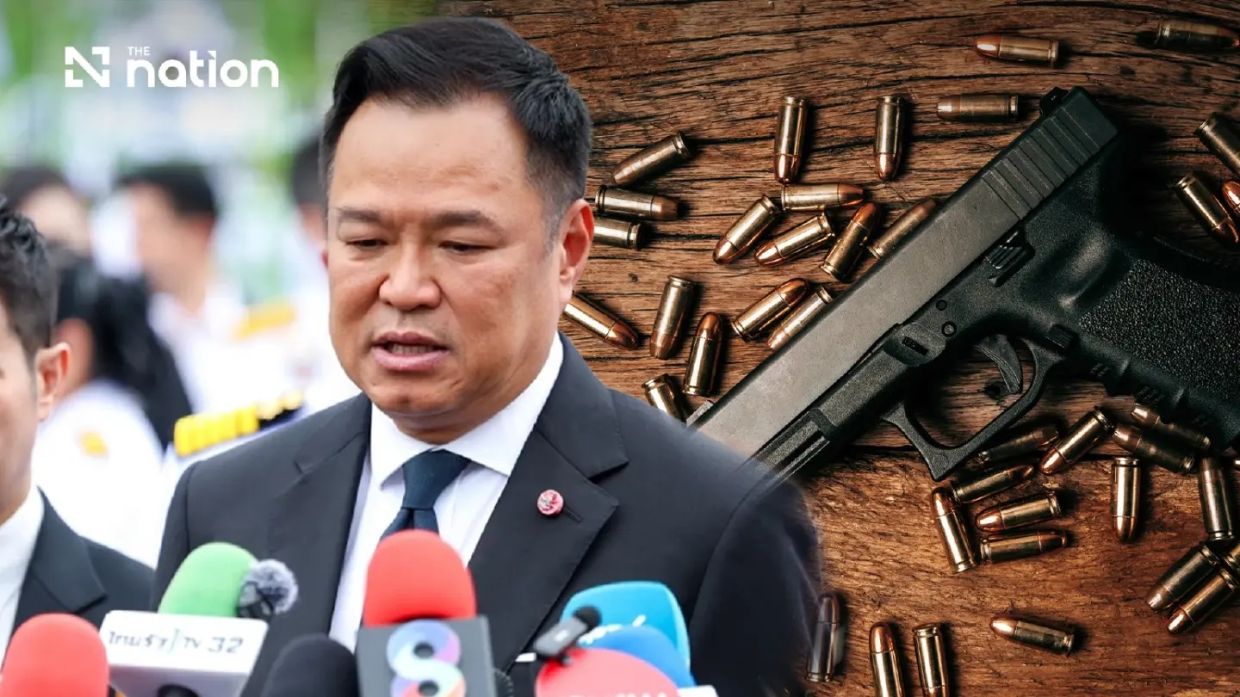
Thai Prime Minister Anutin Charnvirakul has committed to tightening the country's firearms legislation in response to a devastating mass shooting at Debsirin Nonthaburi School, signalling a hardline approach to gun ownership and regulation. Following discussions with national police chief Pol Gen Kittharath Punpetch at Government House, after visiting the school attack scene, Anutin outlined a comprehensive strategy to combat illegal weapons and strengthen public safety measures across the nation.
The Prime Minister's position represents a significant stance in a region where gun violence remains a persistent challenge, and Thailand's history of mass shootings—including the 2020 Korat shooting that killed 29 people—has kept the issue in the spotlight. Anutin's emphasis on setting up checkpoints and intensifying inspections reflects a broader security framework that seeks to remove firearms from unauthorised hands before violence occurs. He stressed that any individual found carrying a gun in public spaces, vehicles, or outside their residence without legitimate official duties would be subject to serious criminal charges, framing such behaviour as categorically unacceptable under law.
A particularly notable aspect of Anutin's response involves his explicit rejection of proposals from some quarters to permit teachers to carry firearms for self-defence purposes. This stance underscores a fundamental philosophical difference in approaches to school safety—rather than arming educators, the government is choosing to strengthen perimeter security and police enforcement. Anutin justified this position by emphasising that teachers lack the legal status and training of authorised officers, and permitting civilian educators to carry weapons would contradict the government's overarching commitment to disarming the general population.
The Prime Minister has also signalled openness to reviving a previous amnesty programme that would allow holders of illegal or unauthorised firearms to surrender their weapons to state authorities without facing prosecution. Such initiatives have historically been deployed in post-conflict situations and in response to mass casualty events, recognising that some illegal gun owners may lack clear pathways to compliance. However, Anutin tempered this possibility with an unambiguous declaration that weapons already in circulation must ultimately be seized, and that illegally held firearms could never be legitimised regardless of circumstances.
Anutin emphasised to the public that possessing an illegal firearm carries substantial risks that outweigh any perceived benefits. He outlined a streamlined surrender process whereby gun owners could deliver weapons to the Department of Provincial Administration, district offices, or police stations, where official records would document the handover and provide legal protection against prosecution for the act of surrender itself. This bureaucratic transparency serves multiple purposes: it creates an auditable paper trail, incentivises voluntary compliance, and removes weapons from homes before they can be accessed by unauthorised users, particularly children.
Household firearm storage has emerged as a critical concern in the government's policy framework. Anutin mandated that all registered gun owners must keep their weapons properly secured, inaccessible to minors, and documented through official registration systems. This requirement acknowledges a harsh reality in many jurisdictions—that legally owned firearms kept in homes pose significant risks, particularly in households experiencing conflict or where children lack adequate supervision. The dual accountability framework, holding both registered owners and actual users responsible for misuse, creates strong incentives for responsible storage practices throughout the gun-owning population.
Regarding the underlying social factors contributing to the shooting—including preliminary suggestions that bullying may have motivated the perpetrator—Anutin urged restraint pending completion of police investigations. This cautious stance reflects awareness that premature speculation about motives could trigger copycat incidents or amplify grievances within vulnerable student populations. By directing public discourse away from conjecture and towards factual investigation, the government aims to prevent sensationalisation of the tragedy and avoid inadvertently providing a blueprint for potential future attackers.
The government's approach extends beyond immediate legislative responses to encompass institutional coordination across multiple agencies. Police and other authorised law enforcement bodies have received explicit orders to intensify thorough inspections across jurisdictions, targeting locations where unlicensed weapons are likely to be concealed. This operational directive translates policy intentions into practical enforcement mechanisms, involving not merely increased patrols but systematic verification and seizure operations designed to shrink the illegal firearms stock circulating throughout Thai society.
Augurin's position reflects international trends in countries confronting similar challenges, where comprehensive regulation rather than selective arming of civilians represents the dominant policy approach. The strategic emphasis on prevention through checkpoint enforcement and removal of weapons from unauthorised circulation, combined with strict storage requirements for legitimate owners, creates multiple barriers to gun violence. For Southeast Asian policymakers monitoring developments in neighbouring countries, Thailand's response demonstrates how democracies can implement aggressive gun control measures while maintaining legitimate civilian ownership within strict regulatory frameworks.
The shooting at Debsirin Nonthaburi School has catalysed a broader reckoning with Thailand's gun culture and ownership patterns. Anutin's insistence that long-term suppression of firearms-related offences requires sustained effort across governmental bodies signals that this initiative extends beyond temporary political response to a genuine policy reorientation. The Prime Minister's repeated emphasis on enforcement, registration, and secure storage suggests the government recognises that mass shooting prevention depends on cumulative compliance across a critical mass of gun owners and administrators, rather than relying on spectacular displays of enforcement against outliers.
Looking forward, the success of these measures will depend on implementation consistency and political will to maintain pressure on illegal gun holders even as public attention shifts away from the tragedy. Thailand's experience will likely influence discussions within ASEAN nations facing comparable security challenges, particularly those with significant civilian gun ownership populations and recent mass casualty incidents.

