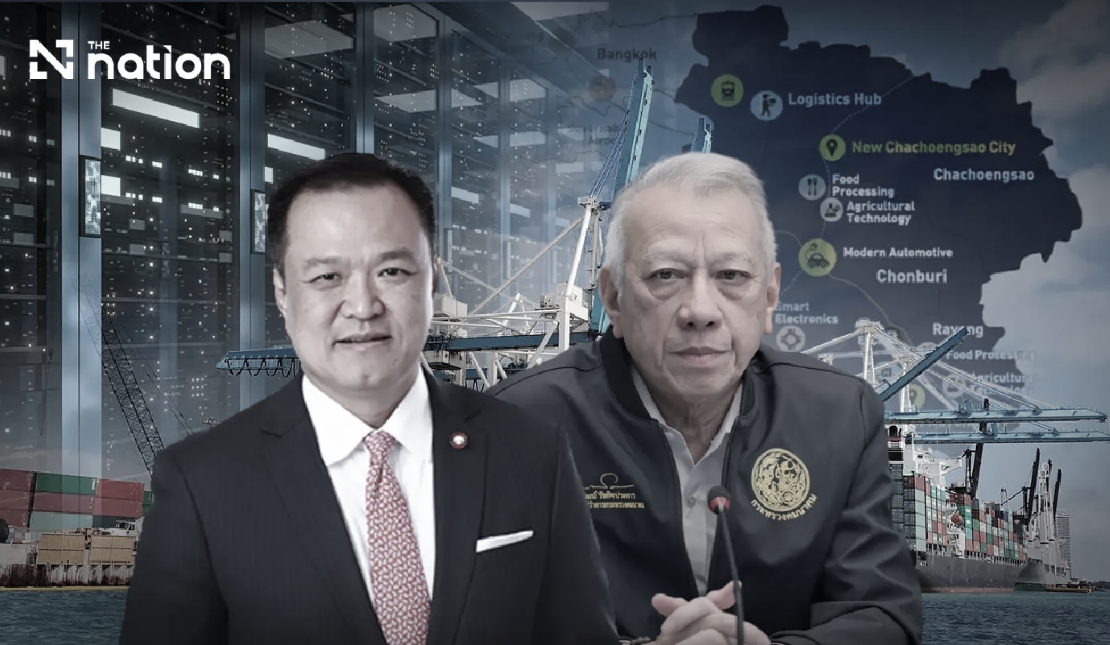
Thailand's Prime Minister Anutin Charnvirakul has reassumed direct personal supervision of the Eastern Economic Corridor, marking a significant strategic recalibration for the nation's most ambitious regional development initiative. The move comes after Cabinet approval of orders revoking the portfolio authority previously held by Deputy Prime Minister and Transport Minister Phiphat Ratchakitprakarn, effective immediately from June 15. Rather than signalling discord between the two leaders, the decision reflects a calculated repositioning of how Thailand packages its eastern region to the global investment community, with Anutin positioning himself as the primary architect of the nation's foreign investment pitch.
The Eastern Economic Corridor, one of Thailand's flagship development programmes, has traditionally anchored its appeal around heavy manufacturing and industrial clustering. However, government officials acknowledged this model faces mounting constraints stemming from electricity and water supply limitations, both critical bottlenecks that impose substantial procurement costs on resource-intensive operations. This structural ceiling prompted a strategic rethink about the corridor's competitive positioning in an increasingly crowded regional marketplace. Rather than attempting to compete head-to-head with other Southeast Asian industrial hubs on conventional manufacturing grounds, the Thai government is now emphasising the eastern region's distinct comparative advantages in agricultural and food production systems.
The rebranded Eastern Economic Corridor will now champion itself internationally as a strategic hub for global food security. The eastern region possesses established strengths across livestock operations, fisheries, agricultural production, tropical fruit cultivation, and horticultural exports—sectors experiencing rising geopolitical importance as countries worldwide reassess supply chain vulnerabilities and food sovereignty concerns. Thai officials argue these industries represent increasingly attractive investment targets for multinational corporations and sovereign wealth funds seeking to diversify agricultural exposure and secure reliable supply networks. This framing transforms the corridor from a traditional industrial zone into a strategic asset responding to genuine global market dynamics.
Data centre development represents the corridor's second transformative pillar. Thailand's Energy Ministry is implementing a new electricity user classification—Type 9—specifically designed for data centre operations, which acknowledges their exceptional power consumption profiles by imposing higher tariff structures. Data centre investment demands sophisticated coordination across multiple government agencies overseeing electricity infrastructure, water supply systems, and supporting telecommunications networks. By positioning the Eastern Economic Corridor as Thailand's primary data centre destination, Anutin's government signals sophisticated understanding of Southeast Asia's emerging role in global digital infrastructure, particularly as companies seek operational alternatives to China and diversify their server facilities across the region.
Government sources characterised the portfolio transfer as a collaborative decision rather than a power struggle, emphasising that Phiphat himself had identified ongoing friction between the Eastern Economic Corridor Office and the Board of Investment as an operational impediment. According to this account, Phiphat proposed that Anutin assume direct oversight to eliminate these inter-agency tensions and facilitate more coherent policy execution. This explanation carries credibility given that Thai bureaucratic reorganisations frequently reflect genuine administrative problems alongside political calculations. The transfer arguably streamlines decision-making by consolidating authority, allowing Anutin to orchestrate the EEC's international marketing without navigating competing institutional interests.
Phiphat's earlier public comments suggested some surprise at the Cabinet announcement, noting he had not received advance notice of the decision and had merely heard the orders read out during the regular Cabinet session. His measured response—denying the reshuffle constituted a demotion or reflected internal Bhumjaithai party discord—adhered closely to the official narrative of administrative reorganisation rather than political conflict. This choreographed messaging appears designed to prevent speculation about leadership tensions within the coalition government, particularly given that Bhumjaithai remains a significant component of Thailand's ruling alliance.
Official sources explicitly denied that the Eastern Economic Corridor reshuffle related to Phiphat's previously firm stance on the Don Mueang-Suvarnabhumi-U-Tapao airport rail link. This three-airport connectivity project, originally concessioned in 2019 to the Asia Era One consortium linked to CP Group, has languished for years amid contractual disputes. Phiphat had opposed amending the payment mechanism away from the original model—where the private partner must complete construction before receiving government compensation—toward a progressive "build-and-pay" arrangement. The government's denial that the EEC reshuffle reflected these rail project disagreements deserves scrutiny, as high-profile policy decisions rarely occur in isolation from other governance tensions.
Another dimension emerging from official commentary involves Anutin's questioning of the proposed Disneyland development within the Eastern Economic Corridor. The Prime Minister reportedly challenged Phiphat on the project's timeline and commercial viability, noting the absence of rigorous feasibility studies demonstrating that returns would justify the required investment. This line of questioning suggests Anutin intends to impose greater financial discipline and evidence-based evaluation on EEC initiatives, potentially signalling dissatisfaction with previous development proposals lacking solid analytical foundations.
The strategic repositioning carries significant implications for Malaysia and broader Southeast Asia. If Thailand successfully positions its eastern region as a regional food security and data centre hub, it could establish competitive pressures on neighbouring countries' industrial development strategies. Malaysia, which similarly pursues food security objectives and digital infrastructure investment, may need to clarify its own positioning and comparative advantages. The Thai initiative demonstrates how regional economic corridors increasingly compete not primarily on labour costs or resource availability—traditional manufacturing advantages—but on integrated value-chain capabilities, policy coherence, and strategic alignment with emerging global priorities.
The timing of this announcement reflects Thailand's recognition that traditional industrial corridor models face structural limitations requiring fundamental repositioning. By assuming personal leadership of the Eastern Economic Corridor, Anutin signals priority commitment to the initiative's revival and credibility in foreign investor discussions. The emphasis on food security taps into genuine anxieties among developed nations regarding agricultural supply chain resilience, while the data centre focus acknowledges Thailand's geographic position as a strategic Southeast Asian location for digital infrastructure serving both regional and global markets.
Looking forward, success of this repositioning depends substantially on executing complementary infrastructure investments, regulatory streamlining, and securing early anchor investors capable of attracting secondary investments through network effects. The government's willingness to undertake this strategic recalibration demonstrates adaptability in development policy, recognising that static industrial strategies prove increasingly inadequate in evolving global markets. Whether this realignment generates the anticipated foreign investment inflows, however, will ultimately determine whether the Eastern Economic Corridor achieves genuine transformation or merely undergoes rhetorical repackaging without substantive economic impact.