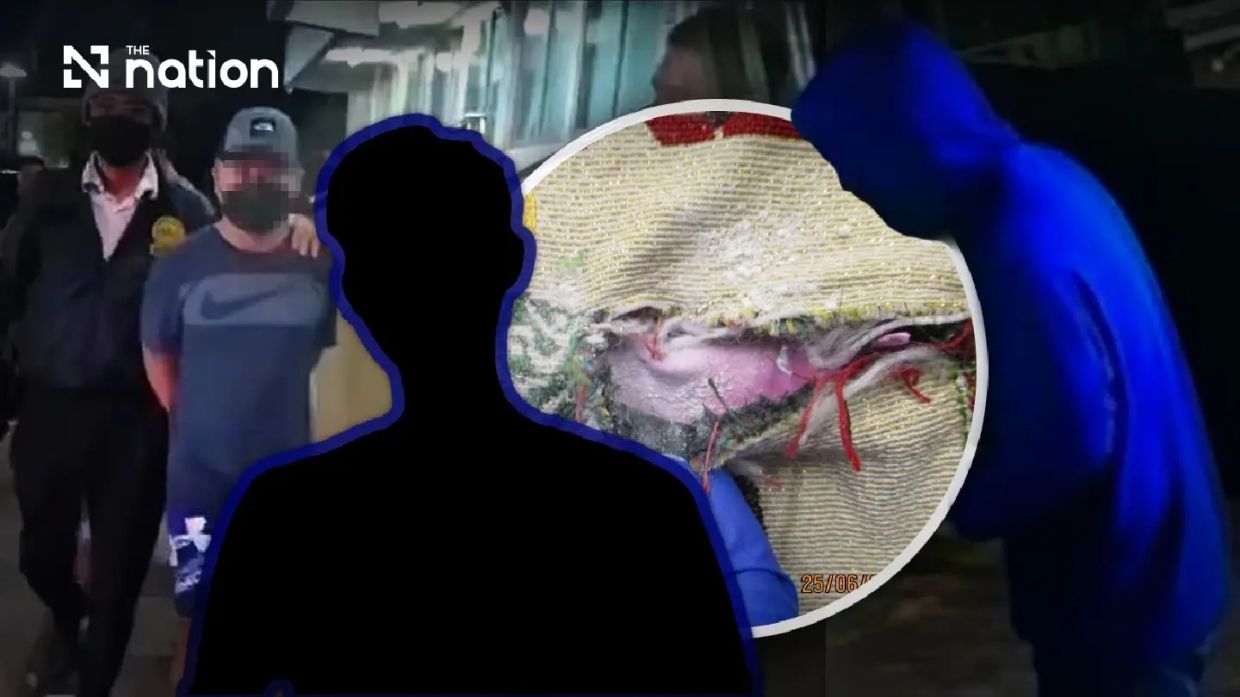
Thai police have arrested a suspected intermediary in a sophisticated heroin trafficking operation, expanding their investigation into a network that recruited airline personnel to smuggle drugs to Australia. The arrest of the man identified as Ekkawit in Phayao overnight marks a significant development in a case that began with the discovery of narcotics concealed in an elephant-print fabric bag destined for overseas delivery.
According to Pol Maj Gen Theeradej Thamsuthee, deputy commissioner of the Metropolitan Police Bureau, investigators have identified a complex supply chain involving multiple players across Thailand's northern provinces. The network appears to operate with careful compartmentalisation, with individual operatives handling distinct stages of the trafficking process to minimise exposure and maintain operational security. Ekkawit's role centred on receiving instructions through encrypted chat applications and physically managing the transfer of drug-laden bags between designated collection points.
Police allege that Ekkawit, operating under the chat handle "Rin Rin," coordinated the handover of the elephant-print bag to a man named Uthai, who was previously arrested in connection with the case. Uthai subsequently passed the bag to flight attendant Mina, allegedly recruited to transport the shipment to Australia. The arrangement demonstrates how traffickers exploit the professional mobility and trusted status of airline staff to move contraband across international borders undetected. During questioning, Ekkawit admitted to receiving THB100,000 for his involvement and claimed to have executed similar deliveries between two and three times previously, suggesting the network has operated successfully multiple times before police intervention.
The investigation has revealed the operational procedures underlying this trafficking enterprise. Ekkawit purchased the elephant-print bag in Chiang Mai, then notified his contact operating under the alias "Rose Rose" that the item was ready. Once obtained, he would leave the bag at a pre-arranged kilometre marker in Chiang Kham district, Phayao. An associate of Rose Rose would then collect the bag, conceal heroin inside it—allegedly in Laos, though police expressed scepticism about this claim—and return it to another kilometre marker. Ekkawit would retrieve both the bag and THB100,000 in compensation, subsequently arranging for Uthai to collect it by depositing THB60,000 through an automated cash machine, further obscuring the financial trail.
Detectives have identified Rose Rose as a close relative of Ekkawit, based on photographs showing them travelling together and their shared origin in Phayao province. Despite operating from an anonymous account, narcotics police have accumulated substantial intelligence about the person behind this alias through communication pattern analysis and corroborating evidence. Rose Rose appears to function as a coordinator and dispatcher within the network, using encrypted messaging to recruit willing couriers and manage logistics. The person utilised this same method to contact Mina, the flight attendant, proposing the dangerous assignment to carry the bag internationally.
Police do not regard Rose Rose as the network's apex operator, however. Senior investigators believe a more established trafficker remains at the top of the organisational hierarchy, orchestrating major decisions and directing the overall strategy while maintaining distance from operational details. This suspicion reflects the typical structure of large-scale drug trafficking networks, where leadership deliberately insulates itself from direct involvement in contraband movement. The existence of higher-level organisers suggests this investigation may yet yield larger arrests and dismantle broader criminal infrastructure.
Ekkawit's preliminary admissions under police questioning revealed the workflow, but investigators remain sceptical about aspects of his account, particularly his claim that heroin was concealed inside Laos rather than within Thailand. More significantly, authorities question whether he fully explained the scale and frequency of his participation. During initial interrogation, Ekkawit offered only limited details, prompting police to conduct further questioning after obtaining additional context about his role. The limited initial cooperation and later discrepancies suggest either deliberate obfuscation or a reluctance to fully incriminate associates higher in the network.
Uthai's interrogation has raised similar concerns about truthfulness. The arrested man claimed involvement in only five or six previous operations, yet police discovered he had rented accommodation in Phra Nakhon Si Ayutthaya province for at least five to six months continuously. The extended rental period contradicts the small number of operations he admitted and suggests substantially more frequent participation in trafficking activities. Investigators believe Uthai's initial account was carefully rehearsed beforehand, representing an attempt to minimise his culpability and protect others in the network from exposure.
The case carries significant implications for Southeast Asia's narcotics control efforts. Thailand's geographic position as a transit country for heroin produced in the Golden Triangle makes it a natural hub for trafficking operations moving product through multiple countries. The involvement of commercial airline staff demonstrates how traffickers have adapted to exploit legitimate international travel infrastructure. Mina's recruitment—whether through coercion, financial incentive, or other means—highlights a growing vulnerability in aviation security, where insiders can facilitate contraband movement while evading standard customs and security protocols.
The network's use of encrypted chat applications represents a modern trafficking innovation that complicates police work. However, the case demonstrates that digital forensics, communication analysis, and old-fashioned investigative work can pierce operational security. Pol Gen Samran Nuanma, deputy national police chief, was scheduled to personally question Ekkawit on Friday, July 10, 2026, indicating senior-level official attention to the case. This escalation suggests Thai authorities view the investigation as significant enough for high-ranking oversight and potential policy implications.
Police are now pursuing multiple investigative threads simultaneously. Beyond Ekkawit, officers are identifying and locating other network associates, particularly the person operating as Rose Rose and any superiors directing operations from above. The expansion of the investigation reflects growing confidence that arrests to date represent only the visible portion of a larger trafficking infrastructure. Success in dismantling the complete network would require apprehending coordinators, recruiters, financial handlers, and potentially higher-level organisers controlling multiple cells across Thailand and neighbouring countries.

