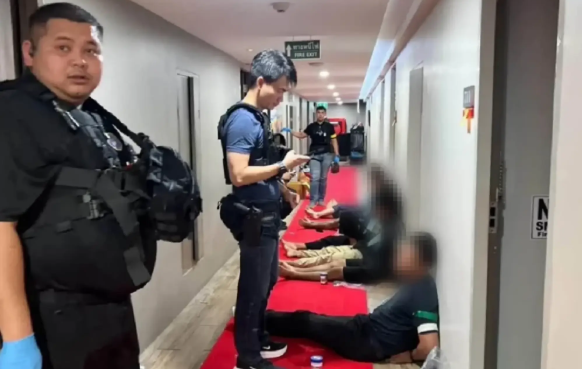
Thailand's Central Investigation Bureau has executed a sweeping raid on a luxury hotel in Nonthaburi province, uncovering what police describe as a sophisticated underground network offering illegal gambling, narcotics, and sexual services primarily to Chinese nationals. The operation, codenamed "Dragon Nest," targeted what authorities characterised as a "grey dragon" syndicate—a reference to illicit Chinese capital networks that have increasingly established footholds across Southeast Asia in recent years.
The raid was conducted at a hotel located on Ngam Wong Wan Road in Bang Khen subdistrict, Mueang district, following intelligence gathered from public informants who had observed suspicious activity at the establishment. Police noted that the hotel appeared to operate exclusively for a select clientele, with Chinese nationals continuously entering and exiting at all hours, while ordinary tourists were turned away. This selective access pattern first alerted authorities to potential criminal enterprise.
Investigators determined that a Chinese organised group had leased the entire hotel complex and repurposed it as a clandestine multi-function criminal hub, complete with enhanced security measures to prevent detection. The operational structure was vertically integrated across multiple floors, with residential quarters occupying levels two through six while the seventh and eighth floors had been converted into dedicated areas for drug consumption parties, high-stakes gambling activities, and arranged sexual encounters. This compartmentalisation reflects growing sophistication among transnational organised crime syndicates operating in the region.
More than 100 police officers participated in the operation, which was authorised by the Criminal Court and executed under Operation "Dragon Nest." The raid resulted in the arrest of a 33-year-old Chinese national charged with trafficking ketamine, a Class 2 controlled substance, with intent to distribute. Additionally, three Myanmar nationals were taken into custody for immigration violations, having entered and remained in Thailand without authorisation. Police statements indicate the Myanmar detainees had come to work at the establishment.
The seizure operation recovered an extensive cache of evidence reflecting the breadth of illicit activities. Police confiscated more than 200 items including substantial quantities of ketamine and so-called "happy water"—a colloquial reference to liquid drugs often mixed into beverages. Officers also impounded drug preparation equipment, gambling paraphernalia comprising poker chips, playing cards, dice and baccarat gaming sheets, electronic hi-lo devices, cash reserves, banking records, mobile communication devices, and comprehensive CCTV surveillance system data.
The arrested Chinese suspect initially denied involvement in drug trafficking operations, claiming instead to be merely an employee following delivery instructions. This defensive posture is consistent with typical operational structures within transnational crime networks, where culpability is deliberately compartmentalised to shield higher-level organisers from direct liability. The Myanmar nationals reportedly acknowledged having illegally migrated to Thailand specifically for employment at the establishment.
This raid exemplifies a broader pattern of Chinese-led illicit enterprise in Southeast Asia, where organised groups exploit the region's porous borders and financial infrastructure to establish recreational and gambling facilities. These operations target affluent Chinese nationals, whether international tourists or business owners operating throughout Asia, generating substantial revenue while remaining largely insulated from conventional law enforcement detection. The model has proven particularly resilient because it combines legitimate hospitality infrastructure with hidden criminal operations.
For Malaysia and other Southeast Asian nations, this development carries significant implications. The presence of such sophisticated transnational networks operating across the region's hotel and hospitality sector indicates that similar operations may exist domestically, particularly in urban centres with significant Chinese business communities and tourist infrastructure. The operational template—leasing entire establishments, targeting specific nationality groups, and integrating multiple criminal revenue streams—could be replicated elsewhere with minimal modification.
The Thai authorities' ability to penetrate and dismantle this network demonstrates the value of public intelligence and coordinated law enforcement action, though it also suggests how such organisations routinely operate for extended periods before detection. The operational model's emphasis on tight security and selective customer access creates natural barriers to detection that conventional policing methods struggle to overcome. The existence of such operations raises questions about whether hotel ownership and management screening procedures throughout the region are adequately designed to prevent misuse of commercial establishments for organised crime.
The seizure of CCTV data and mobile communication devices will likely prove crucial for investigators attempting to identify the network's command structure and identify whether this represents an isolated operation or part of a larger regional syndicate. Cooperation between Thailand's investigative authorities and counterparts in Malaysia, Singapore, and other ASEAN nations could reveal interconnected criminal relationships and shared operational infrastructure. Such intelligence sharing remains essential given the transnational character of these organisations.
The case underscores how economic integration and cross-border movement, while facilitating legitimate commerce, simultaneously enables criminal entrepreneurs to establish complex operational networks. The targeting of Chinese clients specifically reflects how diaspora communities and established business networks can inadvertently provide cover for organised criminal activity. Moving forward, regional law enforcement agencies will need to enhance coordination on hotel sector oversight and develop better mechanisms for identifying when commercial properties are converted to criminal use.
Authorities have transferred the suspects and all seized materials to Rattanathibet Police Station for formal legal processing. Charges against the Chinese national focus on the Category 2 controlled substance trafficking charge, which carries substantial penalties under Thai law. The outcome of this investigation may inform regional policy discussions regarding transnational organised crime prevention and cooperation among ASEAN member states.

