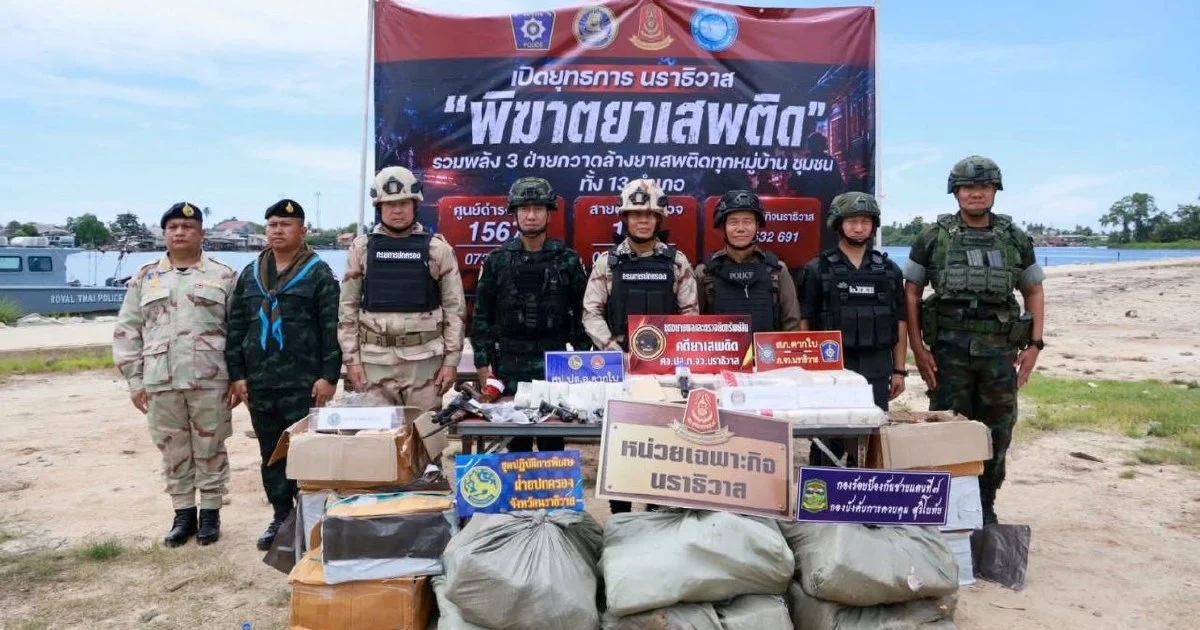
Thai authorities have dismantled a significant drug trafficking network operating across the Thailand-Malaysia border by arresting 233 suspected members of criminal syndicates during an intensive anti-drug operation in Narathiwat province. Law enforcement officials believe some of those detained have established connections with Malaysian-based drug traffickers, highlighting the persistent cross-border nature of narcotics smuggling in the region. The coordinated crackdown, which ran for approximately one month, represents a substantial effort by Thai police to disrupt trafficking operations that threaten both nations.
The operation in Narathiwat province, which sits in Thailand's southernmost region directly adjacent to Malaysia's Perlis and Kedah states, underscores the strategic importance of this frontier as a trafficking corridor. The province has long been identified as a critical junction where drug networks distribute illicit substances across Southeast Asia. Criminal organisations have historically exploited the porous border and established smuggling routes to move narcotics between Thailand and Malaysia, capitalising on weak enforcement capacity in remote areas and the region's geographic complexity.
The scale of arrests—233 individuals—demonstrates the breadth of the operation and suggests Thai authorities deployed significant investigative and enforcement resources to map out networks rather than simply pursuing street-level dealers. Such operations typically focus on identifying kingpins and mid-level organisers who manage the supply chain, coordinate shipments, and maintain relationships with Malaysian counterparts. The month-long duration indicates sustained intelligence gathering, surveillance, and coordinated police actions rather than isolated raids.
The suspected links between arrested Thai traffickers and Malaysian criminal networks reveal how regional drug markets operate as interconnected systems. Malaysian organised crime groups have long utilised Thailand as a production and transit hub, particularly for amphetamine-type stimulants and heroin. The southernmost Thai provinces serve as manufacturing and consolidation points where drugs are packaged and prepared for shipment into Malaysia via land routes, maritime channels, or concealed compartments in vehicles crossing official border checkpoints. These networks exploit family ties, ethnic connections, and kinship networks that straddle both countries to maintain operational security and ensure reliable delivery.
The implications of this crackdown extend beyond immediate arrests. Disrupting established trafficking networks forces criminal enterprises to reorganise, rebuild supply chains, and adapt operational methods. This creates temporary disruptions in drug availability and distribution, which can lead to price volatility and market instability in Malaysia and other regional markets. However, sustained suppression requires ongoing intelligence collaboration between Thai and Malaysian law enforcement agencies, which has traditionally faced coordination challenges despite shared threats.
Malaysia faces particular vulnerability to Thai-sourced narcotics given the country's position as both a transit corridor and consumption market. The rapid expansion of methamphetamine use in Malaysia over the past decade reflects the efficiency of these cross-border supply networks. Street-level enforcement has made limited impact on availability, suggesting that only disruption of wholesale and manufacturing operations can effectively reduce supply. The arrests in Narathiwat represent the kind of upstream intervention necessary to address production and distribution at scale.
These operations also highlight the economic drivers sustaining trafficking networks. The region's poverty, limited legitimate economic opportunities, and high profit margins in the drug trade create persistent incentives for criminal involvement. Rural communities in Narathiwat and similar border areas often lack sufficient agricultural income or employment alternatives, making drug trafficking an attractive, if dangerous, livelihood option. Addressing trafficking comprehensively therefore requires not only law enforcement responses but also economic development and livelihood diversification in source and transit regions.
The Thai authorities' focus on organised trafficking syndicates rather than individual users reflects evolving regional drug enforcement philosophy. Prioritising kingpins, mid-level managers, and supply chain coordinators over addiction-driven street dealers recognises that disrupting institutional criminal structures produces greater systemic impact. Malaysia has similarly attempted to reorient enforcement toward trafficking networks, though rehabilitation and treatment capacity remains constrained relative to incarceration rates.
International cooperation remains essential for sustained progress. Intelligence sharing, coordinated investigations, and joint operations between Thai and Malaysian agencies, supported by ASEAN frameworks and bilateral agreements, provide the most effective approach to dismantling networks that deliberately exploit border jurisdictions. The Narathiwat operation demonstrates Thai commitment to this task, yet lasting success depends on equally robust Malaysian enforcement and willingness to pursue traffickers operating from Malaysian territory or targeting Malaysian markets.
The arrested individuals now face prosecution under Thai drug laws, which carry severe penalties including lengthy imprisonment and capital punishment for trafficking charges. The outcome of these cases will influence how other trafficking organisations perceive the enforcement environment and may deter some criminal activity or prompt further operational adaptation. Malaysian authorities will likely increase border surveillance and intelligence collection in response to these developments, particularly monitoring entry routes from Narathiwat and increased cartel activity as arrested networks reassemble operations.

