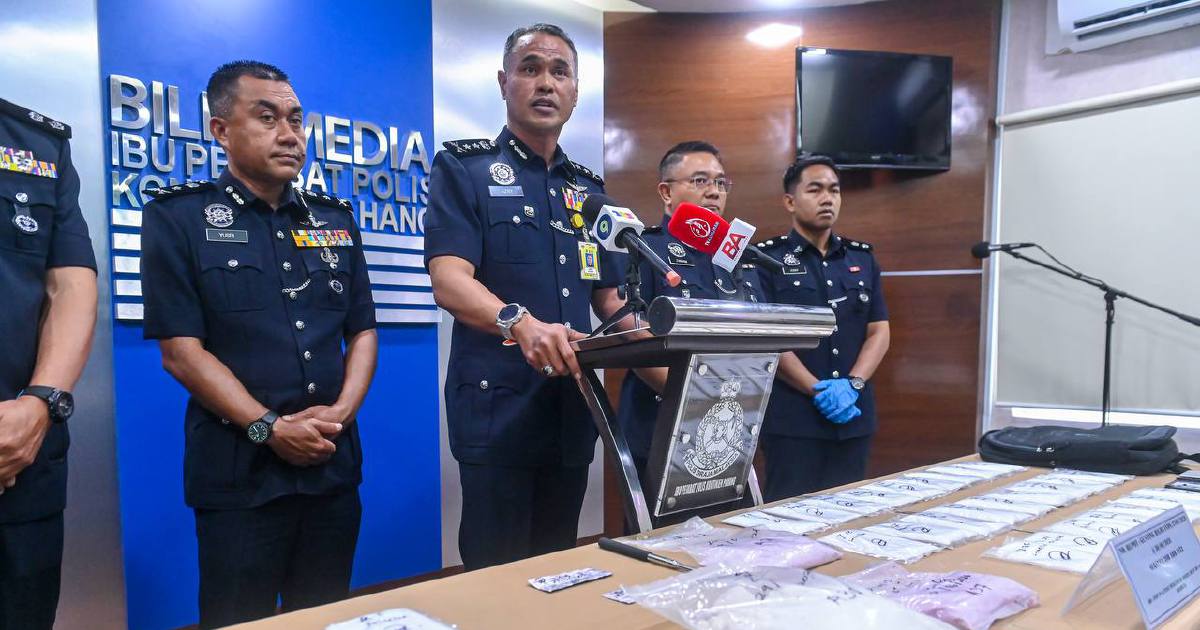
Police in Pahang have successfully intercepted what is believed to be a significant supply chain operation after apprehending a Thai woman and her Malaysian partner in Genting Permai, Bentong. The arrests concluded an operation that uncovered controlled substance shipments valued at close to RM728,000, marking another breakthrough in the state's ongoing battle against organised drug trafficking networks.
The detained pair is suspected of functioning as active couriers within a larger criminal syndicate, a role they are alleged to have maintained consistently over a three-month operational window. This extended period of alleged activity suggests a well-established distribution arrangement with regular movement patterns that eventually became the focus of law enforcement attention. The circumstances surrounding their capture indicate that investigative efforts had been tracking their movements and communications prior to the intervention.
The seizure at Genting Permai represents a substantial seizure by regional standards, though such operations have become increasingly common across Malaysia's border regions and transport hubs. The location in Bentong, which sits strategically between major population centres and transport corridors, has long been identified as a critical juncture for narcotics trafficking activity. Enforcement agencies have previously noted that the town's geography makes it an attractive waypoint for criminal organisations moving contraband between states and across international borders.
Malaysian authorities have intensified their focus on dismantling courier networks rather than merely targeting street-level dealers. This operational approach reflects a growing understanding that disrupting the supply chain at key distribution points proves more effective than reactive enforcement at the consumption end. By targeting individuals who repeatedly move substantial quantities, investigators can potentially map out larger organisational structures and identify the criminal networks orchestrating these operations from behind the scenes.
The Thai national's involvement in this case underscores the transnational dimension of Southeast Asia's drug trafficking challenge. Criminal organisations increasingly employ foreign nationals as operational personnel, exploiting visa arrangements and cross-border movement freedoms to facilitate their activities. This pattern has prompted regional law enforcement agencies to strengthen intelligence sharing and to develop coordinated strategies that recognise the inherently cross-border nature of modern drug smuggling.
The three-month timeframe mentioned in the investigation is particularly significant, as it suggests the operation was neither a one-off transaction nor a minor distribution arrangement. Such an extended period indicates regular consignments, established procedures for handovers, and presumably a reliable customer base waiting for deliveries. The fact that authorities were able to identify and apprehend the couriers suggests they had built sufficient intelligence to predict when and where an operation would occur.
Pahang has become an increasingly important focus for narcotics enforcement in Malaysia, reflecting both the state's strategic location and the evolving geography of drug trafficking patterns. Authorities have reported a notable uptick in seizures across the state, correlating with increased patrols and intelligence operations in regions beyond Kuala Lumpur's immediate orbit. The Bentong area specifically has attracted greater police attention as analysts have identified it as a distribution hub serving both local consumption and onwards trafficking into the Klang Valley and beyond.
The arrest carries implications for broader drug policy debates in Malaysia. While trafficking convictions can attract severe penalties under the Dangerous Drugs Act, questions persist about whether enforcement strategies adequately address demand-side factors and whether rehabilitation and treatment infrastructure remains inadequate relative to the scale of addiction in the population. International experience suggests that supply disruption alone, without accompanying efforts to reduce consumption and support treatment, produces only temporary market adjustments.
This operation also highlights the ongoing challenge posed by prescription drug diversion and the synthesis of novel psychoactive substances, which complicate enforcement efforts. Modern trafficking networks exploit regulatory gaps and legal ambiguities surrounding emerging drugs, adapting their operations faster than classification and enforcement systems can respond. The substantial street value attributed to the seized materials suggests the confiscated items likely included high-demand products commanding premium prices in Malaysia's street markets.
The partnership between the Thai woman and her Malaysian associate raises questions about recruitment practices within trafficking networks. Such arrangements often emerge from existing personal relationships, family connections, or ethnic community networks that provide the trust necessary for handling valuable contraband. Understanding these recruitment patterns and relationship structures has become central to modern intelligence gathering by regional narcotics agencies.
Looking ahead, the arrests will likely trigger investigation into broader network connections, as authorities seek to establish who supplied the seized narcotics and which downstream distributors were intended recipients. Such mapping exercises often reveal far more extensive criminal infrastructure than initial arrests suggest, potentially leading to secondary waves of enforcement action in subsequent weeks or months. The information derived from detained individuals may prove as valuable as the physical seizure itself.

